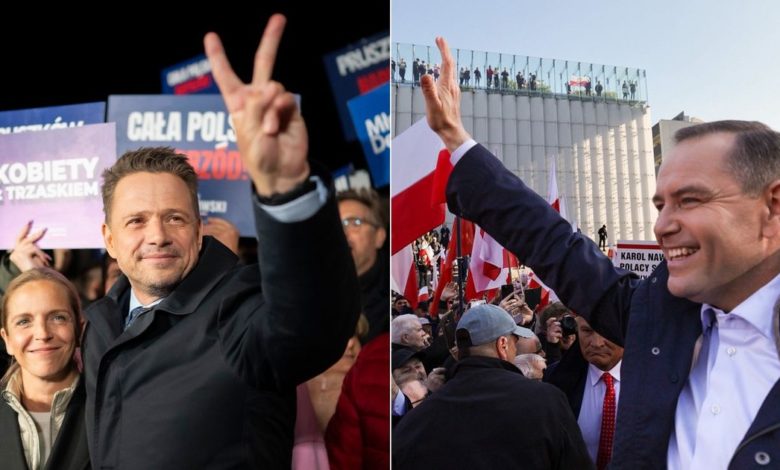
The second round of the presidential elections in Poland is held on Sunday, June 1, in a tense climate, with a symbolic load that exceeds the borders of the country and which, from many points of view, reminds of the ideological struggles in Romania. Specifically, by those recently lost by Donald Trump's local allies, writes politico.eu.
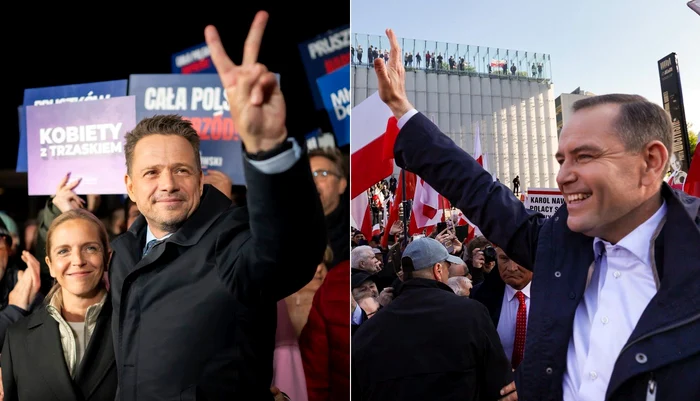
Rafał Trzaskowski and Karol Nawrocki will face the second round of Polish presidents
The candidate supported informally by the Current Maga (Make America Great Again), Karol Nawrocki, is in the middle of a scandal campaign, but also of a fervent support from an electoral base in “traditional values”. History of the band and former director of the Museum of World War II in Gdaitsk, Nawrocki has in the meantime became the head of the Institute of National Memory, a key institution in the nationalist mythology.
Although he is not a member of the Conservative Party Law and Justice (PIS), he is his de facto candidate. His choice was regarded by many as an attempt by the formation to prolong his influence in a period when Donald Tusk's liberal government is trying to re-establish Poland on the pro-European line.
Scandals that no longer bother anyone
Nawrocki's campaign has been marked by a succession of accusations – from the involvement between the football galleries, to alleged links with the at least questionable real estate networks and real estate actions. Paradoxically, this information does not seem to have eroded his support. On the contrary. In an increasingly polarized society, many voters choose to interpret the press attacks as a “liberal” conspiracy, and the image of “people of the people” is reinforced by his past turbulent.
Asked about scandals, Nawrocki responded in an almost mimetic manner according to Trump's style: “Defamination from the press did not destroy President Trump. Even Karol Nawrocki will destroy it.”
A polish between Washington and Brussels
Poland is in a moment of bifurcation. The result of these elections will influence not only the internal direction of the country, but also its position in the European Union. If the Liberal Rafał Trzaskowski will win, the government led by Tusk will be able to advance an ambitious European agenda. If, on the other hand, Nawrocki gets the presidency, it will become an institutional brake.
The Polish president has a predominantly symbolic role, but his legislative veto powers can block key government initiatives. This is why the stake is a political and strategic, not just electoral.
A match at the limit
In the first round, Trzaskowski obtained 31.4% of the votes, followed by Nawrocki by 29.5%. All subsequent opinion polls indicate a bayonet race, with an insignificant advance for the liberal candidate – in the margin of error.
No one can ignore the radical voters of the eliminated candidates, of whom Sławomir Mentzen, the leader of the Confederation party, is the most courteous. With a score of 14.8%, he now plays the role of king without crown. Although he refused explicit support for any of the two remaining candidates, Mentzen negotiated conditions – among them, rejecting Ukraine's accession to NATO. Nawrocki signed. Trzaskowski avoided.
Poland – the next Bastion Maga in Europe?
Donald Trump received Nawrocki in early May, at Mar-A-Lago, and told him: “You will win.” His support did not stop there. His former secretary for internal security, Kristi Noem, publicly supported the Polish candidate at CPAC Poland – the first edition of the US Conservative Conference organized on European Earth, in the city of Jasionka.
These gestures are not accidental. Poland remains one of the most pro-American countries in Europe, and Trump knows that a symbolic victory here would reverberate.
Trzaskowski: Between diplomacy and balance
For his part, the mayor of Warsaw, Rafał Trzaskowski, is an experienced politician, a former MEP and minister, known for the pro-European visions, but also for supporting LGBTQ+-aspects that brought the opposite of the Conservatives.
In the last days of the campaign, he has tried to navigate finely between the electoral basis: attracting central voters and mobilizing progressists, without aliena on disappointed voters who flirt with the far right. His final message: “Choose carefully. There is no return.”
A duel with European implications
If Romania has rejected the sovereign current, Poland is still in the company. Sunday's vote is not just about two diametrically opposed political personalities. It is about the direction of a nation that decides if it will play in the Great League of Europe or prefer the populist isolation with Hungary of Orbán and Slovakia of Fico.
And, above all, it is about how deep the trumpist America can penetrate into East-European democracies, notes politico.eu.