A thousandstronic (and more than that) the “great, beautiful act” of Donald Trump is a great example. Since its acceptance by the Chamber of Representatives last week, this law has been (rightly) criticized for many reasons: it favors rich at the expense of the poor, cruelly limits social security and recklessly increases the debt. Even Elon Musk is dissatisfied.
However, investors who care about the state of the Treasury or who are non -American entities with assets in the US should also worry about the clause hidden in the behemot's visuals, called Section 899. It enables the Department of the Treasury to impose penalties on “persons covered by regulations” from “discriminatory foreign countries” by increasing the federal income tax and tax rates A maximum of 20 pp from their investments in the USA, according to a variable scale. This can therefore be seen as an innovative “tax on revenge” (as some lawyers call it), which Trump could use to intimidate both friends and enemies in commercial negotiations.
At best, all this undermines previous efforts to build a global tax system based on cooperation, undertaken by such organizations as OECD, along with its provisions regarding insufficiently taxed profits. In the worst case, it makes Trump look like a feudal European king who intends to use taxes as a capricious tool to pull tribute from other countries. Either way, it undermines the idea that America is a place of consistent investment regulations and shocked lawyers in countries such as Canada.
“Section 899. It is toxic [i] It can potentially change the rules of the game for foreign investment, “this week, Larson Gross, a group of tax advisers, told Customers. or, as the Canadian lawyer Neil Bass wrote in their letter:” The United States has just declared a tax war aimed at allies. “
George Saravelos, an analyst at Deutsche Bank, writes in a note for clients: “Section 899. He undermines the open character of American capital markets, clearly using the taxation of foreign American assets as a means of pressure on the implementation of US economic goals.”
Continuation of the material under the video
Will it actually come into force? The only honest answer (as with most Trump's decisions) is: “Nobody knows”. Trump often threatens, but does not keep his word, and the courts sometimes stop him, as can be seen from the example of duties from this week.
In any case, around section 899. There are many unknowns. The Senate may insist on alleviating or removing this clause. However, if the additional fee remains unchanged, there may be provisions enabling investors and enterprises outside the United States to which this fee relates, deducting it from domestic taxes.
Nobody knows exactly how the concept of “discriminating against a foreign country” will be defined (although the Treasury Department is to regularly submit reports on this subject). It is also not entirely clear which investors and enterprises can be covered by these provisions.
At first glance, the Act applies only to investors and enterprises from outside the United States who are already taxable in the USA. However, as I noticed recently, the White House warned in a decree that it could repeal the key ruling of 1984, which released, among others, Chinese investors from 30 %. tax on source on assets such as American tax bonds. If this happens, these flows can also be covered by section 899., suggest analysts such as Michael Mcnair.
Another reason for uncertainty are divisions among the advisers of Trump himself. As I was told, some of them support the idea of imposing retaliatory taxes to foreigners, because this will be met with a positive reception of Magic supporters, and the Think Tank associated with the vice president of JD Vance estimates that such taxes could bring $ 2 trill. [7 bln 509 mld zł] income over the next decade.
In addition, people such as the Secretary of Trade Howard Lutnick are eager to look for new arguments that could be used in trade negotiations with the EU and Canada.
Ken Cedeno / PAP
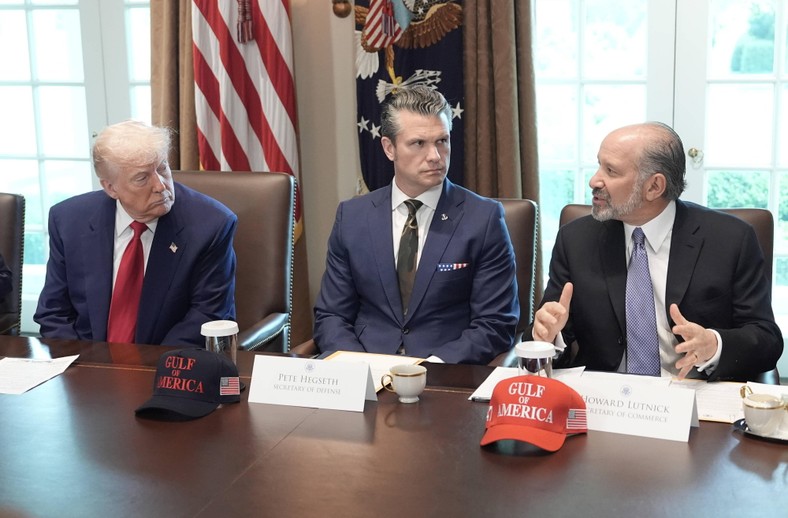
US President Donald Trump (L), defense secretary Pete HegeSeth (Ś) and Secretary of Trade Howard Lutnick during the office of the office in the office room of the White House in Washington, USA, 30 April 2025.
As indicated by the Davis Polk law firm, the fact that these two regions – together with Great Britain – impose taxes on digital services, can make them an easy target for funds provided in section 899.
However, the treasury secretary Scott Bessent will probably be cautious in the use of section 899. because he does not want to scare off global investors from tax bonds. In the end, he must sell countless US government bonds to finance a constantly growing debt – and there are signs of capital escape.
Either way, the key issue is that the very presence of Section 899. In this act – regardless of what will eventually happen – he will probably undermine global trust even more, because it shows that Trump's team at least considers the possibility of transforming commercial wars into capital wars in the future.
It is not surprising that investment groups, from Canadian pension funds to powerful Asian institutions, tell me that they are secretly diversifying their assets, departing from American. Or that representatives of the federal reserve have recently expressed concerns about the likely damage to the American economy if its status of “safe marina” for the investment is undermined. For a legislative bomb, it is a suicidal effect. The Senate should reject it.
I’m Ashley Davis as an editor, I’m committed to upholding the highest standards of integrity and accuracy in every piece we publish. My work is driven by curiosity, a passion for truth, and a belief that journalism plays a crucial role in shaping public discourse. I strive to tell stories that not only inform but also inspire action and conversation.