London's weak point. Much “depends on what comes to mind to Trump”

The British government – which increases defense expenses – said that as part of the review, which is to take place this Monday, would deal with a threat to pipelines and other submotine infrastructure.
This happens in the context of growing tensions with Putin's Russia, and when Europe is already in a state of readiness in connection with the wave of potential sabotage acts regarding submarine cables and pipelines.
However, British experts, including high government officials, believe that the weight of these threats is underestimated.
In an interview with Politico Grant Shapps, who in the years 2022–2024 was the secretary for energy and defense in the last government of Great Britain, said that “self -complacency” in this matter is “really disturbing”.
In an interview with Politico Grant Shapps, who in the years 2022–2024 was the secretary for energy and defense in the last government of Great Britain, said that “self -complacency” in this matter is “really disturbing”.
“Our submarine infrastructure is a kind of soft lower abdomen of British security and does not get enough to remedy it,” Shapps said.
– It is not a matter of whether a problem will appear at some point, but when it happens. This should be the subject of much greater concern for the government. And I do not mean just placing it in the hazard register. […] We need nationwide activities, the national plan for the protection of our submarine infrastructure – he said.
In the style of Nord Stream
The submarine infrastructure is “one of the areas” that will be examined as part of the defense review – the ministers informed. Great Britain and its allies have already increased sea patrols and monitoring to combat the threats to infrastructure.
However, while the attention of politicians focuses mainly on data transmission cables, Safety and energy experts warn that the greatest threat may result from an attack on a gas pipeline – similar to the mysterious attack on the Nord Stream gas pipeline in the Baltic Sea in 2022.
Great Britain is more than most G7 countries dependent on gas for heating houses and electricity production. Over half of the demand is covered with imports, mainly from Norway, and most of the Norwegian imports come from one gas pipeline – 715 miles (1150 km) Langeled, which was built in the first decade of the 21st century and remains one of the most important energy arteries of the country.
“LangeLed is our biggest weak point,” said Adam Bell, former head of the energy strategy at Whitehall, and currently the political director at the Stonehaven consulting company. – This does not mean that we would all fall dead if it was blown up, but it means that everything would quickly become much more expensive. We are exposed to the risk of rationing [dostaw gazu] He said vividly.
Although the likelihood of the attack is “quite low”, its effects would be “catastrophic” – said Jack Richardson, former energy secretary Claire Coutinho in the previous conservative government, and currently a collaborator of the Council for Geostrategies and the Director of Politics at Ortopus Energy.
– It can't be put different. If LangeLed is destroyed, we will be in great trouble as a country, he said.
Sidharth Kaushal, an elderly researcher for the maritime power at the Think Tank Royal United Services Institute, said that Putin's Russia “has invested quite significant means in abilities that can be used to sabotage the key national infrastructure.”
An open attack on Great Britain's infrastructure would be an act of war, which means that all such attempts on the part of Russia would probably be carried out in secret. However, as the scientist said, the government should be aware of the risk, which may appear “on the first day” of a potential conflict or “during the transition from crisis to conflict”, if Russia wanted to paralyze energy supply to Great Britain before the start of hostilities.
“Considering that they have [Rosjanie] Not much time, they will probably focus on areas where they think there is a minimum redundancy [zapasowe zasoby, które mogłyby w razie potrzeby zastąpić te główne]” – added Kaushal.” Langeled is an obvious example … I definitely consider it an important element of their strategy at the initial stage of the conflict or transition from crisis to conflict, “he said.
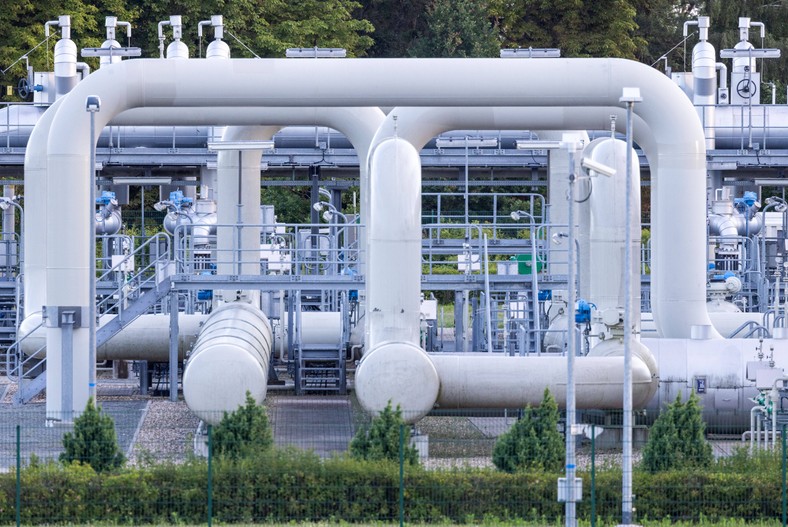
Pipeline systems at the Nord Stream 1 gas pipeline in the Baltic Sea, Mecklenburg-Pomorze front sea, ormin, July 11, 2022.
Plan for a network failure
The ability of Great Britain to survive the attack would largely depend on the broader issues related to supply and demand, including whether a wave of frost would occur in the country, how many gas is in warehouses and whether more liquefied natural gas (LNG) could be obtained on the international market – cooled gas that can be transported by tankers around the world.
The United States is the largest LNG supplier for Great Britain.
“A great risk is that we will lose LangeLed, and the United States will cease to deliver LNG, which is unfortunately very likely,” Bell said. “We would probably survive one of these situations, but not both without introducing rationing,” he added.
It is impossible to predict whether the United States will support in such a scenario, because “it depends on what will come to Trump about three in the morning,” said Shapps.
If sufficient gas is not found to replace lost supplies – for example, in the case of an attack on many pipelines – a state of emergency may be announced in the supply of network gas. These procedures are written in the law, but they have never been launched Since the construction of a gas network in Great Britain in the 1960s.
Initially, gas power plants could be closed, which would lead to interruptions in electricity supply. After restoring normal gas supplies, they could be restarted quickly, but in the extreme scenarios of the factory and enterprise – in the last resort some households – could be completely cut off from the gas network.
Experts of the energy industry, who, provided that anonymity, agreed to discuss crisis plans, stated that in the event of such drastic steps, individual engineers will have to re -connect each house to the gas network in a safe way. According to them, restoring the normal functioning of the network may take several months.
Ireland, which depends on gas imports from Great Britain, would also suffer seriously.
The latest British National Risk Register, published at the beginning of this year, contains “a justified scenario of the worst case of” a terrorist attack on gas infrastructure, which leads to “intermittent breaks in energy supply lasting up to three hours” and predicts that “restoration of gas infrastructure affected by failure may take about three months.”
When asked about what scenarios he considers the most dangerous for Great Britain, Shapps replied that “he is careful in talking about his greatest fears, not sleeping at night, because it could lead someone to responding.”
– It is unlikely that all our gas pipelines are cut at the same time. But [załóżmy]That it happened and we don't have gas – you would have to bring more LNG, try to compensate for it in many different ways. I think the most serious attack [byłby] A combined attack on energy and data transfer cables – then we would deal with a completely different level of difficulty – he said.
Let's leave the gas
The United Kingdom still satisfies about half of its gas demand from the national resources of the North Sea, but its resources remaining in the ground decrease.
Richardson and Bell say that in the long term, a way to guarantee the Gas security of Great Britain is to reduce dependence on these fossil fuels.
The government of the Labor Party plans to almost completely eliminate gas from the energy system until 2030, but Richardson argued that ministers should also “take much more actions in the field of gas consumption, especially for heating.”
– A simple answer is: you need to diversify the energy sources as much as possible, including moving from oil and gas – Shapps agreed, but he added that in the short term ministers should give up plans to introduce a ban on issuing new licenses to search for gas in the North Sea and best use national resources.
“Stopping your own oil and gas is a complete idiocy based on ideology,” he said.
Spokesman [brytyjskiego] The government said: – Our priority will always be to maintain national security and protect the submarine and coastal infrastructure.
– Together with our allies from NATO and common expeditions, we strengthen our activities to prevent ships and aircraft from secret operations near the territory of Great Britain or NATO, using new technologies, such as artificial intelligence, and coordinating patrols with our allies – he added.
The Norwegian company Gassco, which supports the LangeLed pipeline, did not answer the request for comment.