The unknowns behind the project on high voltage submarine cable that will cross the Black Sea

The Ministry of Energy announced, in early April, that the feasibility study for the high voltage interconnector in DC (HVDC), the so-called “green corridor”, has been successfully completedand the results are positive. Asked by HotNews about costs and next stages of the project, the ministry representatives say they cannot provide information.
The Ministry of Energy's response was that “the project partners cannot make available to the public additional information compared to those already broadcast through the press releases”.
In the April statement, the Ministry of Energy claimed that the “East-West interconitor enters the next phase”, but did not specify, at the request of Hotnews, which is this.
“The partnership relations of the parties involved in this project are carried out on the basis of a collaboration memorandum that establishes including the conditions of communication of information. Thus, in terms of the provisions of this memorandum, Transelectrica SA informs us that none of the signatory parties has the right to disclose information from the component documents of the project, but does not include technical data, Specialty or information on transport capacity, without the prior consent of the other parties ”, the Ministry of Energy also transmitted.
What do we know about the project “Corridorul Verde”
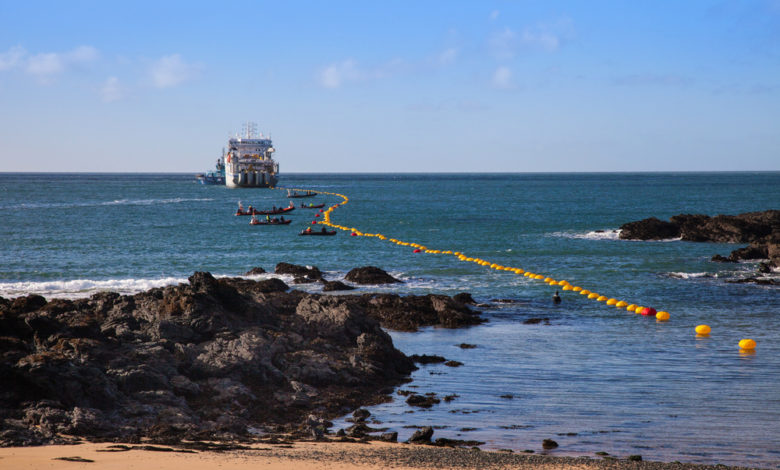
The project is developed by the State Company Transelectrica along with Taqa (Abu Dhabi National Energy Company PJSC), Meridiam (France, Fluor (USA) and E-Infra (Romania). It aims to build a high-voltage submarine cable, which will cross the Black Sea.
The cable will connect, through the Black Sea, Romania and Georgia, the connection being extended to Hungary and Azerbaijan. In January, a joint venture company was set up, and the founding associations are Transelectrica, JSC Georgian State Electrosystem (Georgia), OJSC “Azerenerji (Azerbaijan) and MVM Energy (Hungary), each having a 25%stake.
The company is called Geco Power Company – Green Energy Corridor Power Company SRL and is based in Bucharest. The administrators of the company are Florin Stanciu (Romania), Attila Bally (Hungary), Mammadov Farhad (Azerbaijan) and Zviad Gachechiladze (Georgia).
The feasibility study was done by the Italian consulting company CESI. Azerbaijan was the one who contracted the Italian company, on behalf of the signatories of the project agreement, being transferred to the project company.
In September 2024, representatives of governments and energy transport operators in the four countries (Romania, Hungary, Azerbaijan and Georgia) met at the Victoria Palace, to sign an agreement on Corridor Verde.
Interconnection network from the Black Sea to the North Sea
From the public statements of the current Minister of Energy, Sebastian Burduja, the high-voltage submarine cable will extend on 1,200 km, cross the Black Sea, connecting with Georgia, and will cost about 3.5 billion euros. It is not clear whether this amount represents the whole project or just that stretches on the territory of Romania.
The planned route will connect the Black Sea to the western border of Romania, passing through Bucharest, and will connect with the energy networks in Hungary and other European states, the Ministry of Energy shows.
On the territory of Romania, the existing infrastructure, such as those of BRUA and Tuzla-Podișor, will be used to build the cable. “This approach allows the significant reduction of the time needed to obtain the opinions, lower costs and decrease the impact on the environment. It is an intelligent and efficient solution, which uses the already available assets and can be a model for future energy investments,” says the Ministry of Energy.
The high voltage tension interconitor will allow the transport of green energy, including from future offshore wind parks to the Black Sea, to consumers in the country and other European states. “At the same time, it will allow Romania to benefit from green energy produced in Azerbaijan when we have a deficit,” the Ministry of Energy shows.
According to him, the project is compatible with other European infrastructure initiatives, such as Swedlink or Nordlink, and will contribute to the formation of an interconnected energy network from the Black Sea to the North Sea.