
Romania has been practicing from 2018 a 10% income tax rate applicable to all employees, but there are European states that charge and more than three times, while others practice a slightly higher share than half of the Romanians pay.

European states charge income tax. Photo shutterstock
The quotas of the income tax vary significantly in Europe, the northern countries pay the highest taxes, and the Eastern European countries.
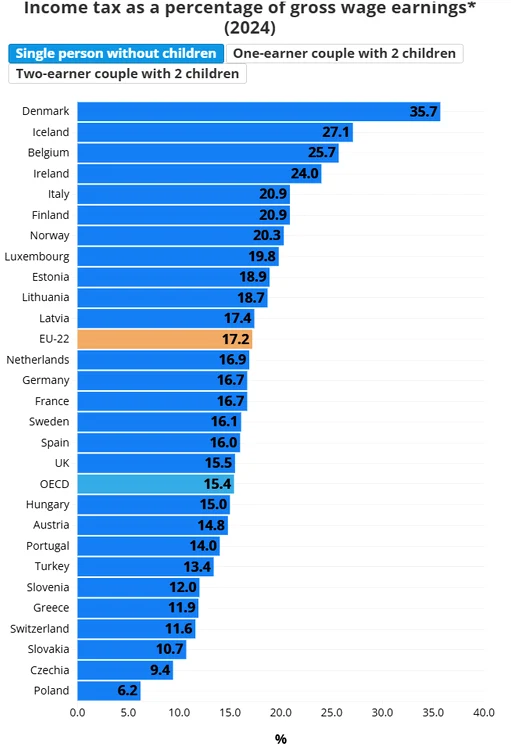
The OCDE report on salary taxation in 2025 analyzes tax rates using several indicators, writes Euronews in its focused analysis on income tax as a share of gross wage earnings. This shows which part of your salary is allocated to income tax. Contributions to social insurance are not included in this calculation.
Person alone without children
Among the 27 countries included in the report – including 22 EU Member States, the United Kingdom, three Aels and Turkey – income tax as a percentage of gross wages for a single person without children in 2024 varied from 6.2% in Poland to 35.7% in Denmark.
These figures apply to people who earn 100% of the average salary in their respective countries. If a person earns more or less than the average, the income tax changes too – as we explore below.
Among the first five economies of Europe, Italy had the highest income tax rate, of 20.9%. The others were around 16%: Germany and France (both 16.7%), Spain (16%) and the United Kingdom (15.5%).
Euronews graph
The quotas of the income tax are generally higher in the Nordic countries. Except for Sweden (16.1%), all had quotas of about 20% or higher. Similar odds were also observed in Belgium and Ireland.
In addition to Poland, five other countries had 12% or lower income tax rates: Slovenia, Greece, Switzerland, Slovakia and the Czech Republic.
One -income couple and two children
For couples with a single source of income and two maintenance children, the income tax varied from -12.8% in Slovakia to 32% in Denmark. Germany also registered a negative share of -0.1%, placing both countries in the category of refunds.
A negative tax rate shows that taxes have been reimbursed, not deducted. This refund is largely separated from standard family allowances.
The first four countries with the highest income tax rates in this category were all northern nations. Sweden also exceeded both the OCDE and the EU-22 average.
Among the five largest economies in Europe, the income tax rates for a single source of income and two children were significantly lower in France and Spain compared to single people without children – decreasing from about 16% to about 10% in both countries.
The quotas of the income tax were also below 5% in Switzerland, Slovenia, Portugal, Czech Republic and Poland.
Couple with two family income and two children
For couples with two people contributing to the income and two children, the income tax quotas ranged from 1.6% in Slovakia to 35.7% in Denmark.
This table facilitates the observation of how the income tax varies depending on the number of people who have income from a household and the presence of children, reflecting the fiscal policy of each country.
In general, single people without children pay the highest income tax. There is no country to pay less than any of the two types of households with children.
However, in several countries, the income tax rate is the same for all three types of households. These include Estonia, Finland, Greece, Lithuania, Norway, Sweden, Turkey and the United Kingdom.
On the other hand, this does not mean that the relationships between net income and gross income are the same. Contributions to social insurance and family allowances create differences in total net income.
The main trends in the field of income tax in Europe
Denmark has the largest income tax burden for all types of households. Belgium and Iceland also report relatively high levels of taxation, especially for single people.
Slovakia and Germany present unusual models, with negative income tax rates for single income couples and children. The strong negative share of Slovakia reflects a policy meant to support families.
Poland and Czech Republic are among the countries with the lowest income tax rates for all three options.
Nordic countries are constantly having the highest taxes, regardless of the type of household. Western Europe follows, with moderately high rates, especially for people who have only one income.
Eastern European countries tend to have the lowest levels of income tax in general.