
Mihai Viteazul, conqueror or patriot? The truth about the Union from 1600, explained by historians and contemporaries

425 years have passed since the first unification of the provinces inhabited by Romanians, made by Prince Mihai Viteazul. It was a historical achievement for a Romanian voivode, perhaps the most important in all the medieval history of our people.
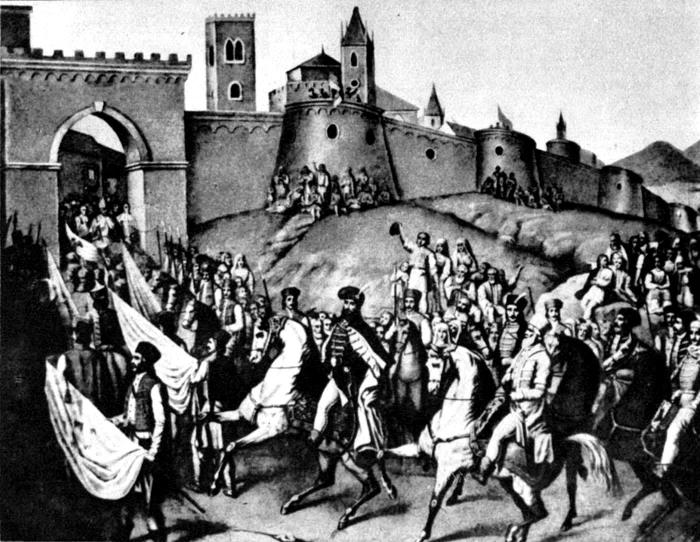
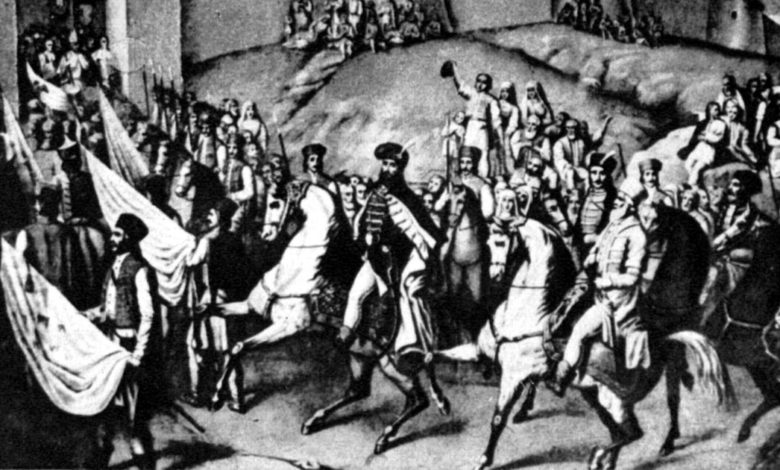
Mihai Viteazul's entry into Alba Iulia Photo Wikipedia
On May 27, 1600, that is 425 years ago, Mihai Viteazul was proclaimed “Lord of the Romanian Country and Transylvania and the whole country of Moldova”. He was the leader who managed to unify the three inhabited, majority, Romanians. Although the unification lasted only four months, it was a unique act in the medieval history of the Romanians. This historical event was speculated by the Romanian historiography of 19th and 20th century and loaded by a nationalist mythology that deformed the historical truth. Moreover, the Union from 1600 was charged, artificially, by meanings unknown to the people of that time. Significations had contradicted modern historians, but also by contemporary chroniclers.
The master of the Romanian Country, Transylvania and Moldova
After making peace with the Turks and after a treaty with Rudolf II, the emperor of the Roman-German Empire, Mihai Viteazul begins his series of conquests. The first territory targeted by the warrior prince Valah was Transylvania. Cardinal Andrei Bathory, the new voivode of Transylvania, was alias with the Poles, but also aspired to a good understanding with the Turks. Mihai Viteazul, had learned from the spies that as a result of this agreement, he was to be removed from the throne. Taking advantage of the fact that neither Rudolf II, who dreamed of anti-Ottoman crusades, did not agree with Cardinal Bathory, Mihai were on Transylvania.
After shattering, in Șelimbăr, the armies of Cardinal Bathory, Mihai Viteazul came triumphantly, on November 1, 1599, in Alba Iulia. In 1600, he cast his eyes on Moldova. He wanted to get her out of the Polish influence. Thus, in May1600, he entered with the armies in Moldova and drives the ruler Ieremia Movilă, the Polish puppet. On May 27, the same year, Mihai Viteazul was ruler of Wallachia, Moldova and Transylvania. It was not a unification in the true sense of the word, especially since the three countries continued to maintain their own organisms of internal administration, ie the diet (in Transylvania) but also the Boeresti advice (in Moldova and Wallachia). However, for a medieval prince it was an incredible achievement. Perhaps the largest in the medieval history of Romanians.
Unifier or conqueror? Political necessity or patriotism?
This extraordinary event was presented, two to three centuries later as a will of the Romanian national spirit. The unification was loaded with nationalist ideology, specific to the 19th century and the beginning of the 20th century. Mihai Viteazul was no longer a medieval leader, with a voivode animated by the patriotic desire to unite all Romanians in one country. He fulfilled, “a secular ideal.” “I will create a big homeland as long as the Romanian land is”wrote Bălcescu in “Romanians under Mihai Voievod Viteazul”. On the same patriotic-nationalist line, most of the historians from the beginning of the 20th century went, but even later, during the communist period, when Mihai Viteazul became a unifying hero, who sacrificed for the “national ideal”. However, the specialists in medieval history say that Mihai Viteazul's patriotism, as well as its alleged national ideal, were only myths invented in the 19th century. Mihai Viteazul was a warrior prince, very skilled in the leadership of the soldiers, a skillful politician, who conquered the neighboring countries, without having a national interest. In fact, in the century he lived, there was no national idea.
His actions were purely political, both to expand his territory, prestige, but especially to be able to guard in front of the intrigues of the Poles and the Turks.
“Mihai conquered Transylvania and Moldova, not because of their Romanian character, but because they had moved from the union concluded between them to fight with the Turks. He restored this unit of the league concluded in 1594, the political idea that in the guide was that of the unit on the basis of the crusade. Special (…) Mihai Viteazul conquered Transylvania for a political reason, the understanding of the Transylvanian prince and the Poles to replace in the chair, a plan that had been shown to him. To abdicate in favor of the Romanian Lord and he will unite under his scepter Transylvania, the Romanian Country and even Bulgaria, which was to be rebellious under his leadership ”wrote PP Panaitescu in the work “Mihai Viteazul”.
For his contemporaries, Mihai Viteazul was only a conqueror. “Oh the lords of the lords and the blind wealth! As much as it will, so much. His, many kingdoms in the world, wanting to take other countries, have extinguished himself. So pir-shared, wanting to take Italy, they lost his countries.wrote the Moldovan chronicler Miron Costin.
In turn, the mountain chronicler, Radu Popescu proudly confessed “They subjected to the reign of the Turks, Moldovans, Hungarshowed this in “The History of the Lords of the Romanian Country”. Mihai Viteazul's weapons of weapons, remained known for centuries, but was not perceived as a liberator or unifying, but rather as a host and conqueror. “This (no Mihai Viteazul) very great host was and the Turks beat them and the Transylvanians overcame them and the Transylvania took it and gave it to Emperor Rudolf”wrote Samuil Micu in the “short knowledge of the history of Romanians” in the eighteenth century.
It was also naturally adding PP Panaitescu, especially since at that time there was no national idea, with only political, local, zonal interests. “But the national idea, in its political form, of the state unit, did not exist yet, neither in us, nor the crazy (…) an idea of Romanian political unity we can seek in the time of Mihai.wrote the historian in “Mihai Viteazul”.
A hat too big for Mihai Viteazul
Mihai Viteazul managed to master the three countries, only four months. The reasons are clear. The Valah voivode did not have the financial strength to support this conquest, nor had time to take administrative measures for their unification, de facto.
“ Mihai's reign falls in a period of economic decline in our history, because, as we have seen, the movement of the roads, the impoverishment of the peasantry, the Turkish exploitation. Mihai Na had at hand the material means to support his great ideas. The basis on which he built his political work was especially the mountain boyhood. It is true that this class was rich for the defense of her threatened assets rose against the Turks, then sought to move to Transylvania. But her wealth was his land and his fruits, she was based on a natural economy, not on the money economy. And the times then demanded money. I saw that throughout Europe the mercenary army had replaced the country soldiers, and with mercenaries, Mihai had to fight, with an army that costs almost 100,000 workshops a month, a huge amount. As long as the Romanian Lord had the money paid by the emperor (no Emperor Rudolf de Habsburg), but when he received the ordinary pension, the disaster was near. “states PP Panaitescu in his book “Mihai Viteazul”.


