
In a video on YouTube, a priest promotes a form of virile masculinity. Skinny jeans, crossing the legs, using iron, eyebrow modeling and even eating soup is among the things they ridicule as feminine.
There are other videos with Father Moses Mcpherson – a father of five children – raising dumbbells on the sound of Heavy Metal music.
He was raised Protestant and once worked as a roof fitter, but now serves as a priest in the Russian Orthodox Church (Rocor) in Georgetown, Texas, a branch of the Mother Church in Moscow.
Rocor, a global network with headquarters in New York, has recently expanded to certain parts of the US – mainly as a result of the conversion of people from other religions.
In the last six months, Father Moses has prepared 75 new baptism followers in his Church of the Virgin, north of Austin.
“When my wife and I converted 20 years ago, we used to call Orthodoxy the best preserved secret, because people simply didn't know what it was,” he says.
“But in the last year and a half, our congregation was tripled.”
Teodor – who until recently rejected any religion – raises weights three times a week with Father Moses
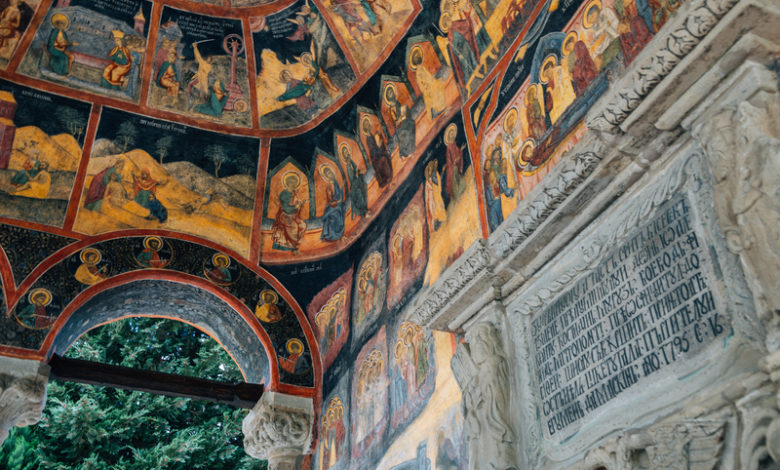
During the Liturgy on Sunday at the Church of Father Moses, I am impressed by the number of men of 20-30 years who worship behind the nave and the way this religion-with traditions dating from the fourth century AD. – It seems to attract young uneasy young people in modern America.
Theodore software engineer tells me he had a dream job and a wife he loved, but he felt empty inside, as if he had a hole in his heart. He believes that society was “very hard” with men and that they constantly tell them that they are wrong. Complains that men are criticized because they want to be family supporters and maintain a housewife.
“We are told that it is a very toxic relationship nowadays,” says Theodore. “It should not be that.”
Almost all the converts I encounter have chosen to educate their children at home, partly because they believe that women should prioritize their families rather than their careers.
Father John Whiteford, a protopop in Rocor from Spring, north of Houston, says that the Home School provides a religious education and is “a way to protect your children”, while avoiding any discussion about transgenderism.
Compared to the millions of believers in the evangelical Mega-Biserice in America, the number of Orthodox Christians is small-only about one percent of the population. This includes Eastern Orthodoxy, as practiced in Russia, Ukraine, Eastern Europe and Greece, and the Eastern Orthodox of the Middle East and Africa.
Founded by priests and clergy who fled the Russian Revolution in 1917, Rocor is considered by many to be the most conservative Orthodox jurisdiction in the US. However, this small religious community is a vocal one, and what takes place within it reflects larger political changes, especially following the turn of President Donald Trump to Moscow.
The true increase in the number of converts is difficult to quantify, but the data from the Pew research center suggests that 64% of Orthodox Christians are men, compared to 46% in 2007.
A smaller study, conducted on 773 converts, seems to support this trend. The most recent income are men, and many say that the pandemia pushed them to look for a new faith. The survey is conducted by the Orthodox Church in America (OCA), which was established by Russian monks in Alaska at the end of the eighteenth century and now has over 700 parishes, missions, communities, monasteries in the US, Canada and Mexico that identify as Russian Orthodox.
Professor Scott Kenworthy, who studies the history and thinking of Eastern Orthodox Christianity – especially in modern Russia – says that his parish in Cincinnati “is full until refusal.”
He attended the same church for 24 years and says that the number of parishioners remained constant until the quarantine imposed by Covid. Since then, there has been a constant flow of new people who are preparing to be baptized.
“This is not just a phenomenon in my parish or some places in Texas,” says Professor Kenworthy, “it is definitely a little larger.”
Digital space is essential in this wave of new converts. Father Moses has a lot of online followers – when he distributes a photo on his Instagram account, he receives 6,000 appreciations.
But there are dozens of other podcasts and videos presented by Orthodox clergy and an army of followers – mostly men.
Father Moses tells the members of his congregation that there are two ways to serve God – to be a monk or nuns or to marry. Those who choose the second way should avoid contraception and have as many children as possible.
“Show me a saint in the history of the church that has ever blessed contraception,” says Father Moses. He adds that Orthodoxy “is not masculine, it is simply normal”, while “in the West everything has become very feminized.” Some Protestant churches, he believes, are mainly addressed to women.
“I do not want to go to jobs that look like a Taylor Swift concert,” says Father Moses. “If you look at the language of” worship music “, everything is emotion.”


