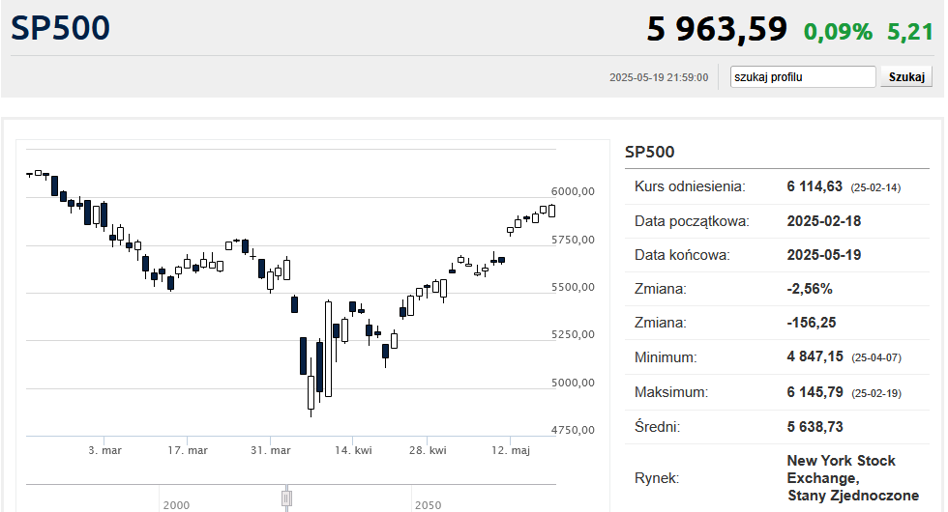
The Monday session at Wall Street ended with a small increase in the main indexes, and S&P 500 recorded the sixth growth day in a row. Investors quite calmly accepted Moody's decision to reduce the US credit rating.
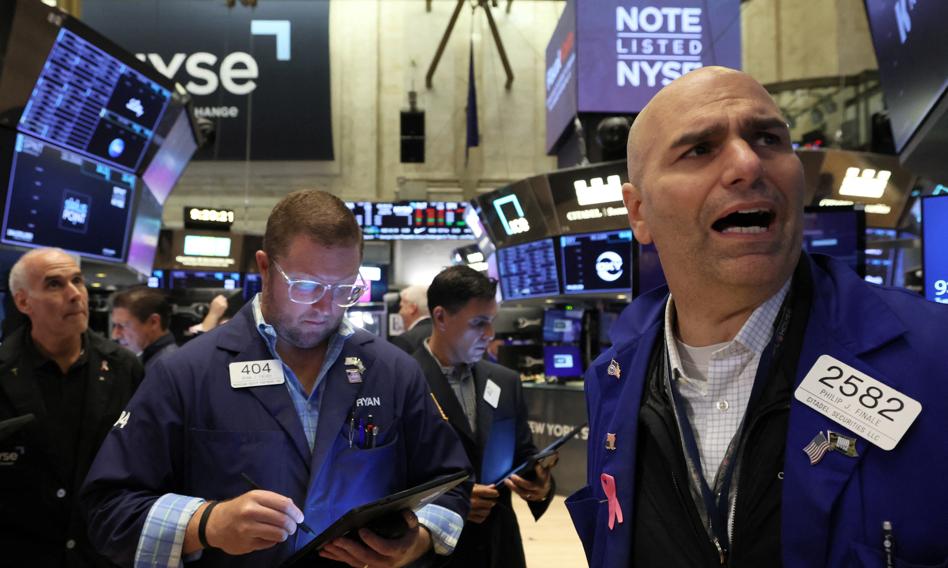
Dow Jones Industrial at the closure increased by 0.32 percent, to 42,792.07 points S&P 500 at the end of the day increased by 0.09 percent and amounted to 5,963.60 points Nasdaq Composite increased by 0.02 percent until 19,215.46 points The index of companies with medium capitalization Russell 2000 drops by 0.42 percent. and is 2.104.43 points The VIX index grows by 5.22 percent, to 18.14 points
The Moody's Ratings rating agency reduced the highest credit rating on Friday, citing the failures of subsequent governments in stopping the growing wave of debt. Moody's reduced the rating from AAA to AA1, emphasizing, however, that the United States has retained their exceptional credit force and the role of the American dollar as a global reserve currency. The agency estimates that the US public debt will increase to approx. 134 percent. GDP until 2035 compared to 98 percent in 2024
The draft law of the US President Donald Trump on tax reduction, which for several days was blocked by republican internal disputes about the cutting of expenses, obtained the approval of the key Congress Commission on Sunday. Analysts indicate that the bill will add USD 3 to 5 trillion to the country's debt over the next decade.
– Lowering the US credit rating by Moody's, as well as progress in the work on the Washington Act, promising large tax reductions, cast a shadow on the markets at the beginning of the week – said the investment director AJ Bell, Russ Mould.
“Given Trump's promise regarding tax reduction, we are afraid that the situation may deteriorate even more. The implications of Trump's unpredictable policy mean that caution creeps back, suppressing the enthusiasm of recent weeks,” said Susannah Streter, head of the money and markets in Hargreaves Lansdown.
“Moody's report did not emphasize anything that every investor would no longer know about the fiscal situation in the US,” said Ross Mayfield, an investment analyst at Baird.
“For me, he simply provided a little shield for the market so that he could relax here, but nothing happened that would structurally change our bullish attitude as to where we think we will be in the next six to twelve months,” he added.
Michael Wilson from Morgan Stanley said that investors should buy decreases caused by the growing profitability of bonds, because the de -escalation of voltage between China and the US has reduced the probability of recession.
Among other strategists, David Kostin from Goldman said that the so -called The magnificent seven will probably have better results this year, driven by a solid increase in profits.
In turn, Lori Calvasina from the RBC pointed to the possibility of increasing the reduction of S&P 500 profits in the future and said that the market may overtake itself a bit from a fundamental perspective.
The American index ahead of the conference Board in April fell by 1 percent. Analysts expected the index to fall by 0.9 percent. A month earlier, the index fell by 0.8 percent, after correction.
The president of the Fed from Atlanta Raphael Bostic said that he was inclined to one reduction of percent rates. In the USA, by the end of the year, taking into account risk factors for inflation reflection.
“Considering the trajectory for the implementation of our double mandate, I am very worried about the inflation side, and mainly because we see that expectations change in a disturbing way,” said Bostic on Monday in an interview with CNBC, referring to consumer expectations about the future pace of price increases.
“At the moment I expect it to take me a little more time to organize it. (…) I am more inclined to one cut this year, because I think it will take some time, and then we will have to see the development of the situation,” he added.
Bostic said that he wanted an elevated level of uncertainty, driven by tariffs and other actions of the Trump administration, decreased before any changes in the level of interest rates, indicating that it is a process that may take three to six months.
On the oil market, contracts for WTI in June increase by 0.32 percent. up to USD 62.69 per barrel, and July Futures on Brenty grow by 0.12 percent. up to 65.49 USD/B. (PAP Biznes)
pr/