Article by Narcis Drejan – published Monday, May 19, 2025, 14:01 / Updated Monday, May 19, 2025 14:09
When history pulls its curtain over a club that has flirted with performance, it rarely does it suddenly. Most of the time, it is a slow process, with small, but safe steps, to the precipice. In the case of Sepsi, the relegation was not an accident. It was an act with premeditation.
When the players allow themselves to knock on the door of the man who is responsible for the Sepsi OSK project, Laszlo Dioszegi, even in front of Viktor Orban, to change the coach-in this case, Dorinel Munteanu-we are not talking about football, but about internal anarchy.
It is difficult to say if that moment was the beginning of the end or just the visible symptom of an old disease: loss of control. In a healthy club, the players play, the coaches train, and the employers do not negotiate the locker room at the corner of the office. In Sepsi, the borders dissolved in chaos and personal pride.
Nor does God sleep, Niczza!
And in the gate, where the symbol, the leader, the pillar – remained Niczza. Once the “ice captain”, today the goalkeeper of the gifts, the hesitations and the excuses. It is difficult to relegate beautifully, but it is even harder when you have a goalkeeper who seems to have lost his reflexes with the balance of the team.
Niczza's mistakes were no exceptions, but rules. In key moments, when Sepsi had a breath, a parade, an intervention, a hope-a joke came. And went.
Then, one more thing, to come from Niczza's entourage to criticize Hagi's generation, that maybe the man was not enough man, it seems to me a challenge to the common sense.
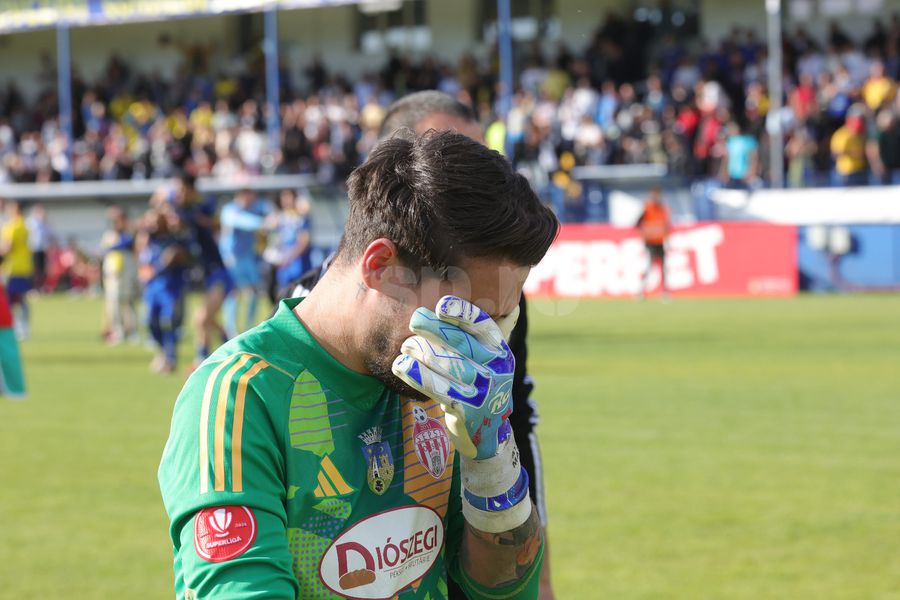
Roland Niczuly. Sepsi Sfântu Gheorghe relegated. Photo: Ionuț Iordache (gsp.ro)
What weak lot do the Covasnens have
You still hear on TV about Sepsi's super team, look at Matei, apart from talking, the man is a champion. When it comes to facts? Two relegations, it's a 3rd place!
Sepsi's lot? An anost mixed between failed stars, mercenari without motivation and “perspective young people” who showed no future. Football is about identity, about inner combustion, about a struggle you feel from the stands. At Sepsi, you felt nothing. It was a team with ironing clothes, but the soda soul.
And what public to push you from behind, when the stadium is confused with the quiet of a closed library? No pressure, without passion, without a murmur at even agony. What to save in a place where nothing burns? It doesn't just go with Hajra Sepsi and a handful of people who praised Dioszegi's bread.
The relegation of Sepsi is, in essence, a decision taken at each stage, in each wrong choice, in each match played with the hand brake. It was not an accident, but a consequence.
If the Second League will be the place where the club washes its sins and reinforces the work of work, it remains to be seen. But maybe, there, away from the light of the spotlight, Sepsi will learn again what unit means. And that no one is above the team – neither the goalkeeper, the delegation of revolted players, not even the owner.
Because, in football, if you do not respect the hierarchy, you inevitably wake up in the basement. And we hope Dioszegi will learn from it! At least now!