The National Athenaeum in Iași announced on Friday that the premiere of actor Mihai Mălaimare, “at the edge of Copou”, scheduled in the evening of the same day, is suspended because of “unfavorable weather conditions”, so that on Saturday it can cancel it. The reaction of the institution came after the actor arrived in the center of attention, following messages from the social networks: “You did not want the second round! The tour II comes as a huge wave and you will reach the channel, or to the channel!”, Wrote the actor, according to the site “Culture at the van”. But what did the channel mean, according to the testimonies of those who survived this work camp?
This article is part of a series performed by using the digital archive Arcanum newspapersin which you can travel 150 years of history of Romania, as it has been recorded in each era by the lens of the journalists of the time, of advertisers, writers and ideologists of all orientations.
In the statement of the Institute for the Crimes of Communism, published in response to the posting of Mihai Mălaimare, we can read: “The message of the actor Mihai Mălaimare, in which he refers to” Canal “as a punishment for the political options of some citizens, is not only unqualified-it is quite toxic. Metaphorically invoking the camp and the communist repression in the key to an electoral triumphalism does not mean only lack of historical memory. It means mocking the real suffering of those who knew the “channel” in the most concrete sense, those who paid for freedom or even life because they thought other than the official line. ”
What did the actor Mălaimare refer to?
The first scenario. Mr. Mihai Mălaimare threatens his compatriots who have other political options than his reign that he could have the fate of the 43 Timisoara shot in December 1989, whose bodies were sent to Bucharest to be burned to the crematorium, as then, the ash to be thrown “In the channel”. All these horrors, following an order given by Elena Ceausescu on December 18, 1989.
“Between 15.00 and 16.00, Elena Ceausescu orders the transport of the corpses from Timisoara to Bucharest to be incinerated and to hide the traces of genocide and use of weapons on the protesters, an action that took place on the night of December 18/19. Thus, the morgue of the county hospital was opened and there was 43 Militia, put in a refrigerator truck, which then left for the capital.
The second scenario. Those who would escape incineration would arrive “At the channel”. For connoisseurs: “The channel of death ”, a proverbial place of suffering and terror, with one of the darkest stories of the Romanian concentration universe.
Rehabilitation song
A few parables to better understand the conditions at the channel.
“In many of the camps of the Danube-Black Sea channel, in 1952, an average of mortality of 30-40 prisoners per month, and between them, some found in torments that, if they were not even recorded in security documents, would be hard to imagine. infirmary with both kissed legs, because it had been tied with chains over the rubber boots that were standing. Died in terrible torments, after a few days, at the camp's infirmary. ” (Memory, 2009/ No. 1-2)
Once they arrived at the channel, the political prisoners were subject to the process of “re -education through work” and not only. For example, at the Galeșul, the commander of the camp, the Lieutenant Major Petrică, kept the detainees, since the arrival, the following speech:
“You have been brought here to work. The way you work will regain your freedom. Remember that you are all that the society has, the pleavy of society, the leaks, the rejections of the world you are. You will work for downloads. You will be distributed 4 people to a wagon. 500, we conclude a short report and end with you. ”
Of these “leaks of society”, at least 50% were intellectuals, doctors, teachers, former officers, priests, lawyers. (Memoria, 2009/ no. 1-2) Among them, Corneliu Coposu, Nicolae Steinhardt, Vasile Băncilă, Ion Ioanid, Dinu Pillat, Ion Dumitrache (one of the largest surgeons of the country at that time) and many other personalities of Romania since then.
“At the channel let's delete the stain/ blacks passed/ road to do with shovel/ And reborn.” – The verse from a “rehabilitation song” that the prisoners had to play on the taking and return from work.
“At the peninsula, the colony with the hardest regime, with the most complex works and most work points, were established, in May 1950, the well -known brigades 13 and 14, with re -education students brought from Pitești, led by the dreaded Bogdănescu and Enăchescu.
[…] Here is another example that demonstrates to where it was possible to reach: moved from the White Gate to the Peninsula, the young officer Dorneanu, passed through a re-education school than the one from Pitești, now reached the brigadier at the Canal, at the first speaker he received his mother with the following sentence: ” Making parents guilty of children's flaws, the Communists were to create a family culpability complex in which the detainee was only the victim of the education received in the family. ” (Memory, 2009/ No. 1-2)Another earthquake testimony
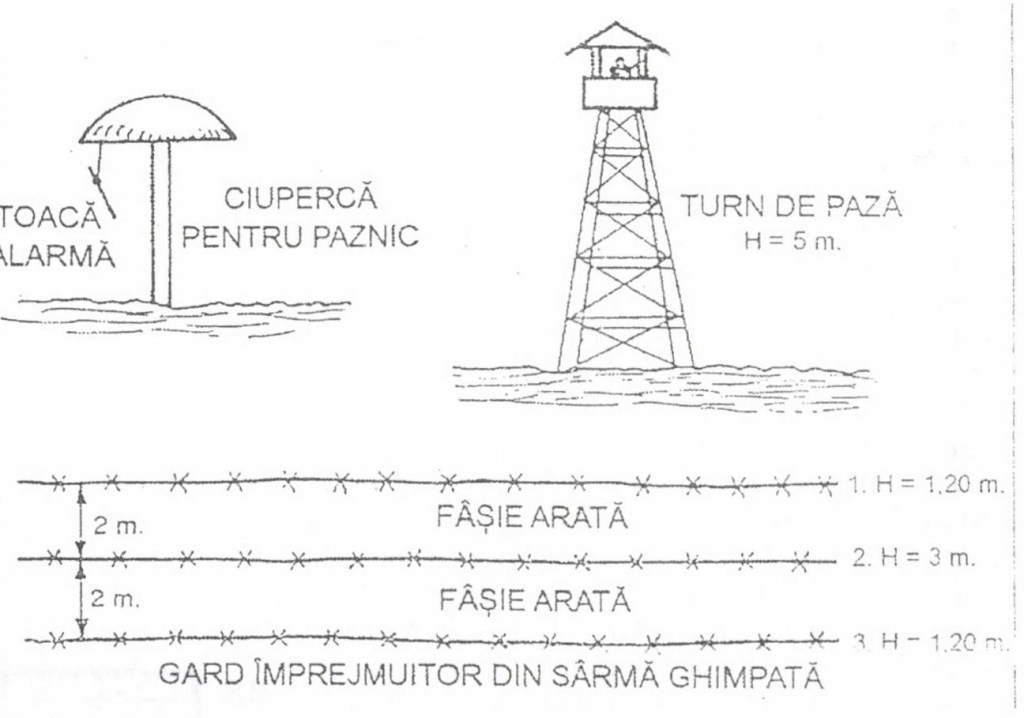
At the Cape Midia, inside the camp there was a specially surrounded pear with three barbed wire fences, inside which there were four barracks. Around this barbecue there were about 15 barracks that constituted the camp itself. This camp in the camp I called the “Death of Death”.
Those brought here were destined for rapid death by starvation. There were former senior officers who fought on the sunrise, former dignitaries, some legionaries, generally worthy and educated. In the morning the coffee was given from fried barley, without bread. At noon and in the evening, a kind of sidelines of stubborn cabbage or broken donuts and from time to time a portion of altered cornotes.
The bodies of those in the “tarcar” looked like ambulance skeletons. You could hardly recognize someone of them: in the “death of death” the earth was empty, as it was. People had eaten all the grass, any weed, even the roots. Any life that crossed this space was caught and eaten: insects, rams, mice, rats, snakes. Once, the whirlwind aroused by a large storm raised the water from a puddle, with everything, and threw it inside the camp.
With the wolves jumped people, hungry, catching and swallowing those frogs alive. One day the puppy of the commander Călău Borcea Liviu disappeared. It had baptized it “Midia” by the name of the Midia camp. He ordered the guards to look for it everywhere. Not finding it, he ordered a search in the “Death of Death”. Here were found bones of cats and paws of the unfortunate missing animal. The madness of the starvation went so far that the bodies of those who died after the evening count were carved by some and the meat eaten so cruelly. Observing this, the administration put plants to guard the bodies of the dead until they were removed from the barracks. Two dead with the improvised and taken in the cemetery were everyday, and those who died at night were thrown into the lake. (Memory, 2009/ No. 1-2)
A report from the former Securitate archives recorded the deposition of a defiled prisoner in the Cernavoda's work camp:
“In December 1952, being sick, I received from the doctor an exemption ticket. The Moroșan guardian who was not going to recognize the ticket and took me to the beat until he filled me, then took me to the commander Cormoș Florian, who beat me in the gate until I fainted. He ordered 3 detainees to be climbed and thrown into the Danube There and he told me: you will return to the prison and you will stay there until you have to perish, not to live. ” (Memory, 2009/ No. 1-2)
We could continue with countless other examples.
Article made with the support of Digitca Arcanum.