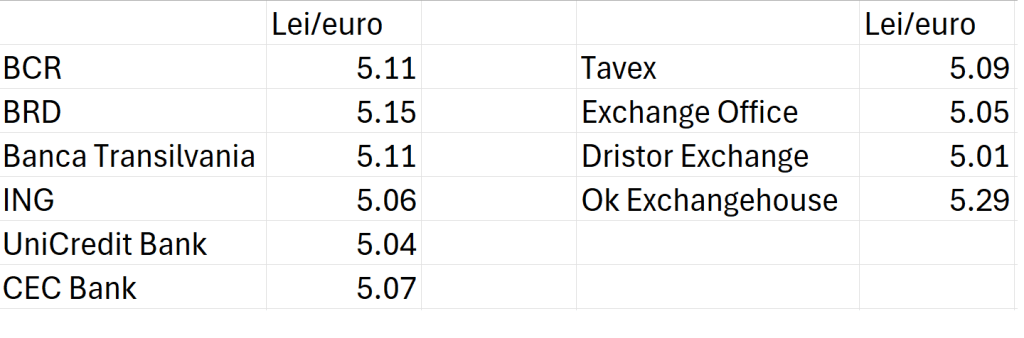
In banks and exchange houses the euro rate varies between 5.11-5.29 lei. “In the current environment, even a very efficient gyroscope would face precision problems,” says the chief economist of a big bank

Mugur Isarescu, BNR governor, photo: Hotnews
After the NBR published the data on the euro rate on Tuesday, the quotation of the European currency at the spare houses varies between 5.11 lei and 5.29 lei for one euro
The arguments for which the lion passed the psychological threshold of 5 lei are primarily economic. Even the governor had pointed out in February that he would leave the lion “easily” to depreciate, admitting that at that time he was over-evaluated by 5%.
“In the current environment, even a very efficient gyroscope would face precision problems, triggered by both geopolitical and internal developments,” a report said on the BRD, coordinated by the Bank's chief economist, Florian Libocor, on Tuesday.
“For an adequate level of orientation, the surrounding realities must be clearly evaluated, accepted the limits, resistant to the extremes and try to distinguish between signal and noise. The control of the above will determine the power balance between the direct and the induced effects, both at the economic and societal level.
Some of the economic arguments that led to the depreciation of the lion:
- The economic growth of Romania is fragile, being strongly dependent on the internal demand fueled by imports.
- The twin deficits (fiscal, external) not only reached the maximums after 2009, but from the beginning of the year they have no signs of regress. On the contrary, the deficit of the current account continued to increase (+84% compared to the previous year in January-February 2025), while the fiscal deficit remained at a level comparable to the same period last year (-2.3% of GDP in T1 2025).
- The current dynamics of the budgetary expenses question the expected fiscal consolidation, ie the interest expenses increased by 64% compared to the previous year in T1 2025, the expenses with the staff and social assistance increased by 15% compared to the previous year, respectively 12% compared to the previous year. Therefore, the expenses with interest, alone, will probably exceed 3% of GDP this year (Maastricht threshold for fiscal deficit)!
- At about 55% of GDP, the public debt increased by 20 percentage points in 2019, a pace that is increasingly testing the internal financing capacity.
Without a proper correction of the imbalances, Romania risks entering a dangerous way, losing the “rescue vest” for financial stability – the confidence of rating agencies (all three have assigned a negative rating perspective) and, inherently, market
The BNR maintains a firm position for now, but cannot subsidize the price of inaction in other fields of the policy mix – at one point, something has to give up, says Libocor. However, the NBR also has tools and safety net (currency reserves) to ensure an orderly adjustment.
Montagne Political Russe that we have all witnessed since last fall is an oasis of valuable perspectives and lessons, the authors suggest the report:
- An electoral offer constantly based on the principle of “younger evil” cannot bring “greater good”. The preparation of the candidates is reflected in the quality of the debate.
- Good times do not last endlessly. Being proactive, rather than reactive, could make the difference. When the decision makers in adjusting the poorly designed policies and implementing the necessary reforms are pleased, this inevitably translates into difficult choices. Who has the knowledge needed to repair things?
- Confidence – the only “active” that can be bought, borrowed, rented.
- Once lost, its reconstruction is a discouraging and long process, without the guarantee of a complete restoration.