
Narrator: This gold bar was made of rubbish.
Materials inside the ejected electronics are worth around $ 60 billion each year.
Jason Gaber, founder, Mt Baker Mining and Metals: We are talking about Pallad, Tantal, Tin, Lead or Steel.
Narrator: To extract the most valuable metals, you need a large strength or bathing in acid.
In many places, e-receive collectors cannot afford appropriate security measures.
The growing number of people dealing with recycling proves that he can earn money, safely processing it in their own garages.
Wade Cawley, founder, Rekindle Me: We could potentially recycled with all e-internships in the country instead of exporting them abroad.
Narrator: Wade Cawley bucks in the garbage as part of its mission – so that the electronics do not remain on the garbage dumps.
His actions led him to cooperate with the startup, which he melts printed tiles and recovers metals from them with a secret broth from nature.
Ollie Crush, head of the science department and co -founder, Mint Innovation: Some of the ingredients come from microbes, and some of the mushrooms.
Narrator: How much money really earns scrapers?
And can they change the way global trade in e-internships?
We went to Sydney, Australia to find out.
Everyone knows when Wade Cawley passes through the city.
Disadvantage: Our family calls this Flash car because it is red, electric and it is full everywhere.
Narrator: Today Wade is on his way to a local workshop, which puts off devices for him that he cannot fix.
Disadvantage: They didn't have a way to recycle things, and they really wanted to do it.
Narrator: Over the past decade, the amount of electronic waste around the world has increased by at least 60 percent.
It is 50 million tons of rubbish each year.
Wade works alone, spreading the equipment with drills, screwdrivers and …
Wade: These are electric pruning shears, but I changed their destiny to be able to cut the cables.
Narrator: Performing this work is associated with risk, but Wade takes precautions.
Disadvantage: I have to put on the breathing mask to remove these fluorescent lamps, because if I break, it will get a poisonous mercury.
Narrator: After a few minutes of work, Wade finally discovers the treasure sought.
Disadvantage: Here is the motherboard, and gold and silver are found in these small black chips.
Narrator: Wade properly deals with each part of the device, even hard -to -recycled plastic.
Recovery of copper, gold and palladium from printed tiles is possible in large recycling plants, but it is expensive and requires corporation and consumers properly getting rid of devices.
Currently, only about 9 percent E-interpts in Australia are officially collected.
In the US, this indicator is only at a slightly better level and amounts to 15 percent.
So unwanted devices lie on the streets, waiting for treasure hunters.
Ernie Petzrick, owner, Shark Scraper: Another nice tile.
I predict that small recycling companies and scrap collectors will continue to grow in strength, both in the United States and many other developed countries.
Narrator: Ernie Petzrick is a retired navy captain who has been dealing with scrap metal since 2019.
His YouTube channel, Shark Scraper, is one of the hundreds of people teaching people about this business.
Erna: Each minute spent scrapping things absorbs your margin, and sometimes you can earn only a few bucks per hour.
If you do it yourself in the garage, it's better to go to work at McDonald's.
Narrator: Scrapping does not really pay off until you invest in heavy equipment, which can cost tens of thousands of dollars.
Jason: After placing the scrap metal on one of our vibrating tables, the metals go to one side and waste to the other.
Narrator: Jason Gaber comes from the world of underground mining, but now he sells crushers that can be used for e-resources.
Jason: E-resources will be the most expensive “red” in the future.
Narrator: For many, scrapping of e-respts remains an secondary occupation.
For some the poorest people in the world, however, this is the only way to stay.
Each year, rich countries send thousands of tons of e-internships to places such as Delhi, the world capital of unregulated recycling of e-receives.
Gulzar, E-Przydpad Collector: This is a risky work, but I do it out of necessity.
Narrator: Gulzar was 14 years old when we talked to him in 2023.
It is one of around 50,000 people who dig garbage imported mainly from countries such as the United States and China.
Gulzar starts his morning by selling breakfasts in his father's food wheelchair.
After school, he goes to the dump to sort old mobile phones, computers and game controllers.
Few people doing this work have gloves or other protective equipment.
Gulzar: When opening phones, this part may prick.
Sharp elements on the printed plate sometimes hurt my hands.
Narrator: To get to valuable metals, many collectors burning e-resources.
This is a problem that, according to experts, has a long -lasting impact on health, including inhibition of growth, miscarriage, organs and reduced bone mineral density.
In 2021, India recycled one-third of 1.5 million tons of e-interpts they produced.
The country's recycling indicator is twice as high as in the case of North America.
Only a fraction of Indian waste was, however, processed by authorized recycling companies.
Not to mention that this country imports about 50,000 tonnes of e-interpts per year.
Thanks to its company, Rekindle Me Wade tries to prevent e-inter-resources to be prevented.
Disadvantage: It would have a really good impact on the whole world, if instead of exporting waste abroad and buried these people, they were able to take care of them ourselves.
Narrator: Today Wade tosses a truck with collected materials for Mint Innovation, a local startup that has printed tiles.
Ollie: Hey, Wade, how is it going?
Disadvantage: Hi, good.
Ollie: Thanks for coming.
You recently brought a lot of nice things.
Narrator: Mint pays him around $ 3.50 per kilo.
Today he earned around $ 3500.
Ollie: How much did you bring today, Wade?
Disadvantage: All in all.
Ollie: Usually in such a party we will find approximately 250-300 kg of copper and maybe 100-200 g of gold.
We'll see what comes out of it.
Here is a small gold sample from the processor.
I will give it to you now as an advance.
It is possible that you will have to give it back to us.
Narrator: Electronic waste goes to a bath full of bacteria, fungi and other organic materials.
Business Insider was visited for the first time by the Mint Pilot Plant in New Zealand in 2021.
Now the company has expanded its activity to include a plant in Sydney, Australia, which is almost five times larger.
Ollie: Here is our first plant.
We are preparing to build them in many cities around the world.
Narrator: The plant is almost completely automated, which prevents direct contact of employees with dangerous materials.
Printed tiles, reaching a two -story belt conveyor, consist of 70 percent. Plastic and 30 percent metals such as copper, silver, palladium and gold.
This machine crumbles them into smaller particles, which are then dissolved in the liquid.
Ollie: A large plastic tank is behind me.
It has a capacity of 25,000 l.
Narrator: The liquid is mixed in this tank for several hours.
Ollie: Then he goes to one of the filter presses.
Narrator: In this blue liquid there is copper, tin and other less valuable metals.
Mint uses electricity to draw copper.
Ollie: We pass through a number of discs, which is pulled out of the solution.
Narrator: Now the solution is ready for gold extraction.
A special “sauce” mint enters the game.
The MINT team identified these tiny helpers in 2017 during research trips to places such as abandoned mines or fields with rusty equipment.
They collected bacteria and fungi that evolved to bind to specific metals.
Ollie: This residual dark -purple color is the remains of biomass, to which gold stuck, creating these beautiful, purple nanoparticles.
Narrator: The purple “cake” goes to the refinery outside the plant, where it is transformed into something that is easier to recognize.
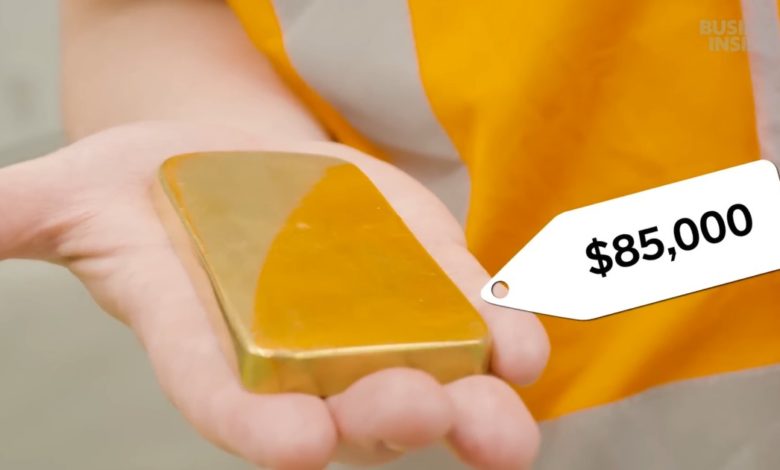
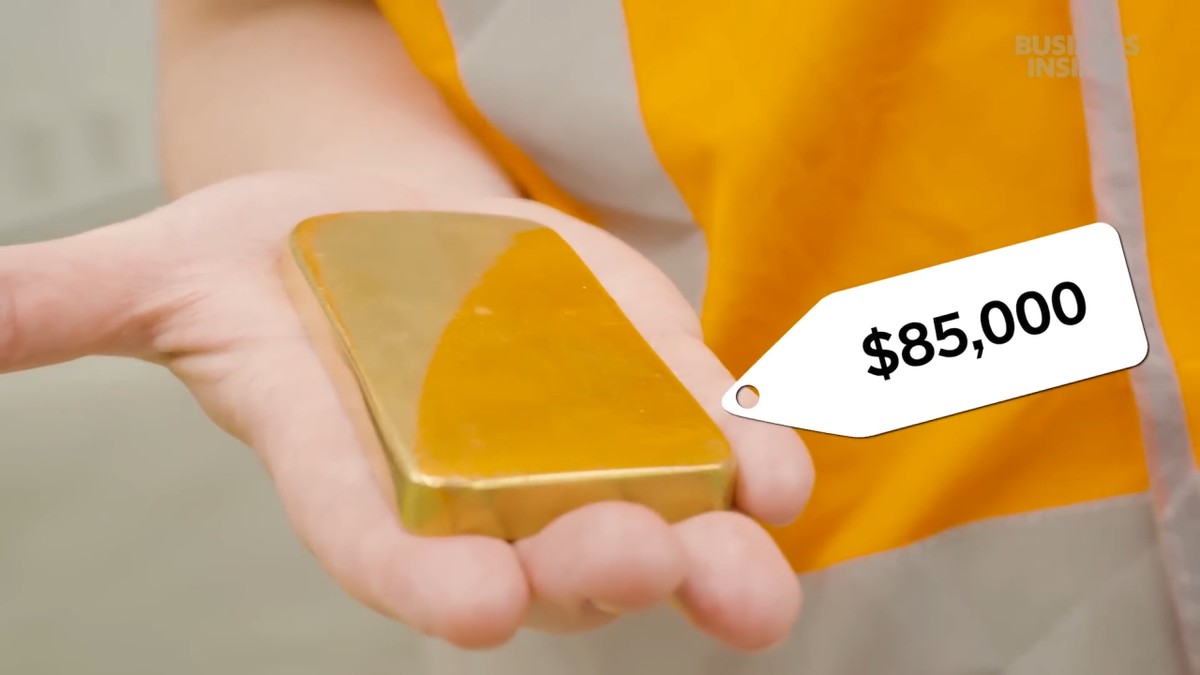
Ollie: This gold bars weighs about 1.2-1.3 kg.
That's all the gold is recovering every day of work.
Narrator: At today's prices, it is gold worth almost 85 thousand. hole.
The company claims that its plant in Sydney can recover gold a year worth over $ 30 million.
MINT also claims that this process has a less impact on the environment compared to other forms of industrial recycling.
Ollie: We have created a closed loop system in which what what the plant leaves is harmless and is not chemical waste.
Narrator: This has helped convince Wade to process his treasures in this plant.
Disadvantage: It's an amazing feeling to see that my printed tiles have finally hit the right place and I know that they are correctly recycled.
It's really nice to see that everything is in place.
Narrator: Wade began to collect old electronics when he was a teenager.
He kept her in his mother's garage.
Michael Cawley, Mama Wade: I was still asking Wade if there is a way to condense his things a little so that we could leave the house through the front door.
Disadvantage: This is a TV from the 1960s produced in Australia.
Here is my first laptop, which initiated my obsession with everything that is historic and electric.
I like to tinker with them and check if I can restore them to action.
From a historical point of view, it is important to keep such things, because there are fewer and fewer and fewer of these older systems.
In my opinion, they are worth much more than gold and silver that are in them.
Narrator: Wade, however, may want to consider extracting from devices from its own collection.
Have you ever heard that the equipment is not currently produced as before?
Well, it's true.
Starting from the late 90s to reduce costs, many companies began to use gold -plated wiring instead of solid gold.
For example: integrated circuits from the IBM PC from 1982 are currently sold for around $ 400. per kilo.
However, the Apple processor, which can be found inside the iMac created almost 20 years later, costs only less than $ 9. per kilo.
Jim Puckett, executive director, Basel Action Network: Most computer equipment is not that valuable.
Of course, there is some gold, copper, platinum or palladium, but these are small amounts.
Narrator: An activist for environmental protection Jim Puckett founded Basel Action Network (Ban) in 1997 to monitor and stop the illegal export of dangerous garbage, such as e-resources.
Jim: We must think about the processing of our waste as a service for society, because we do not want to be lit.
We don't want pollution.
Narrator: Wade says that his company will continue to bring modest income until he is able to invest in new equipment.
Making what is right, however, makes him continue to do it.
Disadvantage: I am motivated by the awareness that waste will be recycled and will not go to the dump.
Added to this is my hobby, because I am pleased to get old things.
It's a really pleasant job for me.
Crowd: Piotr Nazek


