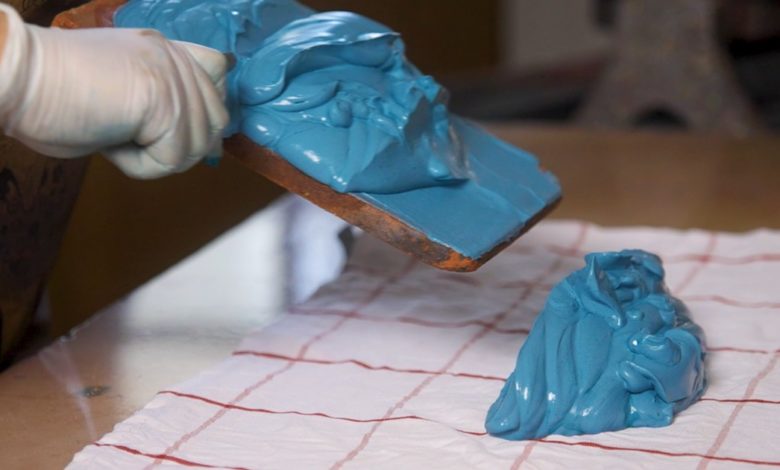
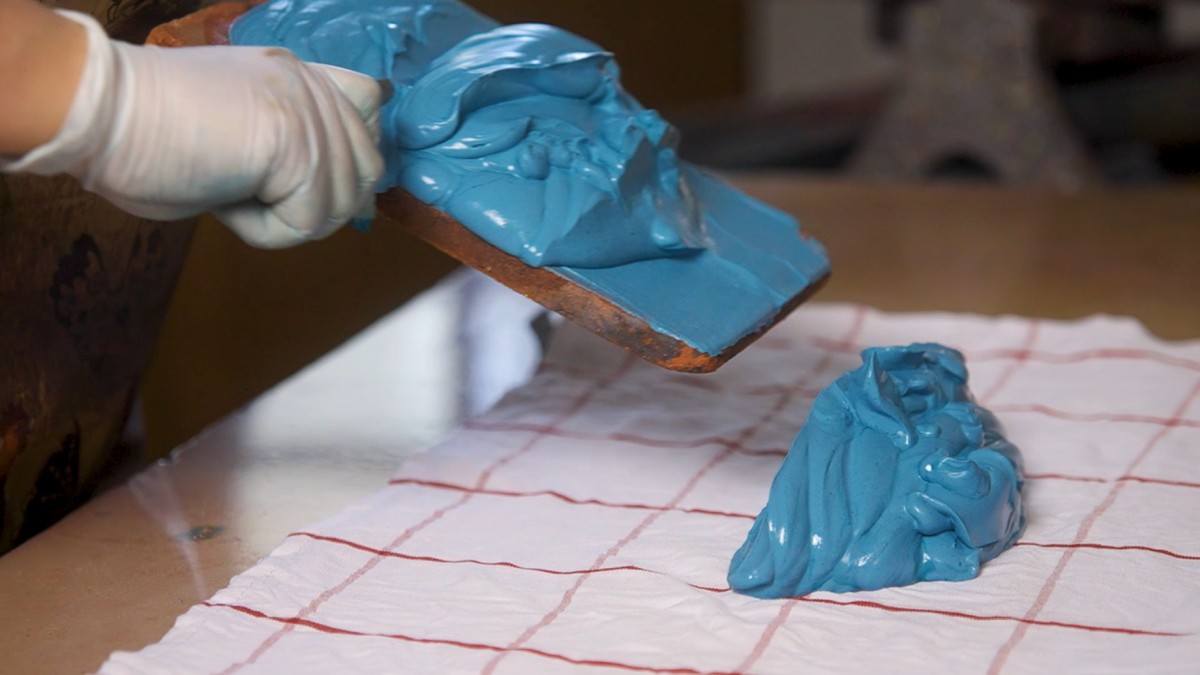
Narrator: In a liquid form, pastels look like paint.
Margaret's goal, however, is to get rid of moisture.
It changes this light blue stain into one of the most famous pastels on the market in the form of chopsticks.
La Maison du Pastel, founded by Henri Roché, has been producing them in the same way for 300 years.
Hundreds of colors are stored in these drawers that differ in shades.
Only a trained eye can see them.
However, premium pastels business is difficult to maintain.
Pastels are not as popular as other artistic supplies, such as oil paints, so for years the company fought to find and maintain a customer base.
Currently, two co -owners work tirelessly to maintain this centuries -old tradition alive without sacrificing quality for which Maison is famous.
So how did this niche company survive?
Isabelle Roché, a relative of Henri Roché, and Margaret Zayer are the only employees of the company.
They create new pastels, very similar to the old ones, starting with pigment and a binder based on a secret formula, which it took to Roché and his son of the decades.
Isabelle Roché, co -owner, La Maison du Pastel: Artists such as Whistler, Redon, Degas and Sisley had problems with this medium.
The powder did not want to stick to the paper, mold appeared on their work.
Henri Roché used his scientific skills to remedy this and provide them with the product they were looking for.
Margaret Zayer, co -owner, La Maison du Pastel: The basis of this new color is Ceruleum, which is a very classic pigment.
Narrator: This new color, the Caribbean blue, will join over 1900 other offered by Maison.
These are the most colors in the company's history.
Maybe even the most pastels in history.
Adding new colors to the mixture requires a thorough eye and skillful hands.
Here is the task of Margaret, which is responsible for creativity in the company.
Margaret: If the sun is not shining and we don't feel like working, we don't work.
And if it shines and inspires us to create a beautiful color, we do it.
Narrator: After choosing the initial color, Isabelle and Margaret divide it into nine gradations – from dark to light.
Thanks to this, artists can find exactly the shade they need.
Isabelle: I aim at the color between these two.
We have one, two, three, four …
It will be number five, six, seven, eight, nine.
Margaret: I started from one and a half teaspoon dark.
I guess I'll make a mess.
Narrator: In its centuries -old history, Maison was famous for its unmatched color palette.
This is especially important for artists painting pastels, who can not simply mix two pastels to get a new color before applying it to paper.
Margaret: It is impossible to mix pastels on the palette as a painter can do.
If you want to make a line in a given color, you need to have the right pastel.
Narrator: Mixing must take place at the very beginning of the “life” of pastel.
Isabelle: I am already close to the desired effect, which is really magical.
I will mix them before I start comparing.
Now the color is a bit too dark, so I will add some white.
Margaret: If the paste is too stiff, it is impossible to easily combine white and color, but leading it to the consistency of the dough, they combine quite well.
Narrator: When women are satisfied with the color, Isabelle puts a mixture on terracotta tiles and leaves it to dry.
Isabelle: We use tiles because it was done in the past, but their advantage is that they are porous.
Narrator: Tiles absorb moisture, thanks to which Margaret has less work when he places a mixture in an ancient press.
When the paste dries, Margaret wraps it in a cloth and uses the historic press to gradually squeeze moisture from the paste.
Margaret: This tool was in Maison when Isabelle took over the company.
I imagine it was used for a long time.
Isabelle: Many of what we are surrounded are tools and drawers from 150 years ago.
It also gives us a sense of something that is called “âme” in French.
I'm not sure how to say it in English.
“Spirit, soul”.
Narrator: Margaret joined Isabelle in Maison in 2010 after visiting the store.
She sent an e -mail with a question about holiday work, which made her found her calling.
Margaret: I would be happy, cleaning the store, so I did not expect an invitation to create pastels with her.
Isabelle: I helped the business survive, and now I give Margaret a chance to extend the life of this craft.
Margaret: We will get something similar to modeling or cake.
This is one of the stages where you need to use muscles, but at the same time be very attentive.
There are some colors that lose water quite quickly and can easily be squeezed too hard, and the addition of water is always more complicated.
Oh, so better.
Isa? I'm going with paste.
Narrator: Manual rolling of each pastel allows you to add more pigment to the mixture than if women used the machine.
Isabelle: We can work with some consistencies with which the machines could not.
We get colors that are either more vivid or deeper or more concentrated.
I always like the creation stage.
This is the moment when pastels are formed, so you see the whole process.
If you don't know how to roll them out, you can get pancakes.
The first pastels I made did not resemble anything.
They had strange shapes, holes and were flat.
Margaret: Cutting with a large blade was also the idea of Henri Roché.
He introduced them to a traditional process, because in the past pastels were cut, so the process lasted eternity.
Now we cut off the tips at one go.
Narrator: When Isabelle took over the company after its aging aunts in 2000, she retained many tools and techniques that Roché developed in his time.
Margaret: Then pastels dry in the air.
It usually lasts for about three weeks, which depends on the season and specific color.
Narrator: A lot had to change to make this business burns.
When Isabelle took over the company, Maison had virtually no products and customers in stock.
Isabelle: My aunt was over 80 years old when I took over the company, which means that they haven't earned much for the last 20 years.
They were very secretive, so they did not try to acquire new customers.
Their customer base, as the artists aged and died, was not replaced.
Narrator: She spent the first two years on the renewal of supply.
Isabelle: I managed to recreate about 250 or 300 colors.
Narrator: Only then did the demand focused.
Maison operates in the so -called market niche.
Imagine that the market is a cake.
Companies operating on the mass market, such as Crayola, try to get as much piece as possible, trying to reach as many people as possible.
On the other hand, companies serving niche markets cut out smaller, “specialized” pieces, reaching a specific type of customers.
The reason for Roché's success was the way he cooperated with the artists to create the colors they needed.
Isabelle was determined to do the same.
Isabelle: The most difficult for me was that I had no experience related to art.
I also had no artistic education.
I did not draw, I did not paint.
When I talked to the artists, I felt like I was speaking in a different language.
Narrator: One of these artists is Claude Bauret Allard.
Isabelle: I know her from the day I took over the reins.
The first color I created was the blue indigo, which she was waiting for for two years.
Claude Bauret Allard, artist: She told you that she made colors especially for me?
Producer: Yes.
Claude: I am very proud of it.
This means that they like how I use their colors.
They serve me and I
It's an exchange like everything in life.
Narrator: Claude began to use pastels at a later stage of her career, after she worked most of the time with oil paints.
Claude: At the beginning I used them sporadically.
However, I discovered that I sold more work done with pastels, because the quality of pigments was great.
Narrator: Historically, pastels have come to the background towards more popular accessories, such as oil paints.
Isabelle: Waves appear in which they are intensively used, and then return to the role of the secondary accessories, which people use only to make basic drawings.
We realize that these waves come and go.
Currently, some artists use this technique for really serious things, not just preparatory drawings.
I approached this, thinking that there is a handful in France, maybe 10 artists who really need pastels.
I decided that if I multiply it through the number of countries around the world, I should be able to make a living.
Narrator: Isabelle inherited the archive of century -old pigments, some of which are still suitable for use.
Sometimes Margaret can even reach the company's past to create new colors.
Margaret: She is beautiful.
It's really beautiful.
I process in real time that I really like this pigment.
This is a real discovery.
I want to see what pastel can be made of it.
This is Ochra, so he will probably have a pleasant texture.
I will compare it with Ochrami, which we already have in the range to see if I am right.
Don't you mind going for paper and white?
Narrator: A significant part of the process remained the same as when Roché ran the company, but Isabelle and Margaret really stick to how he thought about business.
Margaret: What makes our pastels what they are are his recipes and the way they connect with the craftsmanship of the craftsmen he met.
Claude: A continuous growth is achieved with Roché pastels.
He becomes a better artist.
It's crucial in my work.
Isabelle: I know that Margaret has some ideas in his head that he wants to introduce.
He already knows that one day we will exceed 2,000 colors.
As long as people come to the store and ask about the colors they do not have, we will introduce innovations.
Crowd: Piotr Nazek