The Dacian cities sacrificed in the name of progress. “Electrified” fortresses and covered with telecommunications relays

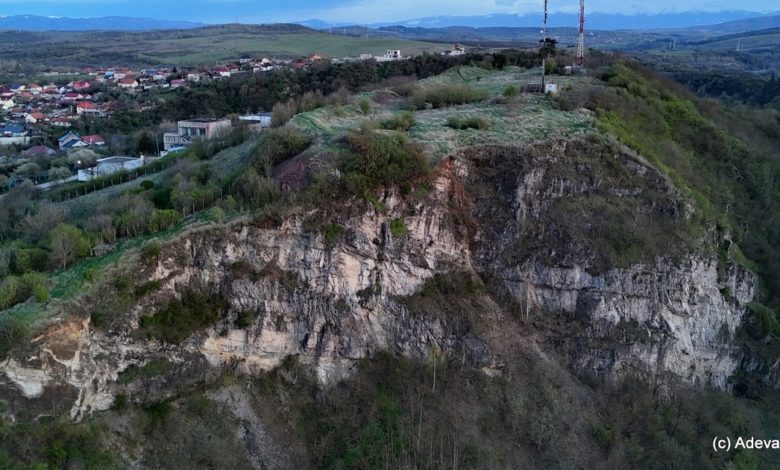
Over one hundred ancient cities and fortifications have been discovered in Romania. The most popular of them were included in the UNESCO World Cultural Heritage, but most of them remained little known to Romanians, and some historical monuments have been completely neglected.
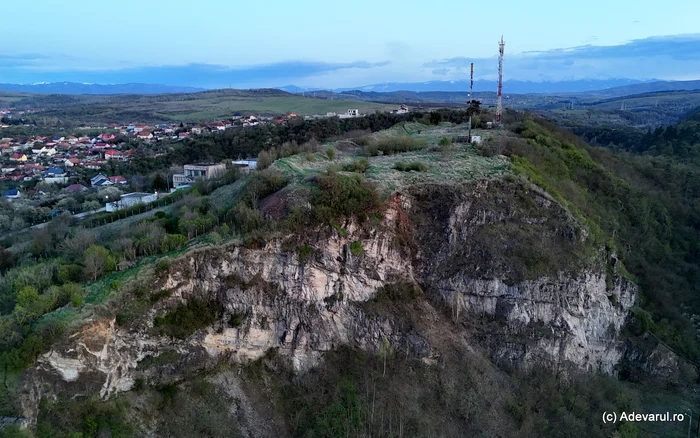
The Dacian fortress on Sânpetru Hill, dominated by telecommunications. Photo: Daniel Guță.
The Dacian Fortress Ardeu (Hunedoara county), located on the Geoagiului Valley, in the Metaliferi Mountains, was built in antiquity to defend the gold and silver mining operations in the area and the ancient road that connected the Mureș Valley and the germ to the mining districts in Apuseni.
Dacian fortress disappeared in the crater of a limestone career
Dacian fortification (video), old from the 1st century BC. Hr., It was abandoned during the wars with the Romans, at the beginning of the second century AD. Subsequently, she was inhabited sporadically in the Roman era and then in the Middle Ages. Archaeologists have discovered the traces of a noble palace (“tower”), a Dacian blacksmith and a workshop where iron, bronze and horn, as well as numerous artifacts, among which a statue of the god Mercury and decorative bronze objects were processed.
The hill on which the fortress is located has been affected since the 1970s by a limestone exploitation, which was used for road construction and lime manufacture. During the excavations, numerous ancient objects were discovered.
“From Ardeu, from the place of the stone quarry, Petru Roşu has gathered several ceramic fragments, hand-worked, ornamented with buttons, alveolar belts, etc. One of the vessels, of jar type, is also intro-type. From here comes the upper part of a grinder, made of a rock, a little,” inform archaeologists in 1977.
The mining exploitation, concluded in the 1990s, led to the disappearance of a large area of the spur on which the Dacian fortress was built, and with it and of some historical vestiges. Following her there was a huge crater.
Since the 2000s, the career has not been reopened, after archaeologists have opposed to prevent the destruction of the fortress. Since then, archaeological research has been resumed, and archaeologists have managed to recover precious ancient objects and discover elements of the fortification (stone walls stuck with clay), remnants of valuable housing and artifacts, including a bone dice, of Roman influence.
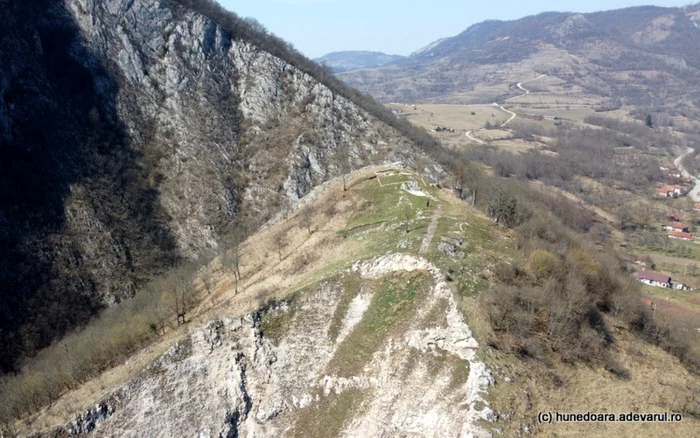
The Dacian Fortress Ardeu. Photo: Daniel Guță Adevărul
Near Ardeu are the ruins of germisare (Geoagiu Băi, video), a former Daco-Roman thermal complex, where temples, baths and gold offers dedicated to ancient deities were discovered. The road that passes at the foot of the fortress leads to Zlatna, a former important gold center of Dacia.
The ancient fortress, electrified in the modern era
In the mid-1950s, on the Prisaca peak (1,219 meters) in the Orăștiei Mountains, in a hard-to-reach area, above the village of Costești (Hunedoara county) archaeologists discovered the ruins of an ancient Dacian or Roman fortress.
Initially, scientists described it as a Roman fort with dimensions of 300 /120 meters, an irregular shape, with rounded corners adapted to the ground, and with a defense ditch that seems to be inside. Its walls were built from stones pile and from a fir wood palisade.
“Dominating the surroundings, the prisaca was a very suitable place for establishing a fortress. To the west you can see Valea Streiului and Călanul, to the south the Plateau of the Luncanilor and, in the distance, the mountains of the Retezat. of the prisces.archaeologists inform in a report of 1959.
In the following decades, the fortification, which some archaeologists considered as an old Dacian settlement than the Dacian fortresses from Costești and Blidaru, has not been investigated. The villages of Ludeștii de Sus (Strugari) and Costești – Deal, on the peaks gradually extinguished, and their roads that crossed the Prisaca peak became impractical. The settlement on the Prisaca peak was included in the list of historical category A monuments, but the authorities did not take this into account.
“In the middle of the monument, some concrete pillars have been stuck, for the electric line serving, I think, the villages Costești and Strugari (Ludeștii de Sus). On the highest point, inside the fortification, the electric line is branched. Could no detail of several tens/hundred meters be made?”advertising archaeologist Aurora Petan, in an article published on dacica.ro.
The Dacian fortress of Hunedoara, with relays and funicular pillars
Located ten minutes walk from Corvin Castle, Sânpetru Hill (Video) keeps the remains of a Dacian fortress, identified by some specialists as Singidava, as well as the traces of a medieval fortress subsequently raised on the same place.
“As this fortress will be called, it is not known, but Hunedoara is still called inidoara, which can be the phonetic trace of the old Singidava.”explained, in the 1980s the archaeologist Tiberiu Mariș.
The plateau was artificially modeled, forming a platform over 300 meters long, at an altitude of 318 meters. In the Dacian time, the settlement was fortified with stone and wood walls, and nearby traces of houses and guard towers were discovered. Research in the 2000s confirmed a continuous living from the prehistoric period to the Middle Ages.
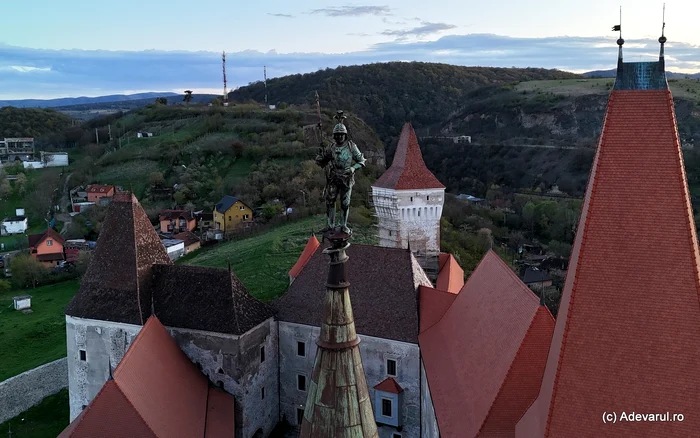
Sânpetru Hill, in the backdrop of Corvin Castle. Photo: Daniel Guță. TRUTH
“The discovery of major complexes and armament elements support the existence of a fortress, functional until the 13th century,” It is shown in the chronicle of archaeological research (2006).
For over two centuries, a reformed cemetery, used until the 1960s, but later and vandalized, has also found. During the same period, the hill was crossed by a funicular network, used for the transport of the ore from Ghelari and Teliuc to the Hunedoara Combined.
In the basement of the hill was discovered a natural water tank, exploited from the 1960s, and then an anti -aircraft shelter was built. Currently, the settlement is largely covered by bushes, and few tourists get to discover its history.
The plateau smoothed over two millennia ago kept the ruins of the funicular installations in communism and the remains of the old reformed cemetery and is dominated by two telecommunications relays, located in 1980 and 2006.
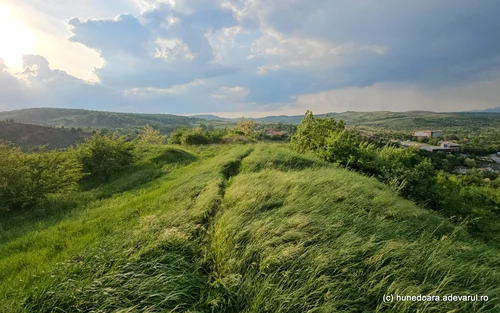
Image 1/14:
Sanpetru Hill in Hunedoara Photo Daniel Guță Adevărul (43) JPG
And other ancient settlements in Romania have gone through as dramatic situations over time, some disappear largely. The Dacian fortress Bănița was dismantled for her materials to be used in the construction of the railway of the Coal Simeria – Petroșani, and from the ruins of the Roman city Sarmizegetusa, the locals took countless monuments to use them for construction in the surrounding villages.