Europe must stop being afraid of nuclear weapons. Whoever hits first dies as the second one

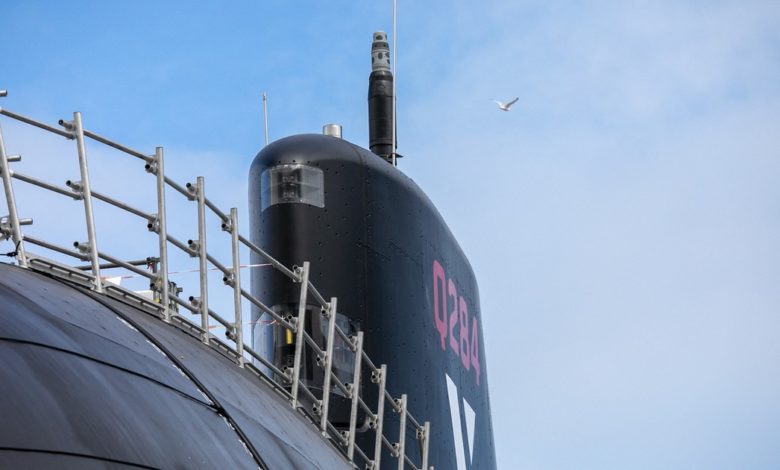
The German security expert Carlo Masala from the Bundehry University called NATO to prepare for the potential Russian invasion of the Baltic States, At the same time, 2029 is discussed in security circles as a possible inflammatory point. Rene Obermann, chairman of the supervisory board of Airbus, predicts that an attack on NATO's eastern flank may occur even earlier.
Europe wakes up from sleep
If Washington really abandons its role as a world policeman, Europe will have difficulty opposing the army of Russian President Vladimir Putin, at least in this time perspective. Many European countries, especially Germany, have neglected their own armed forces in recent decades. While Russia has switched everything to the war economy, part of Europe has just woke up from a peaceful world sleep.
Military experts say that the production of the arsenal of conventional weapons with the size needed to repel the Russian invasion will take over four years. Although most observers consider the Russian attack on Germany that is unlikely, even such a scenario is not impossible.
Therefore, to deter Russia, Germany and Europe need their own nuclear shield.
Germany has long been reluctant to have their own nuclear weapons, partly due to its 20th-century history of militarism. But since the Russian invasion of Ukraine, it is clear that the prospect of a Russian attack on Europe is no longer only theoretical. We need to strengthen our defense as soon as possible. Currently, a debate among leaders at the highest levels of power is increasingly not concerned whether Germany should arm themselves, but how it will look.
Nuclear weapons can and should be part of this rear arrangement to save both time and money. The effectiveness of nuclear deterrence is well known from the Cold War and its doctrine of mutually guaranteed destruction. For decades, neither the USA nor Russia used nuclear weapons because they knew that the retaliation of the other side would be even more destructive. The one who hit the first dies as the second.
Today, this deterrence also works in the case of Israel, who calls it “Samson's option” – a military doctrine inspired by the biblical figure of Samson, who destroyed the pillars of the temple and killed thousands of his enemies with himself when he stood in the face of a certain death. If Israel stood in the face of an existential threat, it is reportedly prepared for the use of nuclear weapons and risk of causing a nuclear war. Although Israel has never officially confirmed the possession of nuclear weapons, this strategy seems effective – recently against Iran.
New European Defense Union
For Germany, the development of its own nuclear weapon, controlled by the state, is not a realistic option. This country has twice legally renounced the possession of nuclear weapons: for the first time in 1975, under a system with non -extension of nuclear weapons, and then in 1990 under the “Two plus four” treaty, which enabled the unification of Germany. However, discussions are already underway about Germany's participation in the nuclear arsenal of France through joint control mechanisms.
However, relying only in France seems to be risky, especially in a situation where the French nationalist Marine Le Pen, a well -known supporter of Russia, or another character from her nationalist party, will potentially take over the Elysee Palace in the near future [zgodnie z wyrokiem francuskiego sądu Le Pen nie może startować w wyborach przez najbliższe pięć lat]. A wider European solution, including British nuclear abilities – and perhaps Poland as a first line – would be much more reasonable.
Of course, there are complex issues that should be resolved, such as, for example, who would exercise command power over European nuclear weapons. It is hard to imagine that any French president would share or waive control over the decisions regarding a nuclear attack. This critical debate, however, cannot be rejected just because there are no easy answers in it. There can be taboo topics here.
Wolfgang Ischinger, chairman of the Council of the Munich Security Conference Foundation, recently presented an unconventional but convincing idea – the stationing of French nuclear weapons temporarily or permanently in Germany or Poland. Like the current agreement on sharing nuclear weapons from the USA, this weapon could be fired by partner countries using appropriate aircraft.
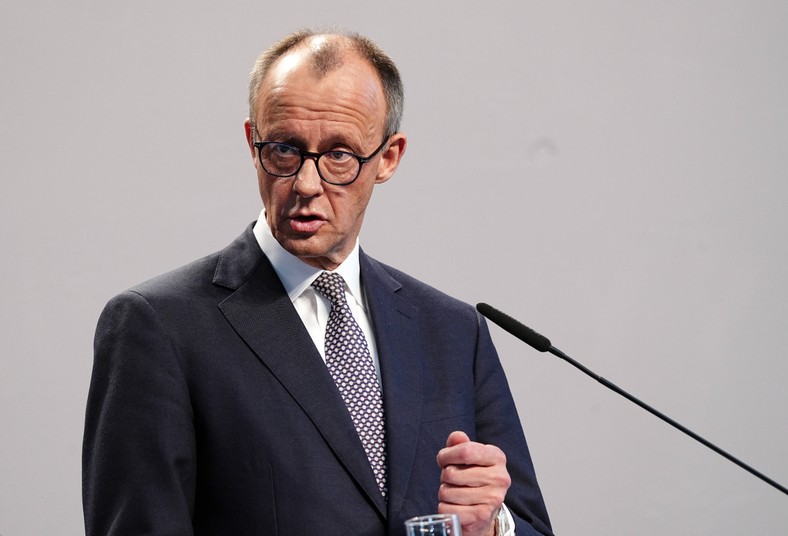
Friedrich Merz, Berlin, April 9, 2025
The future German Chancellor Friedrich Merz showed courage and strategic far -sightedness, expressing openness to such considerations after meeting the President of France Emmanuel Macron. If Merz manages to convince his future coalition partners – as well as allies in Paris, London and Warsaw – about the need to create common European nuclear abilities, he can continue the heritage of European integration carved out by state husbands, such as the German Chancellor Konrad Adenauer and Helmut Kohl.
Merz has the opportunity to shape what would become a new European Defense Union that would no longer depend on the United States, including in the scope of nuclear deterrence.
Europe must finally become capable of self -defense. Leaders of Germany, France, Great Britain and Poland could even create a direct hot line for managing a common arsenal. Just please don't create it on Signal.