publication
2025-09-18 09:35
The United States Central Bank under the pressure of President Trump took the course to a looser monetary policy. So for higher inflation, just to prevent unemployment. It is worth not to suggest the initial reaction of financial markets.

As for one, there is agreement: in the medium – or maybe also in the longer – the period was a breakthrough meeting of the Federal Open Market Committee. Let's start with facts:
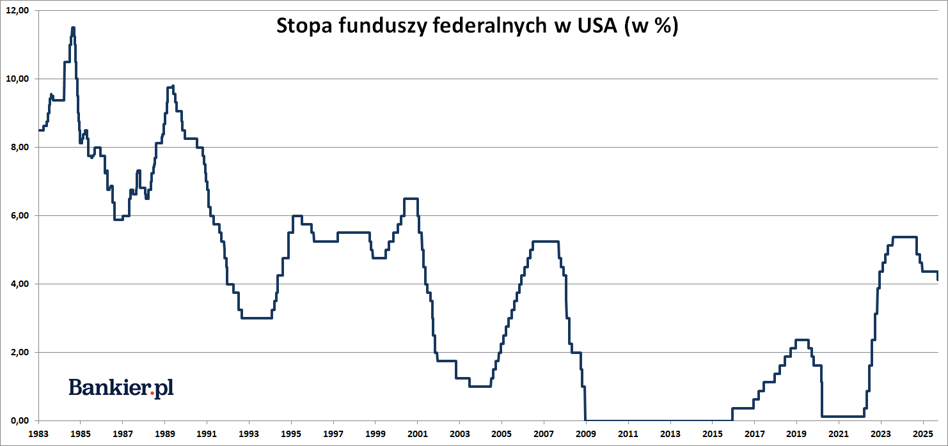
- As expected by the market, FOMC reduced the rate of federal funds by 25 PB. It was the first reduction after the 9 -month monetary “paus”.
- The fedocrops found a majority for two more 25-point foot reductions in 2025. This means almost a foregoneal cuts in October and December.
- The fresh presidential nominee Stephen Miran voted for a deeper-50-point-rate
- Members of the Committee slightly reduced their unemployment forecasts and raised next year's PCE inflation forecast.
- In the FOMC communication, new wording has appeared paying attention to the slowdown of the labor market and the increase in inflation. But the most important thing is that the committee decided that “downside risks” increased
Added to this, quite bland in its pronunciation, the appearance of chairman Powell. He still insisted that monetary policy is “restrictive” (which in the situation of growing inflation and record low credit spreads is the least debatable thesis) and that it would be heading towards neutral policy. Powell, however, quite clearly rejected the postulate of cutting the feet by 50 pb.
We know that much. What can we guess?
– In a short term, the risk of higher inflation increased, and the risk of deterioration of the situation on the labor market increased – added Powell. Such a wording in combination with a dot chart in my opinion It announces the start of the entire cycle of interest rates in the federal reserve.
“Fedocrop” shows that by the end of 2027, the rate of federal funds will fall near 3% and at this level will also remain “in the long term”, where the foot perceived by the FOMC for neutral is 3.0%. It is roughly coincided with market expectations. With the only slight difference that the market sees a descent even below 3% in 2026. But these are details, and the “fedocrop” themselves should not be approached with relentless respect, because they rarely announce what FOMC really does.
Secondly, the federal reserve begins a series of loosening monetary policy in conditions when FOMC members themselves predict a higher than they predicted in June, inflation and lower unemployment rate. After all, this is an open absurdity! In such a situation, a responsible central bank would either refrain from decisions regarding feet, or even risk their increase. But under no circumstances, the reduction, which stimulates inflation and aims to stimulate the economic situation and in this way to strengthen the demand for work (and consequently reduce unemployment). What's more, according to the median forecasts of FOMC members, the base inflation of PCE is to last above the 2 % goal until 2028! The committee therefore made it clear that from its “double mandate” Currently, it submits the purpose of maximizing employment over the inflation target
Gentlemen, let's count the voices
This leads us to an equally obvious conclusion number three: The September decision of FOMC had a purely political dimension. And this is not about monetary policy (because it would lead to the maintenance of FFR unchanged), but the pressure from the White House. In the 7-person council of Governors Donald Trump already has three of his people. Including Stephen Miran, who was called on Wednesday, who “on good morning” He voted against the chairman Powell and was in favor of a 50-point reduction of FFR. Formally, Mr. Miran is still in the White House, so his declarations of “independence” from the president are a pure farce. For this we have Michelle Bowman and Christopher Waller, who in July argued for cutting feet against most of the committee.
Add to this attempt to remove by President Trump Governor Lisy Cook, which so far has been blocked by the Court of Appeal. But the case will probably go to the Supreme Court, and there most of the judges were nominated by the Republican Party. In addition, in May 2026, the term of office of chairman Powell ends, to which Donald Trump will probably choose someone more submissive and faster cutting his feet at the president's request. Then, in a few months, up to 5 out of 7 members of the Governors Council may be “Trump's people”. And they will have a majority in a 12-person open market committee, which is still compatible with the presidents of four local Fed branches and the head of the New York Branch.
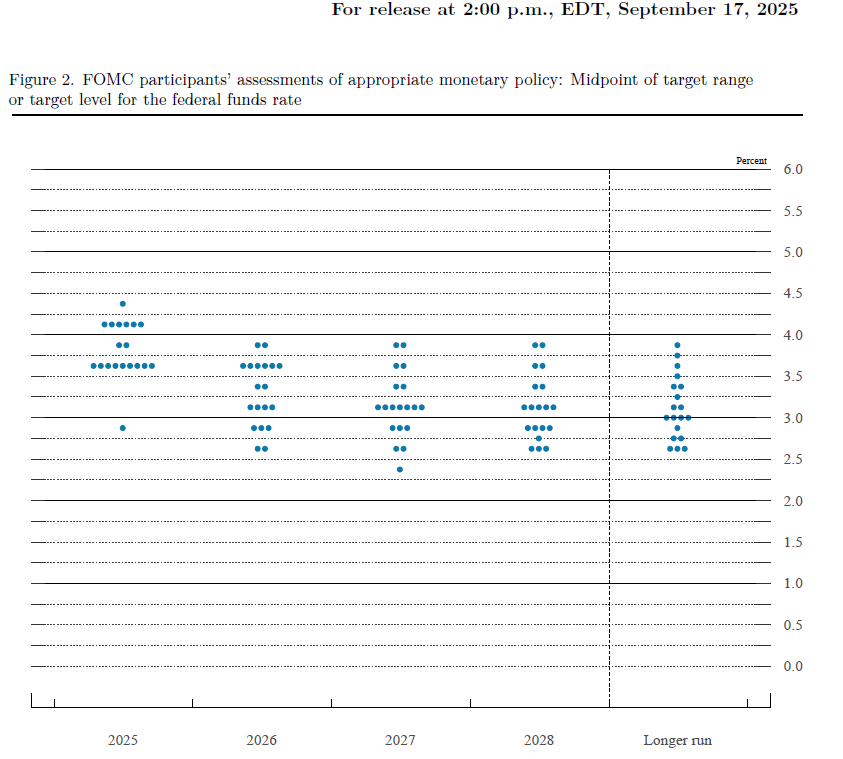
Therefore, it may turn out that in 2026 FOMC will lower interest rates faster and deeper than it would be from the current dot chart. Simply put, President Trump replaces “dots” with such more “pigeons”. And this in the long run will mean less independence of the federal reserve than the executive power in Washington. Such a system always ends with the same: higher inflation.
What will the market say?
The first reactions of financial markets to FOMC messages are often misleading. Initially, the markets reacted very optimistically: the dollar weakened against the euro, and the stock indexes went up. Later, the market went into profit implementation mode and quickly leveled the initial movements. Wednesday's session at Wall Street ended slightly under the line, and the EUR/USD exchange rate fell to around USD 1.18, withdrawing from the newly conquered this year's summit (1,1920).
We will know the actual reaction of the markets today and in the following days. It is also worth remembering that almost exactly such a scenario has been discount for the last few weeks and can work according to the principle: buy rumors, sell facts. We have probably noticed new gold price records over the last days and weeks.
To sum up, the new monetary policy of the Fed will be aimed at maintaining as low unemployment and high satisfaction of President Trump. In the short run, this can support the stock markets, raising the nominal profits of stock market companies. At the same time, hard times can come for investors in bonds. It is also an unambiguous “green light” for precious metals and probably industrial raw materials. The American dollar will be the biggest victim.