The Monetary Policy Council returns from vacation. These are the chances of reduction of interest rates


The Monetary Policy Council will gather at a two -day meeting scheduled for September 2 and 3 (Tuesday and Wednesday). This is the first decision -making meeting from the beginning of July, because during August, which took place on Tuesday, the change of feet was not the subject of discussion.
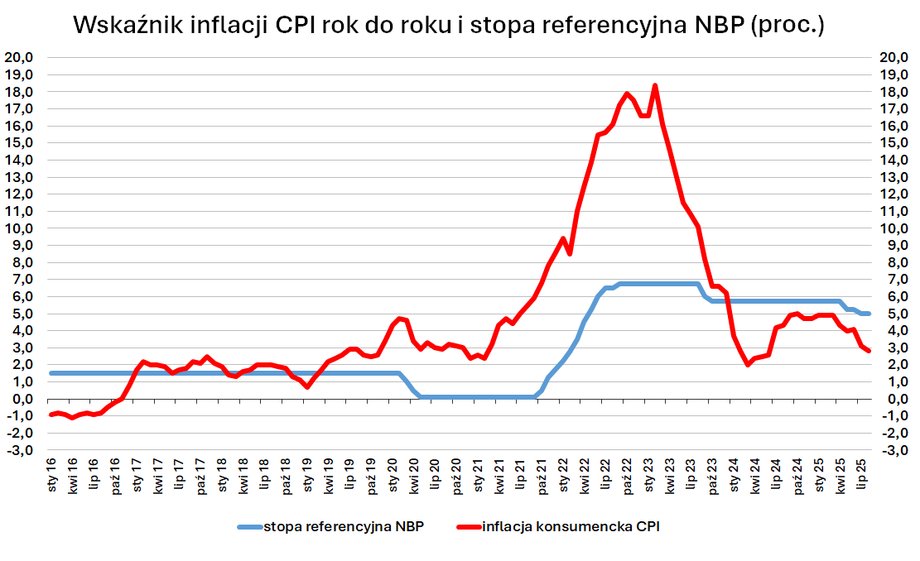
The MPC has recently lowered interest rates, although this is not a typical cycle, with reduction at every meeting. The last, July 2, reduced them by 0.25 percentage points, bringing the reference rate to 5 percent, which is the lowest level from April 2022. In May, she changed the cost of money for the first time in 19 months, cutting an interest rate by 0.50 percentage points. Previously, it lowered her feet in October 2023 (by 0.25 percentage points) and in September 2023 (by 0.75 percentage points). Between October 2021 and September 2022 – fighting with the highest inflation for 25 years – she raised a reference rate from 0.1 percent. up to 6.75 percent, which is the largest ceiling since 2002.
The latest inflation reading favors the expectations of cuts
Most economists forecast that the MPC will reduce interest rates on Wednesday, although it is worth remembering that in the past the council has surprised the market more than once. If the cut occurs, it is probably in a small amount, i.e. by 0.25 percentage points, as a result of which the NBP reference rate would drop to 4.75 percent, i.e. it would be the lowest from April 2022, when the cost of money was just growing.
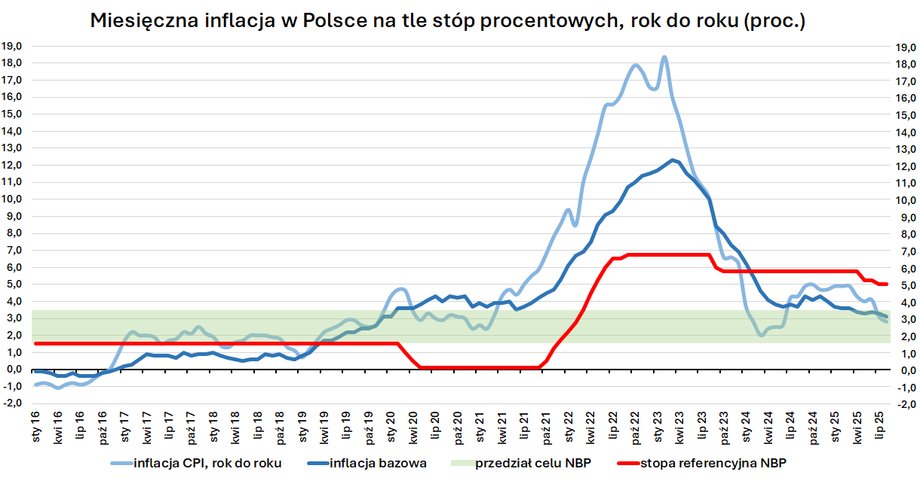
An important factor for the MPC, increasing its tendency to reduces, can be the latest, positive inflation data. On Friday, the Central Statistical Office stated that, according to preliminary calculations, inflation in August fell to 2.8 percent. year on year with 3.1 percent in July. This is slightly less than the analysts assumed (2.9 percent). In relation to July, the average prices of consumer goods and services fell by 0.1 percent. (that is, there was deflation on a monthly basis). According to estimates of analysts, the so -called Basic inflation, i.e. very important for the assessment of inflationary pressure, not taking into account the prices of energy, fuels and food, it could decrease to 3-3.1 percent. year on year with 3.3 percent in July.
According to economists, PKO BP The following months should bring a further decrease in base inflation towards the NBP target, What will be conducive to inhibiting wage growth, which will allow you to decrease in inflation of service prices. In turn, CPI inflation, according to their forecasts, is to remain in the band of permissible deviations from the purpose in the predictable future.
“After a decline in August, inflation is close to the NBP target and safely in the range of permissible deviations from this purpose (2.5 percent +/— 1 percentage point). The decrease in CPI inflation in the summer months and maintaining the downward trend of basic inflation is good news for the MPC, we expect that in conditions of a decrease in inflation around the target and a relatively high nominal reference rate (5 %) in Wednesday will be made to reduce interest rates by 0.25 percentage points ” – economists of ING Bank Śląski wrote.
|
CSO, NBP, own study
PKO BP analysts pointed out that the August inflation data was probably a surprise to the MPC, because Iwona Duda, a member of the council, suggested in an interview with Business Inisider that she had a forecast of 2.9 percent. “The combination of better inflationary data and noticeable braking of wage growth in July prompted us to revise our forecast for the September meeting of the MPC. In our opinion, the Council will decide to reduce by 0.25 percentage points, despite the relatively loose fiscal policy and the lack of regulations regarding energy prices for households” – they added.
Until now, the experts of this bank assumed that in September the MPC will not change their feet and reduce in November on the occasion of the new NBP projection. Credit Agricole analysts had a similar opinion.
Bartosz Sawicki from Exante spoke in a similar tone as economists of PKO BP. “Another decrease in inflation and July data from the labor market – disappointing paying dynamics and surprising decrease in employment – these are the latest macroeconomic arguments for the reduction of the feet at the MPP meeting on September 3” – he wrote in the commentary.
We would like to remind you that the enterprise sector (i.e. in companies employing at least 10 people) the growth rate of average salary in July dropped to 7.6 percent. year to year with 9 percent In June (slowdown was expected, but only up to 8.6 percent). The average employment in this sector in July amounted to 6 million 431.8 thousand. And it was 0.9 percent smaller than a year ago (this means a decrease by 56.8 thousand). Compared to June, employment dropped slightly, by 3.6 thousand.
According to Bank Millennium analysts, Friday's inflation data is a support for cutting feet in September and adapting them to a lower CPI inflation path and base inflation, which for a long time returned to the NBP target range. That is why they maintained their cutting forecast by 0.25 percentage points. in September.
The experts of Bank Pekao pointed out that CPI inflation will remain in the current nearby NBP goal for longer and at the end of 2025 will stay below 3 percent. “It can be said that for a long time we enter the surroundings of low inflation. Moreover, published assumptions of the state budget project at 2026 do not indicate a significant inflationary risk on the part of fiscal policy. It is planned to reduce the deficit from PLN 290 billion to PLN 270 billion, which we interpret as a small fiscal consolidation. It is important because the MPC at the last meetings emphasized the risk of expansive fiscal policy on inflationary perspectives, “they noted. In their opinion, it is enough to convince the MPC to cut the feet on Wednesday by 0.25 percentage point.
The extensive budget hole may be disturbing the MPC
However, there are also doubts about the reduction of the foot. Experts of Bank Pocztowy wrote that although lower inflation readings for August and data from the economy (including from the labor market) justify the reduction of the feet in September, but At the same time, they cannot completely exclude that the state budget project published on Thursday at 2026 will prompt the advice to postpone during this decision. The project assumes that the budget deficit in 2026 will amount to PLN 272 billion (6.5 percent of GDP). For comparison, the new forecast assumes that in 2025 the deficit will be 6.9 percent. GDP (compared to 6.3 percent registered in the last fiscal notification to the European Commission).
Citi Handlowy analysts wrote that, given short -term perspectives, they are less sure about the MPC decision on Wednesday. “Our base scenario still assumes that the council will reduce your feet by 0.25 percentage points, but We currently think that the decision is on the blade of the knife (we previously estimated the likelihood of such a move at about 80 percent)“.
|
CSO, NBP, own study
“The decision is no longer as obvious to us as it seemed to us before reports on the budget. On the one hand, decreasing inflation should lead advice to continue the reduction of the cost of money; on the other handhigh deficit and loose fiscal policy of the state in combination with the impasse on the government-presidential line (lock of tax increases), It can be an impulse to delay the decision to continue cutting your feet. At this moment, we maintain the opinion that the decision to reduce by 0.25 percentage points will be made, but with a significant risk of no change, “said Santander's economists.
Analysts of ING Bank Śląski presented four main factors that the MPC will take into account:
- economic situation
- Labor market condition
- Energy prices
- fiscal situation
They indicated that in most of these areas the situation is developing favorably. “The economic situation is solid, but not so hot enoughto generate additional inflation pressure. He slowed his salary increase in July. Signals about the readiness to extend the freezing of electricity prices for households for the fourth quarter flow from the government and the president. However, the fiscal policy is less favorablewhich is looser in 2025 than earlier announcements (the deficit in 2025 amounted to 6.9 percent of GDP in relation to the planned 6.3 percent), and the budget at 2026 does not bring significant strengthening (6.5 percent of the deficit) ” – added ING experts.
See also: Inflation is close to the target, but something is not enough of the MPP. These will be difficult decisions
It is worth paying attention to the uncertainty factor in the form of freezing energy prices for households for the fourth quarter. It ends with the last day of September and Now, when deciding on the feet, the MPC will take into account the current legal status. President Karol Nawrocki vetoed the “windmill act”, which had an extension of freezing energy prices. And although the government announced a new project in this area, it is not known when, or even whether it will come into force, given the attitude of the President of the Republic of Poland. According to the experts of Bank Pekao, the frostbite of energy prices could conquer inflation by about 0.5 percentage points.
What next? Difficult decisions before the MPC
Citi commercial analysts indicated that the new budget should not significantly change the trajectory of inflation in the coming quarters, and therefore still leaves room for loosening monetary policy. “However, since the presidential election we have been of the opinion that the MPC could decide on a more cautious approach than the investors commonly thought. It seems that the new budget is consistent with it. Our base scenario, which sets up a interest rate of 3.75 percent. by mid -2026, it currently seems relatively optimistic and we see the risk of a higher foot” – they added.
Experts of Bank Millennium also assessed that uncertainty as to further movements is maintained, because the prospect of maintaining loose fiscal policy in conditions of low unemployment and accelerating economic growth prompts you to be cautious in conducting monetary policy. “For this reason, after the possible adjustment of interest rates in September, the MPC will be able to abstain for some time with further foot cuts. More light as to the prospects of interest rates within the average date will undoubtedly be thrown by the new inflation projection of the NBP (published in November) and the opinion of the MPC for the project of next year's budget ” – they added.
According to Bartosz Sawicki, the September rate adjustment should have a scale of 0.25 percentage points, taking into account loose fiscal policy, still high real remuneration dynamics, accelerating the economy and regulatory uncertainty regarding electricity prices. “For similar reasons, you will probably have to wait until November for another reduction, when a new inflation projection is published” – he added.
Forecasts of ING Bank Śląski indicate that inflation will remain near the NBP target in the coming quarters, which is to give the MPC space for further alder policy soothing in 2026. Pekao experts expect that we will also see the cut in the fourth quarter, and the reference rate will decrease at the end of the year to 4.50 percent.
“We expect the president Adam Glapiński will pay attention to slight fiscal strengthening and it will be an argument for cautious monetary policy alleviating in the coming months. In this context, in October we can deal with a pause in foot reductions, and another debate in this matter will take place in November, when the council will familiarize with the new inflation projection ” – wrote the economists of ING Bank Śląski.
Author: Maciej Rudke, Business Insider Polska journalist