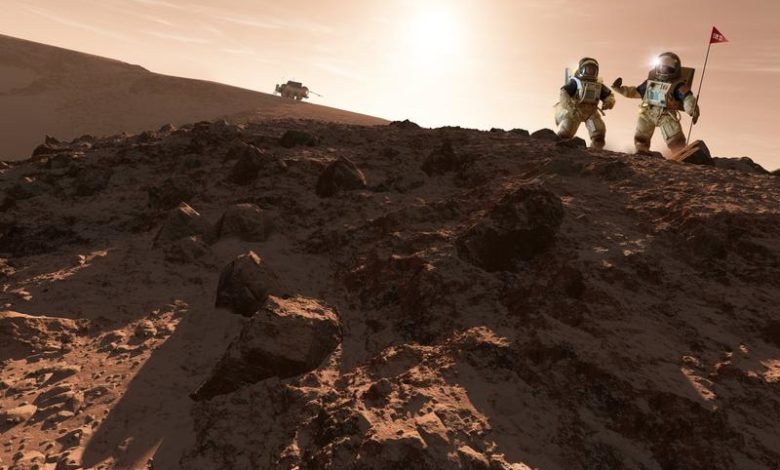
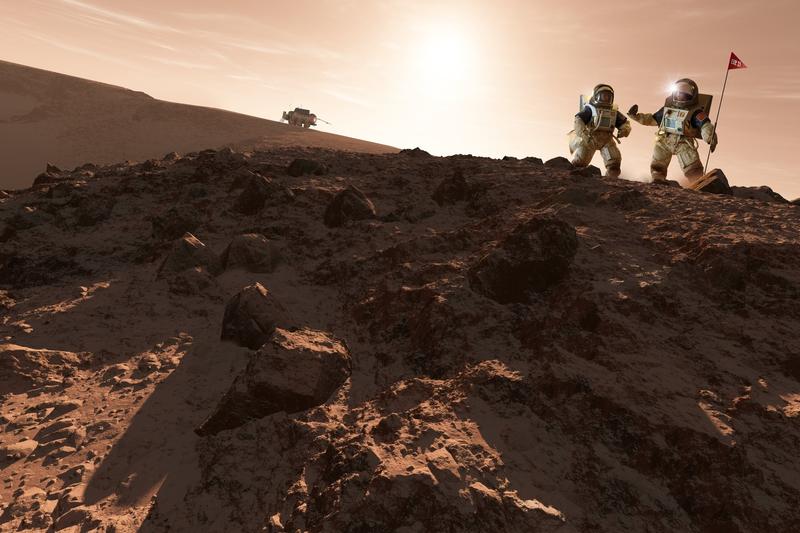
Taikonuţi on the Moon – Photo illustration: Detlev van ravensway / sciencetico / Profimedia
China on Wednesday conducted the first test of a way of aselenization, which he hopes could take the first Taikonauts by the Moon until 2030, the Reuters press agency, which cites the people of the Beijing crew, quotes Thursday.
The descent and ascension systems of the mode of aselenization have gone through a series of exhaustive checks on a test platform in the province of Hubei that was designed to simulate the selenary surface. The surface on which the tests were performed is covered with a special layer that mimics the reflectivity of the selenic soil and is sprinkled with rocks and craters.
“The test involved several operative conditions, it was high and a high level of complexity, thus being an important terminal in the development of the Chinese selenary exploration program with human crew,” according to a statement of the Chinese space exploration program China Manned Space (CMS) posted on his website, Agerpres cities.
The modulus module, known as LANYUE, which means “hugs the moon” in mandarin, will be used to transport astronauts between selenary and orbit soil and is also designed for them, energy source and data center, according to CMS.
China has kept the details about its human crew program secret, but this information about the tests were made public in the context in which the US is trying to stop the rapid progress of the Chinese space program, notes the Reuters Agency.
USA and China, in a new spatial race for the Moon
NASA, through the Artemis program, intends to send astronauts around the month and back in April 2026, a stage followed by a mission of aselenization a year later.
China's without human crew on the Moon for the last five years have allowed the country to become the only nation that has recovered monthly samples on both the close and distant face of the Moon.
These missions have attracted the interest of the European Space Agency, Universities funded by NASA and national space agencies in Pakistan to Thailand.
An aselenization with successful human crew before 2030 would stimulate China's plans to build a “basic module” of the International Monthly Research Station by 2035. This base with human crew, led by China and Russia, would include a nuclear reactor on the surface of the Moon as an energy source.