Ion Iliescu's less known face. One of the most famous historians of Romania for the last century, memories with Iliescu at a Chinese restaurant in Scotland: for three hours I was crazy. I asked him about youth in Moscow

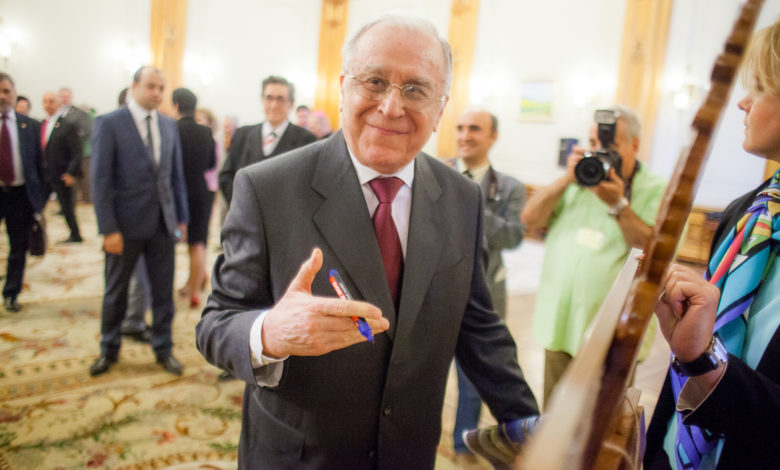
“Ion Iliescu remained for me a consistent, approach and always smile,” writes British historian Dennis Deletant, in a text published on contributors after the former president died on Tuesday, August 5, 2025, at 95.
“On the return from Cluj in October 1988 to Bucharest, my father -in -law, Andrei Caracostea, a professor at the Institute of Construction and Engineering, offered me the unexpected opportunity to meet Ion Iliescu. Iliescu was, at that time, director of the Technical Publishing House, with whom my father -in -law had a contract for the publication of the manual, for the publication, My father -in -law asked me to take the manuscript to the publishing house that was based in the Spark house, built according to the model of the Lomonosov University in Moscow and nicknamed the “wedding cake” because it symbolized Romania's “Union” with the USSR.
I knew the building and, after saying at the reception why I had come, I took the elevator to the office where I had a job. There I shyly knocked on the door and a woman's voice invited me to enter. I explained the reason for my visit, my relationship with Professor Caracostea and I handed his manuscript. “I go to see if the director is in the office. I am sure he would like to thank you.” He knocked on the door and disappeared inside. After a minute, an Iliescu Radios appeared with her, with his outstretched hand to welcome me. “Many thanks that you have brought the manuscript, Professor Caracostea is one of our most valuable authors. But you are in my office, tell me a little about what you are doing.”, Says Dennis Deletant in the text on the contributors.
To a cup of non -zerozol
Ion Iliescu was not a foreign name for the British historian. “Former leader of the party in Iași county, between 1974 and 1979, he had been marginalized by Ceausescu, and in the West there were rumors that he would have enjoyed the sympathy of Mihail Gorbachev, a rumor who gained credibility after the enigmatic call to the reform made by Iliescu in the newspaper Romania, in September 1987. As a coffee replacement, made in the sea and popularly known as Nechezol, I was talking about my academic concerns about Romania and about the first hand that are the daily problems of the citizens Remembering my visit before the Revolution and it was kind to stay with me, asking me about my father -in -law, before an interview he gave to the BBC.
The greatest threat to democracy
The British historian also reminds the moment of the mine of 1990 and then an invitation received from it.
“The biggest threat to fragile democracy and the rule of law in Romania since the Revolution was the use of miners as” shock troops “by the National Salvation Front. The miners from the Jiu Valley made several incursions in the capital, the third being in June 1990, when they were invited by President Ion Iliescu, newly elected by the democratic elections, under the pretext of defending the FSN government. Special trains brought 10,000 miners to Bucharest, armed with wooden sticks and iron bars, at the dawn of June 14. They were joined with companions, later identified, from credible sources, as former security officers. For two days, the miners (helped and encouraged by the Security) terrorized the population of the capital, attacking anyone who resembled an opponent of the regime. The invasion of the miners in Bucharest to which Iliescu resorted to restore their authority significantly weakened both the external image of Romania and its itself.
In July 1990 I received an unexpected invitation from the Presidency, signed by Mr. Iliescu, to participate in Cotroceni with several representatives of the Romanian diaspora at a debate on the image of Romania. The relevance of the questions asked to Iliescu was questionable, especially since the subject of the mining was avoided. A Romanian established in Vienna was crying that he did not find strings there for his violin and asked the president to get some. Iliescu, with a lip suck, replied that he would take the necessary measures. I, together with two Romanians established in Italy, criticized Iliescu's contribution to the mining, reminding him that on June 15 he summoned the miners to a rally, marking their 'victory', to thank them. I added that the invasion of the miners leads us to the tactics used in 1945 by communists in Romania and other parts of Central Europe to undermine democratic order. Mr. Iliescu did not comment. After closing the debate, the Romanian television interviews several participants but bypassed the two Romanians from Italy and me. ”
In the office, at Cotroceni
Another meeting followed with Iliescu, in 1995. “Five years after the Revolution I had the opportunity to meet Mr. Iliescu. I was invited by the BBC television to accompany John Simpson, the chief correspondent for news from abroad, to make a documentary about the evolution of Romania from 1989. Cotroceni, he received me again with a siur and asked me about the mother-in-law and family.
At a Chinese restaurant, in Scotland
Dennis Deletant also invokes another memorable meeting with Ion Iliescu.
“It was a great pleasure for me to meet him in March 1999 at St andrews University in Scotland where I was among those invited by Professor Gavin Bowd at a conference on the topic of France and Romania. President Iliescu addressed the public in plenary and at the end of his presentation many Romanian students asked the” Mysteries ” And on the order, if there were “foreign fighters”, if foreign intelligence agents were involved, by miners). After responding to them, I approached the podium where he spoke and when he saw me, he stretched his arms, closed me and told me, “What good to see a well-known figure, you do not want to have a meal?” And so Professor Bowd invited us to a Chinese restaurant with a French teacher and the president's bodyguard. At the restaurant, Mr. Iliescu insisted on sitting next to him – Professor Bowd, the French teacher, and the bodyguard stayed at the other end of the table – and for three hours I was wandering. I allowed myself to ask the president if he is upset if I ask him to tell me something about his youth, when he studied in Moscow, his career in the party and his relations with Ceausescu. Mr. Iliescu replied that he did not get upset and spoke very openly. It was an extremely interesting and instructive evening for me.
Ion Iliescu remained for me a consistent, approaching and always smiling person. ”
Ion Iliescu died on Tuesday, August 5, at the age of 95.