“There is hell behind our door at night.” Drug problem in Switzerland


In the summer of 2023, Switzerland was in the abyss of the new drug epidemic. Or, as the newspaper “Tages-ansaiger”, “the spectrum has returned”.
In Chur, Zurich, Geneva and Basel, the Crack and Freebase consumption (the names refer to taking cocaine consisting of its smoking – ed.) Led to the creation of an open drug scene.
And where people gathered in groups in public places to take drugs, analogies to PlatzSpitz (the so -called needle park in Zurich, called so colloquially because in the past that in the past he was a place famous all over Europe gathering people addicted to drug addicts – ed.) They were not distant.
“Halo, where are you?”
Now, a year later, the situation seems to calm down. The headlines are less flashy, there is no public turmoil. What happened in the meantime? Anticipating the facts: acquiring cocaine on the street remains a stressful occupation, which can be seen in Kleinbasel.
Telephone booths are no longer repaired when they break. However, many phones are still working. National connections are free. And the cable hangs. The man enters the booth. Knocks the number. Performs a quick connection. Then it disappears.
In Kleinbasel, drug addicts call their dealers, among others. “Hello, where are you now? Stay there, I'm going!”, He is coming out of the booth. Then the woman fits the scooter from the bushes and leaves. A man enters the cabin. Performs a quick phone. Disappears.
A bus stops next to it. Some people get in, others get off. The glass telephone booth stands like a cipher on the side of the road. It's there. And yet invisible.
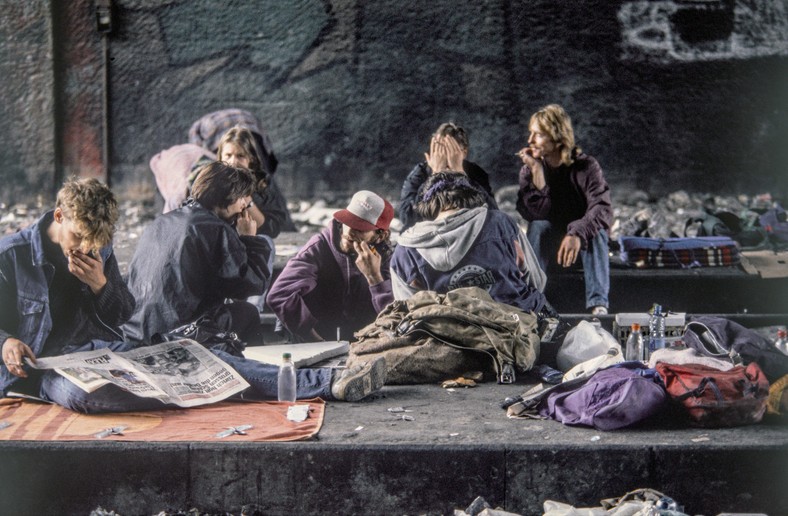
Drug scene at the former Letten railway station in Zurich. At peak moments, over a thousand people abusing drugs were visited by Letten, the successor of the open drug scene in Platzpitz Park, called the “Igieł Park”, Switzerland, August 1994.
Consumer rooms
The area around the K+A contact center (a place where drug addicts can get help) at the other end of the city are also inconspicuous. This is a commercial and industrial area, but there is a main railway station nearby. Experience shows that this is important. If the journey to the center is too difficult, addicts stay away from him.
In Zurich, Geneva, Basel and Olten, consumer rooms (supervised rooms in which addicts can take drugs in hygienic conditions – ed.), Popularly called “Fixerstubs”, have been enlarged or – as in chur – newly opened since last summer. The opening hours have been planned to remove people from the streets.
Horst Buhlmann, head of K+A Dreispitz, is a calm guy. It opens a few drawers, shows syringes, filters and small metal dishes that are freely distributed here, all small elements of damage to reduce damage. Then Buhlmann opens the door to consumer rooms.
Hearing protectors hang on the walls. Some visitors, of whom 80 percent It's men, they put them on to light up alone. The mood and behavior after taking a crack, which becomes clear in four walls of this room, are difficult even for people who take it.
“Each break is valuable”
“In recent years, we have observed a significant increase in smokers,” says Buhlmann. Cocaine, which is cooked with baking soda or ammonia to create small crystals, and then roasted as a crack or freeebase, gets into the lungs.
A change in consumption, which can be observed in all Swiss cities, significantly changes the work of K+A staff. Regular side effects of crack include memory loss, sometimes delusions or paranoia. Then, for example, they are frantically searching pockets in search of more drugs. But there is nothing there.
Consumers are in place. But it is difficult for Buhlmann and his colleagues to reach them. “It requires a lot of patience,” says Buhlmann. Five thin needles in the auricle can also be helpful. The acupuncture method based on the so -called protocol will temporarily reduce the pressure of addiction. The treatment, which is offered in K+A, lasts from 20 to 30 minutes and a small part of the visitors actually uses it. At least, that's what Buhlmann says. “Every break is valuable,” he says.
Collecting syringes, care of hedges
In the summer of 2023, some residents of Kleinbasel felt more and more harassed by loud, sometimes aggressive gatherings of addicts in public places: petitions and round tables were organized. According to the newspaper “Basler Zeitung”, even groups of teenagers arranging with addicts appeared on Matthausplatz. Politicians reacted late. Then, when spring came in many cities, appropriate steps were taken.
The beginning was the expansion of contact centers and help centers. Then more employees appeared. Additional social workers and guards approached the addicts and accompanied them to the doctor if they wished it. Cameras and headlights have been installed on Dreirśosenanlage, Hotspot in Kleinbasel. Municipal sanitary services carefully cultivate shrubs and hedges in parks, and special service, “sprutzewaspi”, removes consumer waste early in the morning.
Every week, the police also carry out large -scale targeted inspections. Only in March and April 1,300 people were inspected and 112 were arrested. The repression intensified. Since then, sellers have become more nervous.
Regine Steinauer, head of the Addiction Department in Basel, presented the activities of Basel during a round table organized by the Federal Public Health Office. Cities, cantons and experts meet regularly to learn from each other. Another periodic report is expected at the end of October.
Peace during the day, hell at night
Kathi Grossenbacher, a resident of Matthausplatz in Kleinbasel, remains skeptical. – It is true that the situation softened during the day. But at night there is still hell behind our door – he says. According to Grossenbacher, it is a coincidence that the drama of last summer did not repeat: – Until early July it rained. Even they (taking drugs) preferred to stay home – he notes. However, when it got warm, the night rest ended again.
In the meantime, some of the residents of the district merged and communicate in a shared chat. If someone calls the police, it will be published there. “The police were alerted”. Thanks to this, not everyone has to call.
Grossenbacher would like to see more support from the authorities at night. “Perhaps the bus where these people could sleep,” he says. Others suggested creating a kind of tolerance zone for dealers on the outskirts of the city.
Exiled from paradise. “I lived here for 20 years”
In conversations with residents and addiction experts, it becomes clear that the drug problem in the district is at the lowest level of precariat. And there, which is also true, The crisis rarely comes alone. Dominique Wick, a mediator from Basel, says: – A shortage of apartments particularly strongly hits people in an adverse social situation. He also notes that the plane of misunderstanding is also this “addicted persons also have the right to use public space. They are part of this society.”
The situation remains unstable and may change quickly when the next hot summer comes.
Cocaine vaccine
Experts in Basel agree: The model of four pillars brings fruit in this crisis. Against the background of the alarming 2023, this is a small success. However, the situation remains unstable and may change quickly when the next hot summer comes. This is another reason why work on new solutions is underway in the background.
The intercity group of experts is currently discussing medically supervised cocaine distribution. In its position, the Swiss Society of Addiction Medicine writes that such a solution would be unique on a global scale and would reduce the pressure on conquering cocaine on the streets. In the meantime, scientists from Brazil are testing a cocaine vaccinereports the German newspaper “Die Zeit”. It should be able to slow down the absorption of the drug into the blood.
Attempts to talk to people affected by addiction remain complicated. “I don't have time,” they repeat over and over in front of the telephone booth in Kleinbasel. There is distrust. Tosca, who's name really is different, stops for a moment and says that little has changed for her since last summer. “For us who we have to beg, every day is the same. The same faces, the same stress.”
Does he think that the state distribution of cocaine could help? Tosca hesitates. “I think so,” he says. “It would give me more time. And goal.”