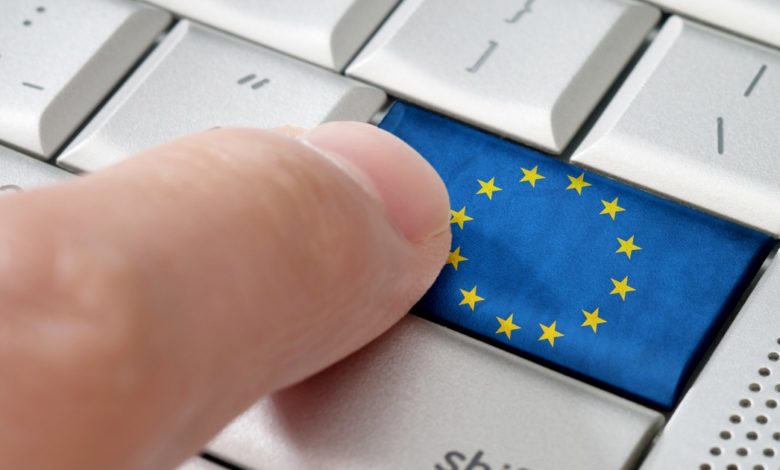
You could have doubts if only a few foreign companies belonged to all European roads, ports or electrical networks. However, for 15 years We just allowed this in our technological infrastructure – In the spine of our economy and democracy.
Currently A handful of American giants controls the systems we rely every day: search, social media, ads and browsers. This is not only online services, it is rails that the European economy moves. And we are not track owners.
Europe, however, begins to wake up. Today in Brussels you can often hear EU officials fashionable slogans such as “technological sovereignty” and “Eurostack” [europejska infrastruktura technologiczna]. An important question is whether the EU leaders will support these words – and whether they have the will to use sufficiently strong drugs for what is wrong with us.
So far the signals are mixed. Last week, the Memorandum from commercial conversations between the USA and the EU leaked, which suggested that European officials may alleviate the enforcement of technology provisions in the hope of lowering customs. If this is true, it would be a serious mistake – strategic and political. New polls show us why.
The recently Yougov survey showed that the vast majority in Germany, France and Spain wants the EU to enforce their digital regulations, even if it upset US President Donald Trump. 63 percent surveyed Germans who had an opinion on this subject, said that The enforcement of technological regulations is actually too mild.
What's more, as much as 74 percent Party members of the chairman of the European Commission Ursula von der Leyen wants a hard position on Big Techów, and the flirt of the billionaire Elon Musk with the extreme right and the threat of cutting off Starlink satellites in Ukraine only tightened these moods. Of course, nobody is pushing into a fight that can be avoided. But as the story shows, Brutals respect strength, not indecision.
Continuation of the material under the video
Some members of the committee may hope that they will be able to manage Trump for a long time to free the European economy with the help of industrial policy. Indeed, the Union must urgently build – both in the member countries and throughout the continent.
But if Europe is serious about regaining control over critical technological infrastructure, we must face the uncomfortable fact: Big Techy tilted the scales for so long in their favor that one policy is probably not enough. Europe now needs a coordinated game: break up, enforce, build.
Time for a technological and economic reset in Europe
First step: break up. This means readiness to dismantle rooted technological monopolies, starting from Google. Although Google sometimes avoids criticism compared to its counterparts, such as X or Meta, It probably has an even greater impact on our economy and society.
Since the technological giant bought DoubleClick in 2008, he has constantly built one of the most powerful digital monopolies in history, and the effects were fatal. With the increase in Google's participation in digital advertising revenues Europe has lost over 30 percent jobs on the media market.Local media weakened, leaving behind “information deserts” – areas where people do not have reliable local information sources.
Realizing this phenomenon has recently been reflected in Germany during the debates regarding digital tax proposals. Wolfram Weimer, a government representative for culture and media, criticized the lasting years “clever tax avoidance” by Big Tech and their “monopoly -like structures”.
However, comparisons are not needed: Google is simply a monopolist. Two American courts have already ruled that he had monopolized search and advertising technologyand an analogous matter in Brussels may end similarly – although the formal decision to break the monopoly seems to be delayed. According to various reports, law enforcement agencies can simply settle for another fine, but this will not improve the market situation. For Google, such fines are like a fine for monopolizing a sector worth tens of billions.
Tada images / shutterstock
Google's office. Illustrative photo
Next step: enforce. Thanks to the act about digital markets (DMA), Europe already has tools in hand that can help in scaling and developing technology. EU startup associations and the main German technology companies – and even the famous American company investing in startups, y Combinator – everyone insists that if it is implemented, DMA can be the best hope for innovators. However, from the Apple tax forced by the App Store to Apple, and ending with the so -called mechanism Pay or ok The finish line that charges Facebook users with fees so that they are not spy, American monopolists show the figs of the law.
The 80-person team responsible for DMA is hardly keeping up with changes. And no wonder: Brussels authorities have twice as many employees dealing only with the enforcement of parking regulations. The economic fulfillment of DMA will only be possible thanks to further strengthening, not weakening. The commission must abandon the illusion that the monoples will adapt with the continuation of the dialogue.
Finally: build. Europe has talents and know-how to regain today's technological infrastructure. Projects for the construction of common services in the field of social media and search are already being implemented, which They will soon allow creative European companies to appear for a fraction of costs. This new infrastructure will not forever need public subsidies – but it can certainly benefit from larger investments.
Strengthening this new infrastructure, also with the help of funds redirected from giants, would not only liberate the media from the yoke of technological monopolists. It would also help to reach clients and recipients everyone else, from shopkeepers to artists, depending on the platforms, which they do not control or they do not trust.
Having courage and farsightedness to use this moment, European leaders can gain unused political potential. Recent comments of Henna Virkkunen, a technology commissioner in which she stated that the EU set of technological provisions is not negotiable, are promising, but must be supported by activities.
Enforcing EU law, recovering the profits due to the monopole, breaking them to frostbt markets and using income to invest in your own digital infrastructure can be exactly this type economic reset that Europe needs.
I’m Ashley Davis as an editor, I’m committed to upholding the highest standards of integrity and accuracy in every piece we publish. My work is driven by curiosity, a passion for truth, and a belief that journalism plays a crucial role in shaping public discourse. I strive to tell stories that not only inform but also inspire action and conversation.