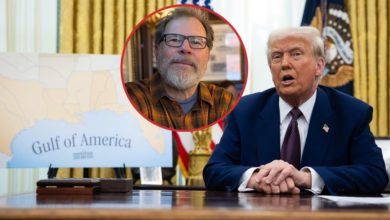
Trump turns commercial negotiations into a list of wishes for foreign policy – political analysis


Under the umbrella of the commercial discussions, the Trump administration presses allies for deep reforms: from defense budgets and digital taxes, to the regulation of Tech giants and fire termination agreements, writes politico.eu.

President Donald Trump uses tariffs as league in commercial/photo negotiations: EPA/EFE
It's no longer just about trade. Since April, when US President Donald Trump has imposed generalized rates for almost all commercial partners, the commercial negotiation agenda has become a mixture of diplomatic claims, economic pressures and strategic conditions.
Behind the closed doors, the sending of the White House raised the stake: requirements for increasing defense budgets, the cancellation of national laws that would disadvantage American companies, but also promises of peace – conditioned by increasing US imports. The temporary agreement between Israel and Iran, for example, is already invoked as a exchange currency in discussions with Beijing, to which Trump asked to buy more US oil.
It is an approach that redefines the idea of commercial tariff: not only economic lever, but a tool for remodeling the international order.
“Access to the American market should cost. If we tie the foreign fare policy, it is absolutely logical”said Steve Cortes, former advisor to Trump. “It is no longer America. It is a new one, and we do the rules.”
Who does not accept, risks punitive rates
Whoever accepts, discovers that this does not guarantee the lifting of restrictions. Canada, for example, was suddenly excluded from negotiations last week, after not renouncing the digital tax for American Tech giants. Trump described her as “a direct and flagrant attack on our country.”
The negotiations are made difficult by this approach “everything on the table” that disorient the world leaders. In the absence of clear rules, the trading partners oscillate between frustration, resistance and attempted adaptation. An Asian official, under anonymity, admits: “It is not clear. But Trump does not show that he would give back.”
For the White House, however, it is precisely the unprecedented character of the approach justifies its amplitude.
“We reset a decades -old quo status in which the US was essentially exploited – in trade, defense, security“, Says an American official, also under the protection of anonymity.” You cannot separate these things. They are linked to each other. “
An illustrative example: at the NATO summit in the Netherlands, Trump threatened Spain with new rates because of its refusal to increase its military expenses. Although Spain cannot negotiate individual commercial agreements – being part of the European Union – the political message has been transmitted.
Similar pressures are also done on Japan and South Korea, despite the fact that they are not NATO members. Target: 5% of GDP for defense – more than its own American effort, which is about 3.4%.
In parallel, Washington asks Seoul to abandon an antitrust bill that does not agree to Google, Apple and Meta. And Europeans, in turn, are pressed to give up the digital tax, despite internal legislation and public resistance.
Peace negotiations against imports
Trump goes on: it suggests that mediation between India and Pakistan, or between Israel and Iran, can be monetized by … American exports. China, for example, should buy more oil in gratitude for the role of Washington in the Middle East agreement.
It is a strategy tested from the first term, when it has imposed tariffs on China in the name of intellectual property protection and Mexico to stop Central American migration.
Currently, the rates also target the crisis of opioids (fentanel) or the Maduro regime in Venezuela. Any opposition is greeted with explicit threats: rates high enough to equate to a de facto embargo.
“The tariff is negotiating lever. And trade is just a component of the relationship”, Said a former official from the White House.
But even those who give in do not necessarily receive what they were promised. President Macron, for example, asked to raise EU tariffs after NATO's states have accepted the increase of military budgets. Answer: silence.
Heavy negotiations, reluctant partners
Over 60 commercial partners are involved in discussions with the US. But the format imposed by Trump – complex, unilateral, often opaque – makes them difficult to support internally. European officials warn that an agreement perceived as an unbalance is likely to collapse politically before being implemented.
“If the agreements are too unbalanced, they will be rejected by public opinion”says a European negotiator.
Even where concessions were made-as in the framework agreement proposed to the United Kingdom-remains a 10%basic tariff, which has aroused negative reactions from other EU Member States.
Despite the dissatisfaction, former American officials see no real intention to change direction.
“There are no signs that the administration will give up this approach”Says Patrick Childress, former legal advisor to the US commercial representative.