
The “reform without austerity” desired by unions, explained by an economist: “You cannot heal from alcoholism by continuing to drink”

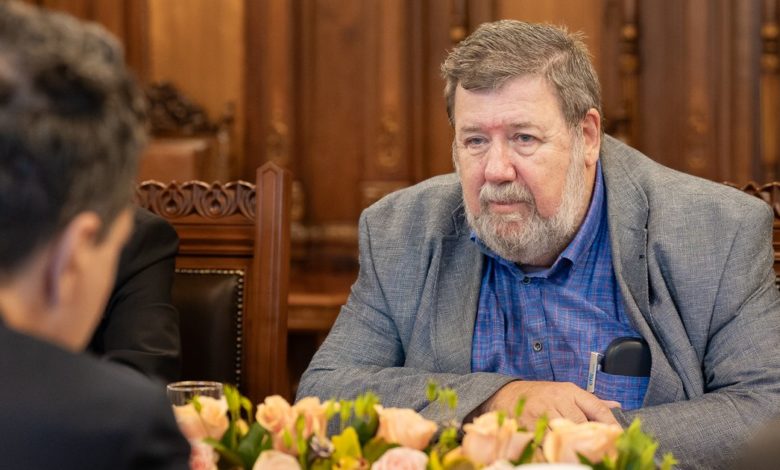
Economist Radu Nechita, professor at UBB, explains why economic reform cannot be made without austerity measures, as the trade unionists demand. As much as it occurred in this country, the state imposed several taxes and spent even more money, he explains.
The leader of Cartel Alfa, Bogdan Hossu does not agree with the austerity measures. Photo: Inquam Photos
“The austerity measures are unacceptable. We do not want to cut bonuses and salaries” – The leader of Cartel Alfa, Bogdan Hossu, reported on Monday, during the meeting with President Nicușor Dan.
At the beginning of the discussions, Hossu expressed a firm view regarding the austerity measures conveyed in the media.
“From our point of view, the Alfa cartel, but I think that my colleagues also agree, the austerity measures that have been conveyed through the media are unacceptable and we do not agree with a heizry system to cut increases and salaries, which would lead to a fall of purchasing power, which is so eroded by the inflation“Said Bogdan Hossu.
“Adevărul” discussed with the economist Radu Nechita, a professor at Babeș-Bolyai University (UBB), about how realistic such a scenario of economic reforms without adopting austerity measures.
“As much as it occurred in this country, the state imposed more and more taxes.”
How do you comment on these statements of union leaders, who will reform, but without austerity?
I just find that unions are much more active when PSD is not in government and enters a kind of semi-adormation when PSD is in government. I also find that they are the same characters for decades, they are the same characters who are always on the buttons.
The trade union movement in Romania went less on the idea of economic growth and rather on preserving the privileges of those who were around, on the lead.
We know the permeability between the trade union movement and the political parties. I don't even have to beat my head very much to remember the trade union leaders who have entered politics. It does not seem to me that the trade union move always fulfills and exclusively fulfills the role of protecting the interests of the employees towards the abuses of the private employer.
Here you must see a little kind of interests. Because at some point a conflict of interest appears. You cannot come and say that you defend the interests of all employees, given that the state sector has a certain job safety and the average salary is higher in the state than in private; In addition, the private sector is the one who is a net contributor to the state budget, so I cannot say that there is a monolithic unit of the interests of the employees.
There are conflicts of interests there and if we look at where the bulk of the union members comes from, we will see that they are from the public sector. Once we understand this, we understand very well the position of this story of austerity.
“The public spends were higher than the budget revenues, by construction, systematically, year by year, always”
Let's go back to the speech on arguments ….
We take it with the beginning. Let's get into this logic of unions: let's do the reform, but without austerity. I ask: Why do we have to make a reform? Since the unions accept the idea that reform should be made, it means that the current situation is not good. Let's understand what happened. I made the diagnosis on other occasions, I repeat it: the state spent more, the public expenses increased and were always higher than the budget revenues, which in turn increased.
So those who say that Romania has no budget revenues and that the state has no money, do not say a truth. The public expenses, currently expressed in euros, in 2024, were at the level of the GDP in 2014. Here, in 2024, the Romanian state spent 100% from a earlier GDP. What do I mean with that? I mean, no matter how much it has occurred in this country, the state has imposed more and more and more taxes.
Romania did not double its surface, the number of hospitals did not double, the population was not doubled and somehow it is spent much more than in the past.
So, the public spends were higher than the budgetary revenues, by construction, systematically, year by year, always.
And I do not discuss the fact that the budget revenues have always been over -stated to allow some oversized public expenses. That this was the mechanism. We were selling the skin of the bear in the woods, it was said that we will have not know what economic growth, so we will have higher budgetary revenues. Therefore, I could spend more than last year, and more than budget revenues.
We did not have a budget balance in these 30 years. And there are some great economists connected to the power circles of this country that say that this would be a normal situation, which justifies this approach to chaining and succeeding the deficits without any weather, without any restraint.
“We can understand that the Finns, the Swedes or the Danes, want to pay higher taxes.”
What was the result of this growth policy ascertaining the state spending?
An increase in public debt. The public expenses increased, they were always higher than the income. So the public debt also increased. Budget revenues increased as the economy was growing. And maybe a little faster. There were years when they grew faster.
This idea of budgetary revenues bothers me. The only person who can say that this is budgetary revenues is the Minister of Economy. We, all the others, should use another expression, which designates this report, namely the tax burden. The fiscal burden, that is, the totality of the compulsory lens from the GDP produced in the respective country. It is a fiscal burden, not budgetary revenues.
We spend more than people want to finance, because people do not want to finance these things. We can understand that the Finns, the Swedes or the Danes want to pay higher taxes, in the idea that they receive some higher quality public services. We are not there. The politicians in Romania want to pay and not ask what happens to the money. When the services are of poor quality, not even at the level of the money we pay, we are told: “but you did not pay enough, you pay.” It's like you go to the store, you took bread, it's a loud and moldy bread, and the explanation would be: “Well, you didn't pay enough, it pays another 10 lei and I can give you another.” And after that, the year I give you all the moldy bread. Exactly as our politicians do.
The need for reform found by unions or accepted by unions comes from, first and foremost, the fiscal incontinence of the Romanian state and the legislative incontinence of the Romanian state. Too many laws are voted, the laws from today are changing tomorrow, the taxation from today is changed and they are spent in ignorance, without all those public expenses being decent, decently, responsibly.
The state budget was used as an election campaign budget for the parties that were in power. I did not hear someone in opposition to say: “the growth of the spends must be stopped ”. I understood that they were not in power, gold and others, but none opposed the front and vocal to grow public spends and chaos in public finances.
Each one said, “To increase, but to give us.” How many politicians said the 3-4,000 state companies should be privatized? I didn't hear anyone. So we have this situation.
“The trade unionists who represent the private ones can ask without austerity”
What do we do then with austerity? Can we even without austerity?
Without austerity it has been so far. I explained before that the “without austerity” policy brought us to today's situation where even the unions understood that they must be reform. Austerity means to restrict your width with which you spend. That means austerity. Go through a period when you consume less.
The unions understood only half the story, they understood that reform is needed, they understood that the situation is serious since accepting reform, but we go and do the same. They want to do exactly the same as before. What does “without austerity” mean?
So basically, it is a contradiction in terms …
They want triangular circles or round triangles. You cannot solve the turmoil in which you arrived doing the same things, the same mistakes that brought you to this mess. You can't heal from alcoholism by continuing to drink.
There are practically two levels: the trade unionists who represent the employees of the state, respectively those represent those in the private environment. Can those in the private environment ask without austerity?
Well let's see if it really represents them. On many things write something, but in fact there are something else. Ideally, yes, they should represent the private ones. Or if they represented them, they would oppose the policies to harass the capital.
This approach is pleadable, in which the trade unionists represent the deprived to ask without austerity, because in the end, and during the pandemic period, the adjustments and the difficult ones were taken by pressing the private sector. Because I do not know how to have been kicked out of customs or by education or by areas where it was not working as much as before, that it was quarantine. No one was put on technical unemployment. The whole state sector took its full salary. They have still received the screen or antenna or something else, some of them.
And be careful, and there in the state, there are differences: to talk about education, some of us have kept our hours, all hours, and we saw this at the teachers and teachers of my children, and we also talked with other friends, some held their hours, including the sports teacher and each in the room. So there are some in education who did their duty, and for those it was a wonderful opportunity to get free. I know cases in which throughout the quarter, some have not been able to enter online and do anything, not even symbolic.
So things are very, very nuanced. That is, I would not want to make a kind of civil, budgetary war, against the private sector.
Then how do we divide austerity?
Well, the austerity will be done by reducing the non-unnecessary components of the state.


