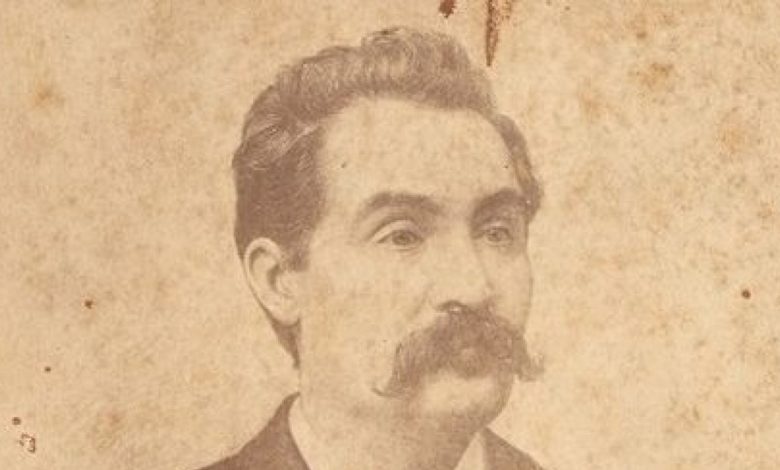
On June 15, 1889, 136 years ago, Mihai Eminescu mysteriously died, at only 39 years old, in a Sanatorium of Mental Diseases in Bucharest. Almost a century after the poet's death came to the conclusion that he was poisoned with mercury. Some suspect a political murder.
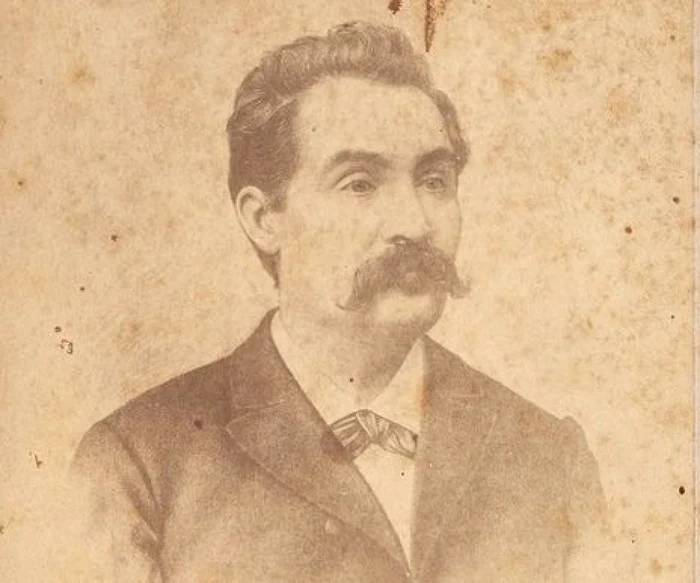
The last photo of Eminescu taken by Jean Bieig in Botosani in 1887
136 years ago, on June 15, 1889 in the Sanatorium of Mental Diseases of Dr. Șuțu, located on Plants street, in Bucharest, at 4.00 in the morning, the poet and journalist Mihai Eminescu was extinguished. He was only 39 years old. His last wish was just a glass of milk and a corner of paper to write his latest lyrics: “Until I die/go angel/At my sad complaint/full of love/Isn't it a sin?.
Although commemorated for over a century and studied in detail by specialists from different fields, Eminescu's death remains a mystery of history. Why did Mihai Eminescu die at the age of 39? It is a question that there are many answers, but few certainties.
Official version: syphilis, erysipelas and crazy plank
The mystery of the cause of Eminescu's death begins the next day after death. On June 16, the doctors Șuțu and Petrescu prepared the legal documentation for finding the death, but also an official report. Peak, a clear diagnosis is missing. Only symptoms of a psychic disorder are reported, to which the poet would have suffered, but without worrying somatic disorders. I mean, Eminescu had a troubled mind, but physically he was a healthy cannon. Things become even more bizarre when in Eminescu's brain is damaged, impossible to study at autopsy. “Unfortunately, I could not give you a lot of information about the brain of the great and unhappy poet Eminescu. The brain was brought from the Şuţu Institute in a state of decomposition that did not allow a fine study of the circumvolution structure.”said the doctor Marinescu from the Babeș Laboratory.
The brain would have been forgotten on the window open by a negligent assistant. There was an official version regarding the possible cause of Eminescu's death. The great poet would have been hit in the head with a plank by another patient of the “Carity” Sanatorium, a certain Petre Poenaru. The circumstances are not known exactly. Two days after the incident the poet died. The doctor came, who also took care of Eminescu, argued that the death occurred from the infection to the head. More precisely, the wound caused to Eminescu by Petre Poenaru, a 2 -centimeter cut in the scalp, has been infected. Made an erysipel (an acute infection with group-hemolytic streptococci A). In addition, Eminescu would have had older endocarditis (an endocard infection, tissue that captures the inner surface of the heart, which may be fatal).
“As seen from the above, Eminescu's death is not due to the cranial trauma and which had completely healed, but it is the consequence of an older endocarditis (diagnosed by the late professor N.Tomescu, primary physician of the Internal Disease Service from the Children's Hospital, who was also a doctor of the Institute) of which he was threatened in every moment and who was threatened in every moment and which was threatened in every moment andwrote in his report the doctor, the report quoted by Nicolae Georgescu in his work “Eminescu late”. Other doctors, such as Julian Bogdan, in 1886, made Eminescu the diagnosis of mental alienation caused by syphilitic gome, exacerbated by excessive alcohol consumption. The diagnosis is taken over by other doctors.
Eminescu, poisoned with mercury. The most famous Romanian victim of malpraxis
For a long time, the cause of Eminescu's death remained a mystery. Some believed him syphilitically, others that he died from the plank (after others the stone) received in the head of Petre Poenaru. After more than a century since his death, modern specialists investigated the symptoms, but also the reports that described Eminescu's condition. A shocking conclusion was reached: Eminescu was the victim of a malpraxis. That is, he was wrongly diagnosed with syphilis and “treated” with mercury.
That is, systematically poisoned with a substance that the countries of the European West had given up precisely because it was inefficient and extremely toxic. In Romania, mercury (especially mercury rubs) were still used as treatment of syphilis. Eminescu was diagnosed with syphilis in 1886 by Dr. Julian Bogdan from Iași, being considered syphilitic, paralytic and on the verge of dementia due to alcohol abuse and syphilitic gums. For his part, the doctor Panait Zosin gives him the same diagnosis.
A doctor from Botosani, Itszak, continues Mercury treatment. As well as Dr. Șuțu at his sanatorium. It is said that in Bucharest, Eminescu would have been injected with Mercury. Contemporary specialists say, however, that the diagnosis was completely wrong. Eminescu was not suffering from syphilis. And the “treatment” was a real catastrophe. In 2014, during a scientific session, a meeting to discuss the cause of Eminescu's death, professor Irinel Popescu, a correspondent member of the Romanian Academy and president of the Romanian Medical Sciences Academy said that the great poet was killed due to mercury poisoning, following an wrong diagnosis. So, the cause of Eminescu's death was a cardio-respiratory stop caused by repeated mercury poisoning.
“Between February – June 1889, Mihai Eminescu was administered intravenously mercury chloride at the Şuţu Institute and, probably, this was the cause of the cardiac arrest, which caused him death.”stated Professor Irinel Popescu. The opinion of Professor Irinel Popescu is also shared by another specialist, the doctor Raul Neghina from the Parasitology Department of the “Victor Babeş” University of Medicine and Pharmacy in Timisoara. For his part, neuropathologist Ovidiu Vuia, who carefully studied the observation sheets, symptoms and all medical-legal reports in Eminescu's case, was convinced that Eminescu had no syphilis.
“My conclusions as a neuropsychiatrist, scientific researcher, author of over one hundred works in the field of brain pathology, are as clear as possible: Eminescu did not suffer from Loes (syphilis) and had no paralytic dementia.”said Ovidiu Vuia in a specialized article published in New York in 1987 and resumed in his work “About the disease and death of Mihai Eminescu”.
Eminescu and the disease that grinded it
Eminescu, however, suffered from a mental illness. But in no case fatal. It was about bipolar disorder. Since 1883, Eminescu began to have a bizarre behavior, noted by the close ones. Alternate between depression and anger, with exuberant and inadequate behavior (especially for those times). The mental state would have been aggravated by excessive smoking, high coffee consumption, but also abuse of alcoholic beverages. For three years, until 1886, Mihai Eminescu was correctly diagnosed in Austria and Italy, with bipolar syndrome, without mentioning syphilis. He was treated for that affection. Indeed, the Austrian and Italian doctors put him on their feet as the writer Ioan Slavici confessed. Returning to the country, Eminescu suffers a nervous fall and begins the monk of the wrong diagnoses and fatal injections with mercury.
“For Eminescu's bipolar syndrome there are direct evidence (Şuţu's reports on behavioral disorders, the opinion of the renowned psychiatrist Eliot Slater – the author of the famous clinical treaty Psychiatry, who received from Dr. Nica the file with Eminescu's disease and concluded, without any reserve, that it is a maniac) Indirect, among which the opinion of some renowned psychiatrists that affective pathology dominates to writers with mental problems, and artistic creativity can be associated with bipolarity “states the specialist in psychiatry Dan Prelipceanu at the 2014 communications session, on Eminescu's disease and death.
The bipolar syndrome was to blame for the development of personal disappointments, but especially the exhausting and stressful work from the newspaper “Timpul”. “Before making the crisis, tired and depressed, it has phenomena caused by sustained and hard work at” Timpul “, so they cannot be qualified as pathological. Near the maturity of the psychosis has presented serious symptoms, but all of a affective and without paralytic stigmates.”said Ovidiu Vuia.
A possible assassinated?
Especially since the mid -20th century, the assassination hypothesis was issued in the case of Eminescu's death. It all started from some reports indicating that Eminescu was in the records of the Austrian secret services, but also from the activity considered subversive of Eminescu who would have disturbed the diplomatic interests of Romania. The poet was a talented and very incisive journalist. Especially in the pages of the Conservative newspaper “Timpul”, Eminescu amazed through his sharp articles and which were not infrequently to overthrow the government. Eminescu instigated the revolt and almost demanded the abdication of King Carol I, criticizing him for the proximity to Germany and Austro-Hungary.
And this is because Eminescu dreamed of the Union of Transylvania, but also of Bukovina with Romania. The articles in the newspaper disturbed. But not as much as the agitation that Eminescu had made in Transylvania and Bucovina. Few know that through the “Carpathian Society”, Eminescu was preparing a revolt of the Transylvanians and Bucovinians against the Austro-Hungarian Empire, and then the union of all Romanian provinces in a state called Dacia. “The Carpathian Society had as a target the restoration of Dacia Great, a project that foreshadows Romania from 1918. And Eminescu was a central personality of the Carpathian society, the main voice for Transylvania, as N. Georgescu is expressed, as for Bucovina or Banat and Bessarabia“, Stated Theodor Codreanu in his work” Eminescu-Drama of sacrifice “.
The agitation caused by Eminescu, through the student organizations, led to an incredible diplomatic scandal. On June 28, 1883, the Austro-Hungarian Empire broke the diplomatic relations with Romania, and the Prussian Chancellor Otto von Bismarck threatened Romania. And all this, the Austrians said, because of the irredentist and provocative actions of a Romanian secret society called “Carpathians”. The King and Romanian officials generally wanted to maintain a good relationship with the Austro-Hungarian Empire, but especially with Germany. So the “Carpathian” company was removed outside the law. From that moment, the Austrians would have begun the spinning of Eminescu.
“Simultaneously, Eminescu was supervised by the Austro-Hungarian secret services. In 1987, MN Rusu pointed out that Eminescu was pursued by the Viennese Secret Services. Baron von Mayr, Ambassador of Austro-Hungary in Bucharest, had charged F. Lachman in this regard.”wrote Theodor Cordreanu in his work “Eminescu-Drama of sacrifice”. In turn, Baron von Mayr reported from Bucharest.
“Eminescu, the main editor at time, made the proposal that the Transylvanian students of Romanian nationality, who attend the educational institutions in Romania to train themselves, to be able to act during the holiday in their native places to orient the public opinion in the direction” Dacia. “ It is shown in the report of Baron von Mayr. It is assumed that after an article by which the Minister of Justice George Duna Vernescu disfigured the fate of Eminescu. The theory of murder is not generally accepted, however. The most plausible variant is considered to be mercury intoxication.