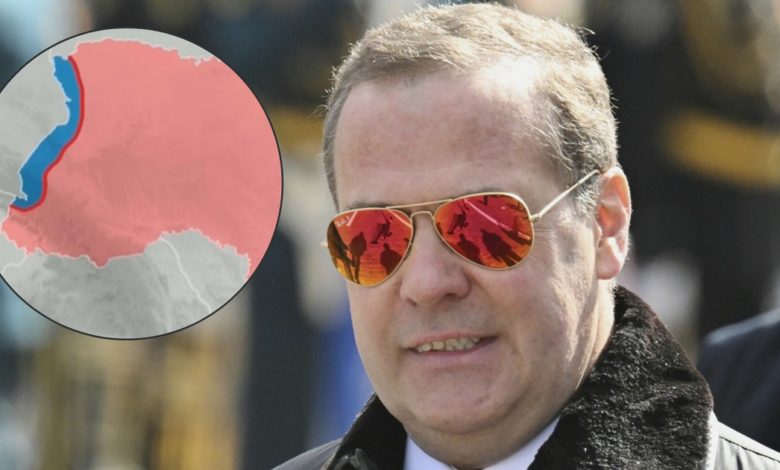
Dmitry Medvedev, former President of Russia and the current deputy head of the Russian Security Council, proposed to create a huge “buffer zone” in Ukraine. Its goal would be to protect Russian cities from Western weapon systems.
“If military assistance for the Banderian regime is continued, the buffer zone may look like this,” wrote Medvedev on Sunday on his channel on Telegram.
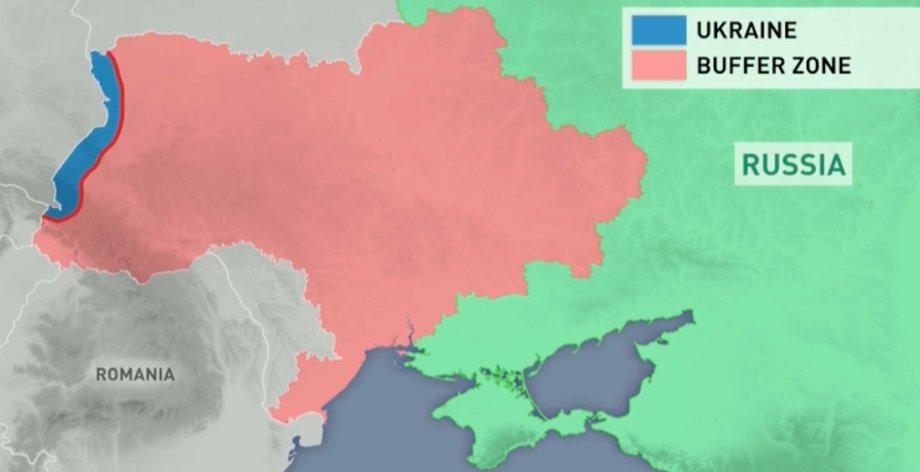
Medvedev's proposal would be based on Russia's occupation of almost all of Ukraine.
|
Dmitry Medvedev
The entry was joined by a map on which almost the entire territory of Ukraine, outside the narrow belt at the border with Poland, was marked as a potential “security zone”.
In a separate entry, published on May 18, the former president explained that the goal is to protect Russian Belgoród from Western weapons, such as British-French maneuvering missiles, Storm Shadow. The standard range of these rockets is about 250 km, but, according to Medvedev, according to some analytical centers they can offend goals even from a distance of 550 km.
“In other words, Russia must be present there: 550 km plus another 70-100 km of supply,” he explained.
Almost a century of offensive
Analysts from the American Institute of War Research (ISW) calculated that the implementation of Medvedev's plan would mean the need to take 587 thousand. 459 sq km of Ukrainian territory.
“Russian forces moved in Ukraine and Russia by an average of 14.3 km km per day between January 1 and May 24, 2025.” – we read in the latest ISW analysis.
At this rate, the implementation of the plan would take about 91 years. For comparison: in March this year Russia captured about 142 km of Ukraine's territory. According to other estimates, it could have been 203 km km.
“At this pace of Russian forces, it would be needed around 3.9 years to occupy the remaining part of Donetsk, Lugansk, Zaporoski and Kherson's districts,” add analysts. It is these regions that constitute the main line of the front in the east and south of Ukraine.
ISW estimates that the Russian army loses an average of 1,500 soldiers a day, killed or wounded. Maintaining such a pace, an attempt to take the rest of Ukraine would cost about 50 million people, or almost one -third of Russia.
Experts emphasize that their estimates do not take into account the natural field obstacles and existing defense lines. One of the biggest barriers would be to cross the Dnieper River, which remains a serious challenge for the Russian forces.
Russia has already used the idea of ”buffer zones”, including In the Kharkiv region, where Moscow tried to create a protective belt against Ukrainian fire aimed at Belgorod. Since spring last year, Russia has been maintaining small abutments in the region.
In recent weeks, Vladimir Putin has suggested creating a similar zone at the border with the Ukrainian Sumski District. The goal would be to protect the Russian Kursk, which last year was the object of a Ukrainian attack from the Sumsky region. Currently, however, Kiev's forces have been largely displaced there.
Russia presents such demands in the context of ongoing diplomatic conversations, which are involved, among others former US president Donald Trump. Moscow is demanding the recognition of the occupied areas since 2014 and the transfer of more areas that Ukraine has managed to defend.
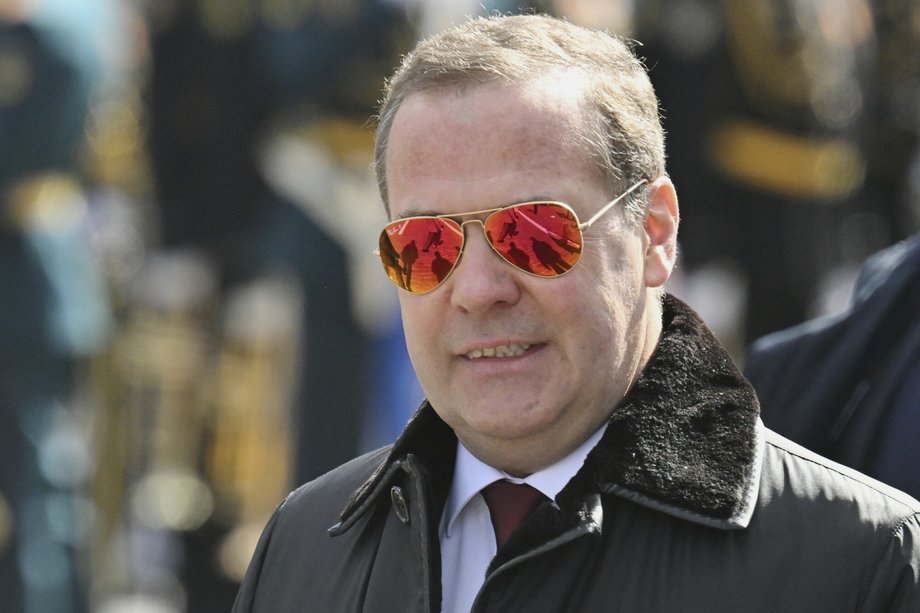
Dmitry Medvedev, one of the most famous Russian war hawks, in the photo during the parade on the occasion of victory day in 2025.
|
Ilya Pitalev/Associated Press/East News/East News
Dmitry Medvedev was the president of Russia in the years 2008–2012, and then the prime minister until 2020. Over time, he became one of the most radical voices of the Kremlin establishment.
The article is a translation with American Business Insider edition.