What a “ancestor of Europeans” really looked. The mystery of prehistoric people born on the territory of Romania today


By modern methods, the specialists managed to reconstruct the face of the oldest hunter in the North-Pontic steppes. It comes from a mysterious community in Ukraine today, in which individuals who came from the territory of current Romania were discovered.
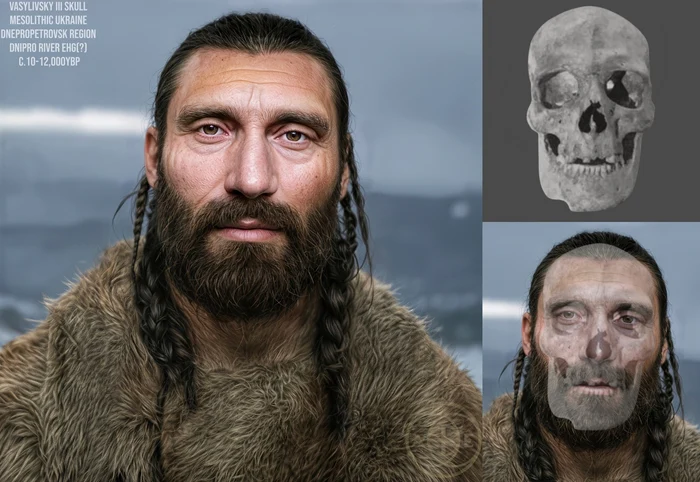
Mesolithic hunting from Vasilyvka-Ukraine photo ancient log/facebook
Old history is a puzzle with many strangers. For example, many wonder what the ancestors of the people who lived on the territory of today's European countries look, what they were dealing with, what they believed, what their lifestyle was. Archeology manages to partially answer a number of questions. As well as the subsequent studies of scientists. For a long time, the face of these ancestors of today's Europeans remained unknown. In the last decades, due to the technology and the advance of the research methods, incredible progress has taken place. The face and origin of some people who lived 10,000 or 12,000 years ago are beginning to come to light. The skulls discovered with the help of the interdisciplinary teams of specialists are transformed by digital technology and artificial intelligence in faces, with facial expressions and unexpected details. This is also the case of a man who has now lived 10,000 on the banks of the Dnieper, the famous river that crosses the territory of Ukraine today. Genetic studies show that it was part of a community that hides many mysteries, including the fact that among its members were some individuals who were originally from today's territory.
The Vasylivka hunter and the connection with the “parents” of Europeans
In 1953, near the Ukrainian town Vasylivka, Soviet archaeologists discovered, on the banks of the Dnieper, the traces of a prehistoric community. It was about inhabitants of the North-Pontic steppes of 12,000-10,000 years ago. There were tribes of hunters-cups of the Mesolithic era, the one that made the transition to Neolithic and the social, cultural and economic revolution, which will lead to the emergence of the great agrarian civilizations in Europe.
The first discoveries took place on the banks of the Dnieper, to save what was left of the sites destroyed during the war. A team of archaeologists from the Kiev Institute managed to recover a series of artifacts and made the discoveries from Vasylivka. It was about a series of tombs of these North-Pontic hunters tribes. Among the osteological remains was found the skull of a man, a discovery that proved crucial for understanding the formation of later European peoples.
“The robust characteristics of the skull and its morphology suggest links with the EHG genetic cluster, which has played a crucial role in modeling the genomic landscape of prehistoric Europe. Either through direct ascendation or through mixture, these populations have contributed to subsequent groups such as Yamnaa Cultures and the Ceramic Ceramics, making the Valeta the roots of the Indo-European expansion ”shows the specialists from Ancient Log. The more recent research, carried out with the help of technology, managed to reconstruct the age, but also the physiognomy of this 12,000 -year -old hunter and to present to mankind one of the possible “parents” of later Europeans.
“Dustled near the Nipru river, in the Dnepropetrovsk region of Ukraine, the skull of Vasylivka III is a rare and remarkable window to the populations of Eastern Hunters-Curse. North-Pontic, during the transition period after the last glacial era ”adds the ones from Ancient Log. The reconstruction of the face, with the help of technology, presents us a man with harsh features, but very similar to those of today's people.
Individuals born on the territory of Romania today, precisely on the banks of the Dnieper
Research in the area, started in 1953, was continued until 1990, with many interruptions and incidents. First of all, due to the difficult conditions and the stratigraphic disturbances, very few artifacts have been recovered. Many osteological debris from men, women and children were found. Some were buried in a chirped position, others in the supine position, which shows that they came from different groups, as tradition, culture and perhaps genetic component. They lived from fishing, hunting and harvesting, consuming much more cereals than other European mesolithic populations and probably lived in a system of clans and tribes on the banks of the Dnieper. They were semi-sedentary.
“The presence of the thresholds and rock chains in the Dnieper area facilitated the creation of traps for the specified seasonal fishing. Their construction, as well as the control of the most productive parts of the valley, required a collective effort, the consolidation of the communities and the reduction of their mobility during the annual economic cycle. The availability of landscapes of different types within the region – the forests of the Rigole and the River Valley, as well as the steppes on the river basin plateau, made it possible to carry out an economy with more resources without long distances. section of the valley ”says specialist Dmyro Haskevych, in a specialized article on Research Gate.
Interestingly, in the graves of this community, individuals have been found in the tombs of this community who, say the specialists, were originally from today's territory. That is, from the area of iron gates. An indication was also represented by the specific pendants with whom they were buried. “Other documents regarding field research, indicate the presence of pendants with pharyngeal fish but also with shells, leading to the author's suggestion that some of the individuals buried in the cemetery came from the Danube Iron Gates area.”shows Dmyro Haskevych, in the same article.
The same specialist from the Prehistory Department of the Institute of Archeology of the Kiev Academy of Sciences believes that there was an exchange of partners between the Mesolithic communities on the rivers of the Dnieper and those in the Danube Iron Gates area. That is, there were mixed couples. “There is a regularity, in the fact that most young men and women in the cemetery have conditional” Danube “Δ13C in the range from −20 to −21 ‰, which means the mutual exchange of marriage partners between those born to the Iron Gates and those in the Dnieper area. A water route is discussed as a more likely way to communicate between these regions ”shows Dmyro Haskevych.