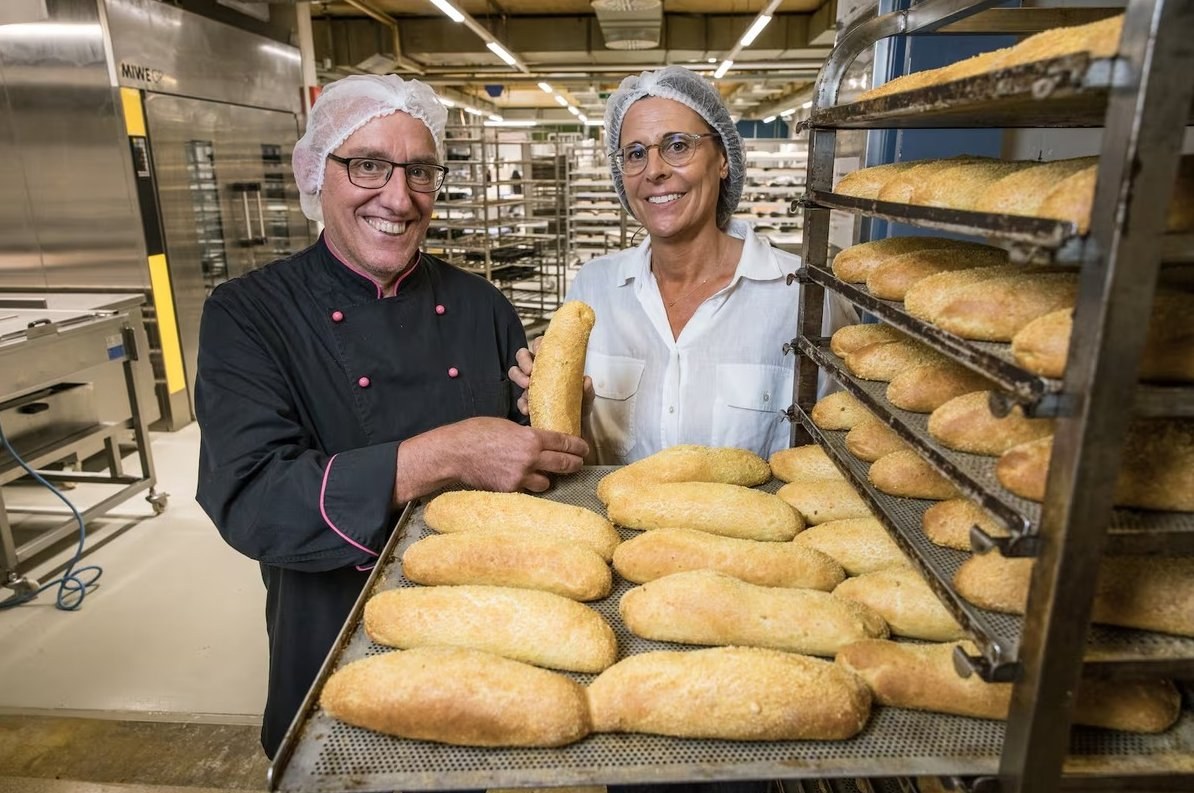
Over the past 25 years, the number of bakeries in Switzerland has halved. In contrast, the Fleischli chain, owned by Konrad and Chantal Pfister, has not only survived but has expanded to 14 locations. The couple emphasizes that their success hinges on automation, stringent cost control, and a selective product range. They believe that prioritizing quality is essential, as importing cheap baked goods could lead bakers down a dead-end.
Konrad Pfister, 58, alongside his 56-year-old wife Chantal, has run the Fleischli bakery in the Zürcher Unterland region for nearly a decade. He dismisses the romanticized vision of craft bakeries and false humility, arguing that these notions contribute to the industry’s decline. According to industry association data, the number of bakeries in Switzerland has decreased by 50% over the past 25 years.
Fleischli has been in operation for 40 years and, with its 14 locations, ranks among the largest bakeries in the country. However, Konrad stresses that scale alone does not guarantee success.
Chantal acknowledges that a larger company size can help weather challenging times.
Low Margins, High Workload
Regardless of company size, managing labor time is critical.
With margins at a mere 6% to 10%, a few extra hours of work can determine whether a business turns a profit or incurs a loss. Consequently, production has been centralized in Niederglatt, Zurich, occupying five floors and 2,500 square meters. Whenever possible, the company opts for automation.
Machines produce hollow chocolate figures, such as Easter bunnies and pralines.
Annual Product Review
Not all production stages are automated, however. When preparing bread dough, the Pfisters still rely on the experience of their workers.
Interestingly, Konrad is not a trained baker; he is a cheese maker and food engineer by education. The vanilla cream is also prepared manually to ensure quality.
He expresses no concerns about the increasing import of baked goods; rather, he is more troubled by something else.
He considers it a serious mistake. Pfister constantly analyzes sales, costs, and prices for each product. Once a year, he reviews the product range, eliminating items that do not attract sufficient customer interest.
Classic products, like croissants, strawberry tartlets, and lemon cakes, face no such threat.
Challenges From Competition
Despite the advantages of scale for efficient production, the Pfisters are not eager to expand at any cost. Chantal values personal relationships with around 300 employees.
Expansion comes at a price.
They have also faced setbacks, such as the closure of their Hochbord location in Dübendorf just a year after opening, as the area dominated by offices and remote work did not generate enough customer traffic. They prefer locations with high foot traffic and ample parking, which are increasingly rare, amid fierce competition.
Balancing Tradition and Digitalization
Instead of further expanding their store network, the couple is focusing on online sales.
While dough is still evaluated by touch in the bakery, bread is increasingly sold digitally. For the Pfisters, merging traditional craftsmanship with a pragmatic approach to efficiency is not contradictory; they view it as a recipe for survival in an industry that has faced growing pressures for years.