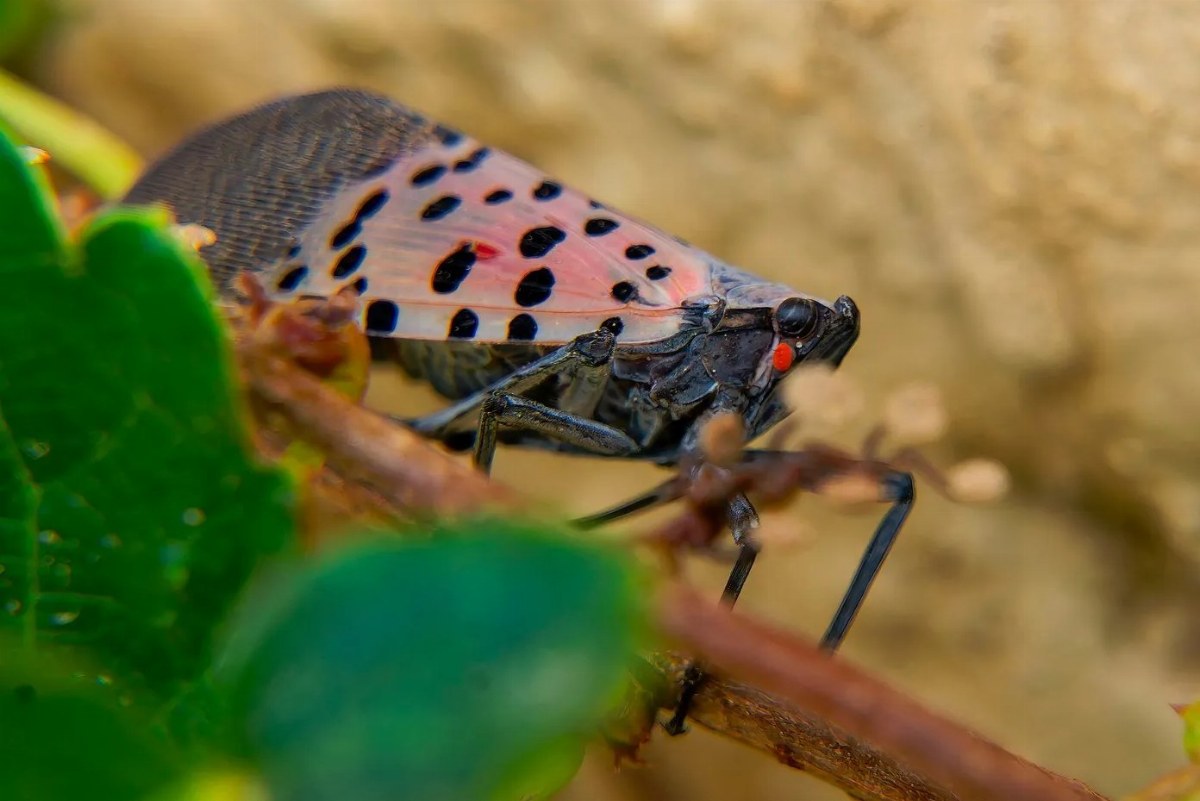
A dangerous insect that poses a threat to agricultural crops, particularly vineyards and fruit-bearing trees, has been identified for the first time in Moldova. Despite the eradication of an initial outbreak, it has since been detected in other public areas within Chișinău. Authorities are urging residents to report any sightings.
The insect, known scientifically as Lycorma delicatula, resembles a butterfly with black spots on its wings, but it belongs to the order Hemiptera, which is related to cicadas.
This pest can weaken plants, causing branch dieback and loss of vigor, as reported by the National Food Safety Agency (ANSA) of Moldova. The outbreak was first identified on Ailanthus altissima, a type of tree found in an industrial area of Chișinău.
A working group established by ANSA has cordoned off the infected area as well as a buffer zone. The infected zone, covering 7,000 square meters, has been treated with pesticides in several stages, and disinfection measures have also been taken. Following these actions, the outbreak was eradicated within the designated space.
However, isolated populations of the pest were later discovered in public areas of the buffer zone. ANSA has mandated the compulsory disinfection of these zones.
Origin and Spread of the Spotted Lanternfly
Lycorma delicatula, commonly known as the spotted lanternfly, belongs to the family Fulgoridae. This species is native to China, Taiwan, and Vietnam, and has spread to South Korea, Japan, and the United States.
The adult insect measures approximately 25 mm in length. Its forewings are gray with black spots, while the hindwings display red spots that are visible during flight.
The eggs are laid in groups that are gray-brown in color, found on tree bark, stones, or other smooth surfaces.
The insect’s abundant honeydew excretion promotes the growth of sooty mold, which hinders photosynthesis.
In vineyards, damage can reach up to 90% of production, significantly affecting grape quality.
This species has over 70 reported host plants globally, with its preferred host being Ailanthus altissima. The pest can also be found on maple, walnut, willow, poplar, as well as fruit trees like apple, plum, cherry, peach, apricot, and almond. Additionally, it can affect numerous ornamental, forest, and herbaceous plants.
As a result, the viticulture, nursery, fruit-growing, forestry, and wood industries are all at risk.
Public Advisory
ANSA advises anyone who encounters this insect to report it immediately, providing photographs and the location of the sighting.
Furthermore, the public is encouraged to avoid moving plant material, wood, or objects from the infested area, as these may carry eggs or adults.
Residents are also urged to inspect their vehicles, equipment, and materials stored outdoors before leaving the area, as the pest can easily spread over long distances.
Females lay eggs on tree trunks, stones, and even on vehicles, equipment, and garden furniture kept outdoors, which can lead to accidental transport from one area to another.