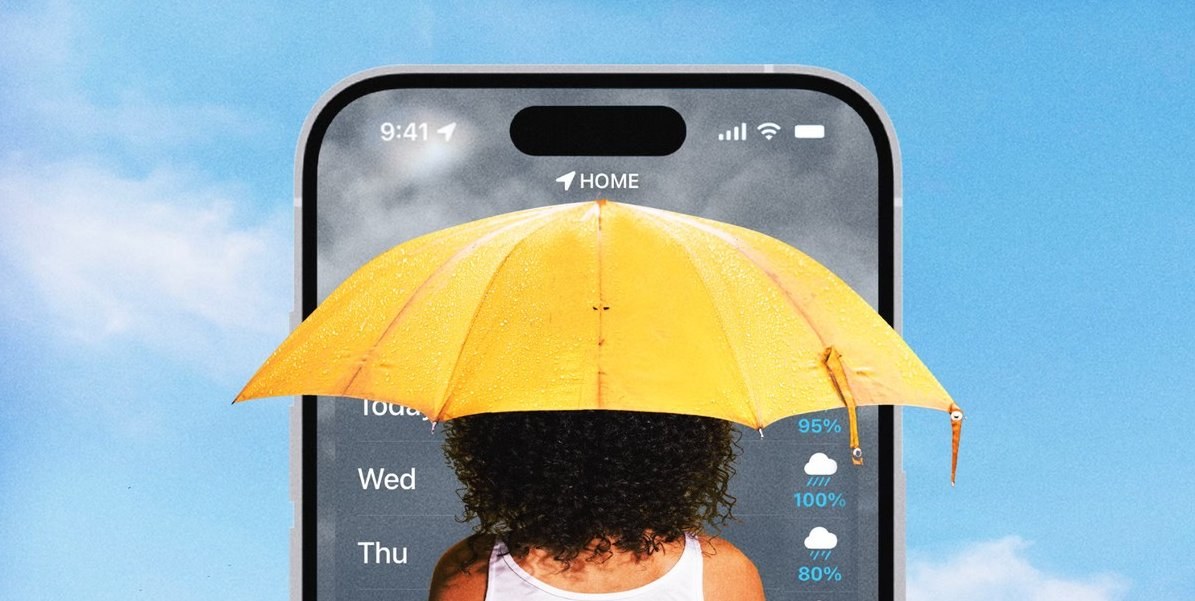
Maya Haddad Miller has long been fascinated by weather applications, particularly their impact on revenue. She operates Brooklyn Beach Shop at Coney Island, New York, where she sells beach souvenirs and accessories. Miller notes that when a rain icon appears in popular weather apps, sales can drop by half, regardless of actual weather conditions.
“When we talk about weather forecasts, we talk about our lives. Everything we do depends on the weather,” she explains.
This issue has become so significant for her that she once maintained a spreadsheet comparing forecasts with actual weather data. She raised her concerns with former New York Lieutenant Governor Kathy Hochul during a visit to Coney Island a decade ago, questioning the misleading presentation of weather data in apps.
“There are many businesses in the state suffering from incorrect forecasts,” she remarked, emphasizing that inaccurate predictions lead to reduced sales and tax contributions.
Misleading Icons
Every day, millions rely on default weather applications on their smartphones to plan their activities. The problem lies in the oversimplified presentation of complex, local, and probabilistic forecasts. Reducing an entire day’s forecast to a temperature range and simple sun or rain icons is a daunting task.
When these shortcuts prove misleading, the consequences are tangible: empty beaches, canceled golf reservations, and wasted weekends. A small cloud icon can translate into real economic losses, as potential customers stay home on a beautiful Saturday, only to realize later they could have enjoyed a day at the water park.
According to climatologist Daniel Swain from the University of California, the science behind weather forecasting has never been more advanced; however, this complexity disappears when forecasts reach a smartphone screen. A single icon represents the day’s dominant weather, even if conditions are set to change multiple times throughout the day.
“Instead of utilizing the wealth of available meteorological data, app developers often rely on just one data source. This can leave us dependent on a model that may not be the best fit for the situation,” Swain explains.
Jason Furtado, a meteorology professor at the University of Oklahoma, believes that basic weather apps are only suitable for a quick overview. The issue arises when actual conditions vary significantly, such as when a storm affects one part of a city while leaving another unaffected. General forecasts often overlook these crucial details, particularly when weather is dynamic.
“When looking at these apps hour by hour, the forecasts change. This is not very helpful, especially when you need to make a specific decision,” says Furtado.
Difficulty in Interpretation
However, the problem is not solely with app creators; user interpretation of forecasts is also an issue. Many people struggle to understand precipitation probabilities.
A 20% chance of rain typically means there is a 20% likelihood that at least 0.25 mm of rain will fall in a designated area. Some interpret this as a guarantee of no rain, leading to frustration when they get wet. Others perceive the risk as too high, choosing to stay indoors, only to find that the sun shone all day.
“People have historically misunderstood terms like percentage probability of precipitation or the difference between a warning and a weather alert. Now everyone carries a convenient weather app in their pocket,” says J. Marshall Shepherd from the University of Georgia and former president of the American Meteorological Society.
He adds that people often ask him for a weather forecast, then respond with, “But my app says something different.”
Moreover, some forecasts exhibit a phenomenon known as ‘wet bias,’ which inflates the likelihood of precipitation to avoid criticism if rain does occur. Studies also show that weather apps tend to provide overly detailed forecasts for many days ahead without informing users of the associated uncertainty.
“Weather apps rarely show the level of forecast uncertainty,” notes Susan Joslyn from the University of Washington.
Economic Impact
The lack of nuance in weather apps affects not only leisure planning but can also harm local economies, especially where businesses are seasonal or weather-dependent. A recent study presented at the American Economic Association conference found that when forecasts exaggerate the risk of rain, local businesses see a drop in customers and consumer spending, even when the weather is fine. Retail, dining, and entertainment sectors are hit hardest. Authors of the study suggest that investing in more accurate forecasts could significantly benefit local economies.
Local entrepreneurs are well aware of this issue. Rob Bryn, a musician from Rockaway Beach in New York, recalls that when he started bartending at the beach in 2011, families would still visit on rainy days. Today, a mom sees a rain icon on her phone and cancels the trip, even if rain is only expected later at night.
“People no longer want to take risks. It could be beautiful, but the beach is completely empty. I thought to myself, ‘It’s amazing how easily people are influenced by an icon on their phone,’” he says.
Bryn follows a local Instagram profile dedicated to weather, whose creator claims to provide live updates from the area because “weather apps always get it wrong.” He even contemplated contacting Apple about the consequences of overstating rain risks.
“I don’t think they realize the impact they have on places like Rockaway Beach. They just want to remind people to take an umbrella,” he adds.
Steven Cohen, vice president of the Brooklyn Cyclones baseball team, wishes fans would use more detailed weather apps. “There are days when it’s beautiful for us while a storm passes just over the Bronx, raining during a Yankees game,” he explains.
Fortunately, many fans purchase tickets in advance. The problem arises when they see a cloud icon days ahead and reconsider their plans.
“In their minds, the idea of bad weather is already fixed,” he adds.
During a conversation with Adam Rinn, director of Coney Island Inc., the weather app was predicting rain all afternoon. By 3 PM, only a few rumbles of thunder were heard, and not a drop of rain fell.
“If you look at the radar, the precipitation just missed us,” he says.
Mike Bengston, director of the Splish Splash water park on Long Island, believes that those deterred by the forecast could actually benefit on such days.
“When the weather seems uncertain, lines are significantly shorter if nothing happens,” he explains.
The impact of weather apps also varies depending on the type of business. In tourist destinations, customers often show up regardless of weather, as they are already on-site. Reservation policies also play a role; if canceling a boat tour costs $100, many think twice.
Nick Ribeiro, who runs the Preserved Links private golf club, regularly receives messages from event attendees asking if a meeting will still take place since their phones show rain. Often, the golf course is already paid for, prompting him to scramble to find replacements or reassure hesitant players.
“There’s always a reason not to play. If the weather stands between you and the first hole, it’s easy to back out,” he says.
Businesses Must Adapt
These challenges also create organizational problems. Business owners must plan staffing levels not only based on the weather forecast but also on customer perceptions. Golf courses may need to resell previously booked tee times. For seasonal businesses, every day is vital, and false “rainy days” can be catastrophic.
<p“The entire economy today is dictated by one icon on a phone,” summarizes Bryn.
This is not solely an American issue. In March, over a hundred British tourist attractions sent an open letter to the UK’s Met Office, warning that misleading rain icons in popular apps cost them thousands of pounds in lost revenue daily.
Forecasting in weather apps is a challenging task. People appreciate the convenience of a quick glance at their phones rather than watching forecasts on television or local news. However, local meteorologists often better understand situations and can explain them more accurately.
Dan DePodwin, vice president of forecasting at AccuWeather, emphasizes that app creators must find a balance between conveying information and overwhelming users. Most people want to spend no more than half a minute checking the weather.
<p“On one screen, you can show a lot of information, but also leave enough space so the user doesn’t feel overwhelmed,” he says.
Not all weather apps are the same, however. Some provide very detailed data while others only offer basic information. Differentiating their quality could become increasingly challenging as AI tools emerge that allow new apps to be developed almost overnight.
Eric Floehr, founder of ForecastWatch, which analyzes forecasting accuracy, points out that there is a substantial difference between an app using a cheap API for a few dollars a month and a professional company specializing in weather analysis.
<p“You often get exactly what you pay for,” he says.
The stakes are high. The mildest scenario is when an app forecasts rain while the sky remains clear. The most dangerous scenario is when someone misses a warning for thunderstorms or a tornado because they focus solely on one number or icon on the screen.
Meteorologists recommend treating standard apps as a quick starting point rather than an infallible source of knowledge. They encourage users to verify forecasts with local meteorologists or official weather services, and to simply call ahead to check conditions before heading to a golf course or amusement park. They also stress that the errors of popular apps do not mean that all forecasts are unreliable; they assert that it is the poor digital forecasts that tarnish the reputation of the entire industry.
On the day Maya Haddad Miller spoke, the forecast called for a series of sunny days. She was cautiously optimistic but didn’t want to jinx it.
<p“Saturday should be wonderful, theoretically. Unless someone adds a rain icon to the app the day before and then removes it again,” she concludes.