Today, there seems to be a growing impatience for everything. We want to learn a language in just three months, become experts after watching a few videos, and build something that traditionally takes generations, all in a matter of seasons. We live in an era where every offering promises a quicker path, requiring less effort and time. Football is no exception, and Giulești Stadium stands as a remarkable symbol of this phenomenon in Romania.
This feeling hit me last Monday evening during the Rapid – Sepsi match in the season’s opening. Upon entering, the first sound I heard was Bresh’s song “Guasto d’amore,” a Genoese artist associated with the Genoa supporters, alongside others from the contemporary Italian music scene like Fred de Palma.
I instinctively turned my head from the height of Tribune I, searching for a port that was nowhere to be found—only the Grant Bridge was visible. It dawned on me that those in the box seemed to believe that the transfer of symbols also brings about a cultural exchange, as if the flow from Rappa had ever reached the speakers at Luigi Ferraris.
Giulești Headquarters: When Did It All Start?
Why should Rapid start resembling Genoa?
In recent years, Rapid has developed a fascination for shortcuts in a multitude of areas, and I do not make this claim as an accusation, as it would be among the last.
The issue lies with what influences are drawn from Genoa, since fresh, civilized, and professional ideas do not arrive alongside the players that the Ligurians no longer counted on.
Identities cannot be borrowed. They do not come with a consultant or a playlist, despite what Mr. Dan Șucu might think. Giulești did not become Giulești due to a plan; over nearly a century, various people have contributed pieces of themselves to its legacy.
In line with new practices, upon entering the stadium, attendees still receive a festival-like wristband. Journalists, guests, officials, and partners are all given a specific color. Everyone wears one, including the owner, now.
Occasionally, a young volunteer checks if the wristband is worn correctly. However, I wouldn’t say this is done with the regularity that Dobre begins his race, as she seems to be falling out of shape. She stops at the press table and asks, “Are you a journalist?”
Some time ago, the area designated for journalists became so permissive that it felt like participating in a gathering of TikTok influencers ready to throw influence at anyone who hadn’t made it to the game.
When things went too far, the club implemented stricter rules: controlled access, checks, searches, wristbands. This idea did not arise spontaneously; it was an immediate response to the discovery of how flares and even weapons were being smuggled into the stadium. The Pyro dossier is extensive, filled with all the details.
Us with ChatGPT: Our Own
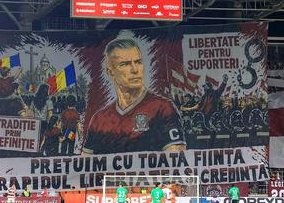
That same evening, the fans dedicated a special scene to Daniel Pancu, featuring a message about tradition, faith, and roots, along with an image generated by ChatGPT.
This isn’t something to condemn; rather, it’s a perfect snapshot of the present. Artificial intelligence is likely to become a common tool in everyone’s life, though I hope it won’t replace the concept of being a supporter. This contrast haunted me throughout the match.
We treat the past using the fastest technology invented to produce images, evoking memory through a tool that neither retains nor comprehends emotions.
Once again, the shortcut appears. The same temptation to believe that everything can be accelerated. A final, subtle auditory image of the evening unfolded during the moment of silence. Among the names mentioned was Mircea M. Ionescu, who passed away on Sunday at the age of 80. The stadium announcer showed the audience the respect to present him as a “rapidist.”
This is true, yet it encapsulates so little. Mircea M. Ionescu was a playwright, writer, commentator, one of the few who believed that sport could also be literature. His love for Rapid was merely a part of his biography, not its entirety.
At that moment, I wondered if this wasn’t another form of a lazy shortcut, reducing individuals to a single label simply because it is easier than encompassing their complexity.
What if, at the next FCSB match, the announcer referred to a former journalist, a balanced professional known for his impartiality, who always appreciated Marius Baciu’s game systems, or at Dinamo, characterized as a great lover of the N&D duo? I don’t understand this drive to appropriateness that enhances respect at the expense of decency.
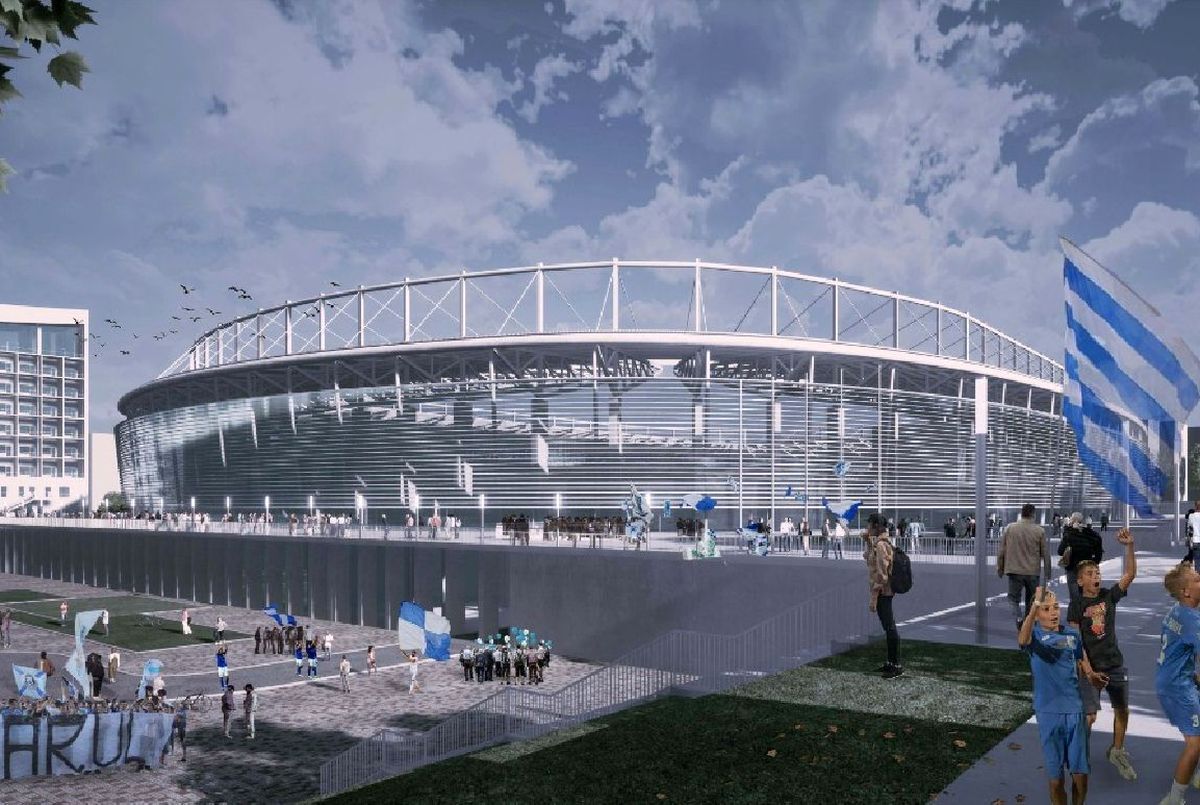
Rapid is on a path of atypical corporatism, with procedures thought out and applied without regard for the club’s traditional mold. Clearly, there is an immediate route to almost anything: a transfer, a sponsor, a marketing strategy, a new stadium.
Yet, no shortcut has been invented for memory, which is the only thing that transforms a venue into a place and a club into a sense of belonging. Thus, whenever Giulești attempts to save time precisely where time is the raw material, it will inevitably arrive at the same point.
Before the Grant Bridge, searching for a port that has never existed there.