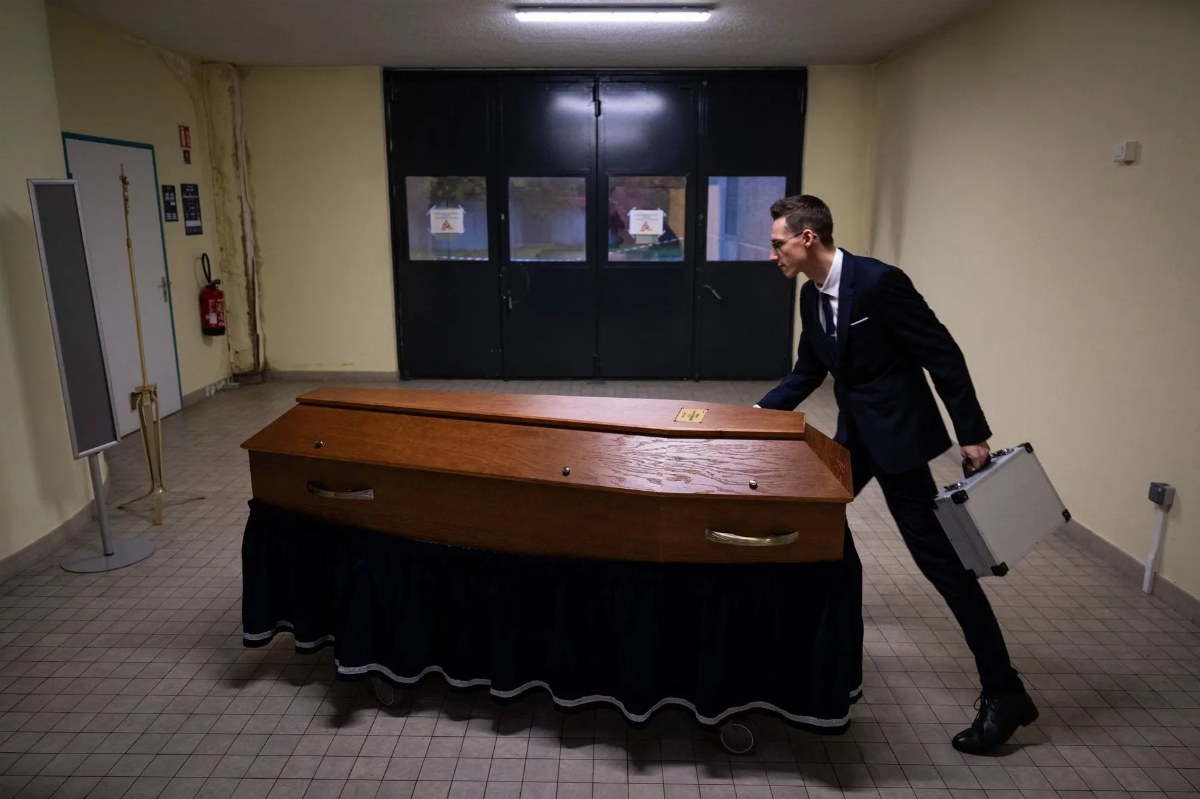
Gautier Caton, who has directed a funeral home for nearly 25 years, has never encountered a situation like the recent record heat wave that struck France in late June. The extreme temperatures forced him to rent five refrigerated containers to store the bodies arriving at a rate up to three times higher than usual, according to reports.
Caton, a member of a family that has been involved in funeral services for five generations, joined the family business shortly after a notorious heat wave in 2003, which contributed to nearly 15,000 excess deaths nationwide. This year, however, his funeral homes in Orléans took in four bodies from overwhelmed firms in Paris, located two hours away by car.
“The Paris region was hit extremely hard and was in the midst of a crisis,” Caton told reporters. “The situation then extended to us in Orléans, where our funeral facilities became severely overcrowded. We were hit hard,” he explained.
The summer of 2026 has brought France face-to-face with three forces reshaping the nation: climate change, an aging population, and a state struggling financially to fund necessary adaptations for the future.
Record temperatures arriving earlier each year have triggered unprecedented wildfires near Paris, closed schools, and exerted immense pressure on unprepared hospitals. The heat also contributed to the deaths of vulnerable elderly individuals living in sweltering homes or nursing facilities.
Over 2,000 Excess Deaths Recorded During Recent Heat Wave
France reported 2,025 excess deaths during the heat wave in late June when temperatures soared to 43.8 degrees Celsius. The death toll increased by nearly 65% in Paris and by almost 50% in the Centre-Val de Loire region, where Caton’s firm operates.
These figures are preliminary, based on approximately 60% of the total deaths accounted for so far, and are expected to rise as more complete data becomes available.
François Bourdillon, who led the French public health agency from 2016 to 2019, stated that France has made significant progress since the 2003 heat wave. That episode caught authorities completely off guard and led to the establishment of a warning system designed to mitigate the worst effects of heat waves through forecasts, public alerts, and protective measures for vulnerable individuals.
However, he argues that France has failed to address the structural vulnerabilities of cities, hospitals, schools, and nursing homes, calling for a multi-year strategy coordinated by the Prime Minister’s office to transform the country to better cope with heat waves.
The need for action became even more evident when his sister-in-law underwent heart surgery at a prestigious Paris hospital that lacked air conditioning, requiring his brother to bring a fan.
“The lesson from 2003 is that we were blind. We are no longer blind, that is for sure. We have indicators and can raise the alarm,” Bourdillon asserts. “The lesson from 2026 is that this is not enough. We are living in a sort of dystopia where we can manage the effects of the heat wave… but we ignore structural problems,” he laments.
Repeated Heat Waves Pressure France’s Finances
French Prime Minister Sébastien Lecornu has pledged hundreds of millions of euros for air conditioning in hospitals and nursing homes. Critics, including the Green Party, which unsuccessfully initiated a motion of censure over Lecornu’s management of the heat wave, argue that these measures are insufficient.
However, the government finds itself in a difficult position, needing to invest to cope with increasingly severe heat periods while also reducing the budget deficit and maintaining spending objectives in areas like defense.
Matthieu Glachant, an environmental economics professor at Mines Paris – PSL, notes that the scorching summer France is experiencing has mobilized public support for a more robust state response.
“The shocks we have experienced have been so severe that they will influence political decisions well beyond the next two months,” the professor asserts.
Dramatic Situation in Nursing Homes
This month, Caton’s funeral firm was called to a local nursing home where a 94-year-old woman had died. Staff had gathered immobilized residents in the air-conditioned TV room, the only room with climate control, while white sheets were hung in the corridors to reduce sunlight exposure.
“I no longer look at the weather forecast,” says Béatrice Noyer, the head nurse of the home. “It depresses me,” she adds.
Residents were cooled with wet towels and fine mist sprays, although some required intravenous fluids. Most spent their days in the climate-controlled TV room, while others refused to leave their bedrooms.
A public survey conducted last year by the French Ministry of Health revealed that 41% of nearly 3,000 surveyed nursing homes lacked any communal air-conditioned space. Less than 10% had air conditioning in residents’ rooms.
Noyer insists that urgent investments are needed in both personnel and infrastructure.
“But for now, nothing is changing, and I am not sure it will change,” she states. “Elderly individuals do not count for our politicians,” she accuses.
Excess Death Toll Expected to Rise
The increase in excess deaths could provoke a political reaction.
Preliminary data indicating 2,025 excess deaths do not yet include details regarding individuals who died at home, a category in which the number of deaths surged by over 91% during the period of June 22-28.
Caton notes that such cases typically account for about 25% of the funerals organized by his firm, but during the heat wave, their numbers increased by 80%.
“They were not necessarily individuals fully prepared to die or whose deaths were expected,” he states.
As a result, his firm received bodies of individuals who had died alone in their homes more than two weeks prior, with no one checking on what had happened to them.