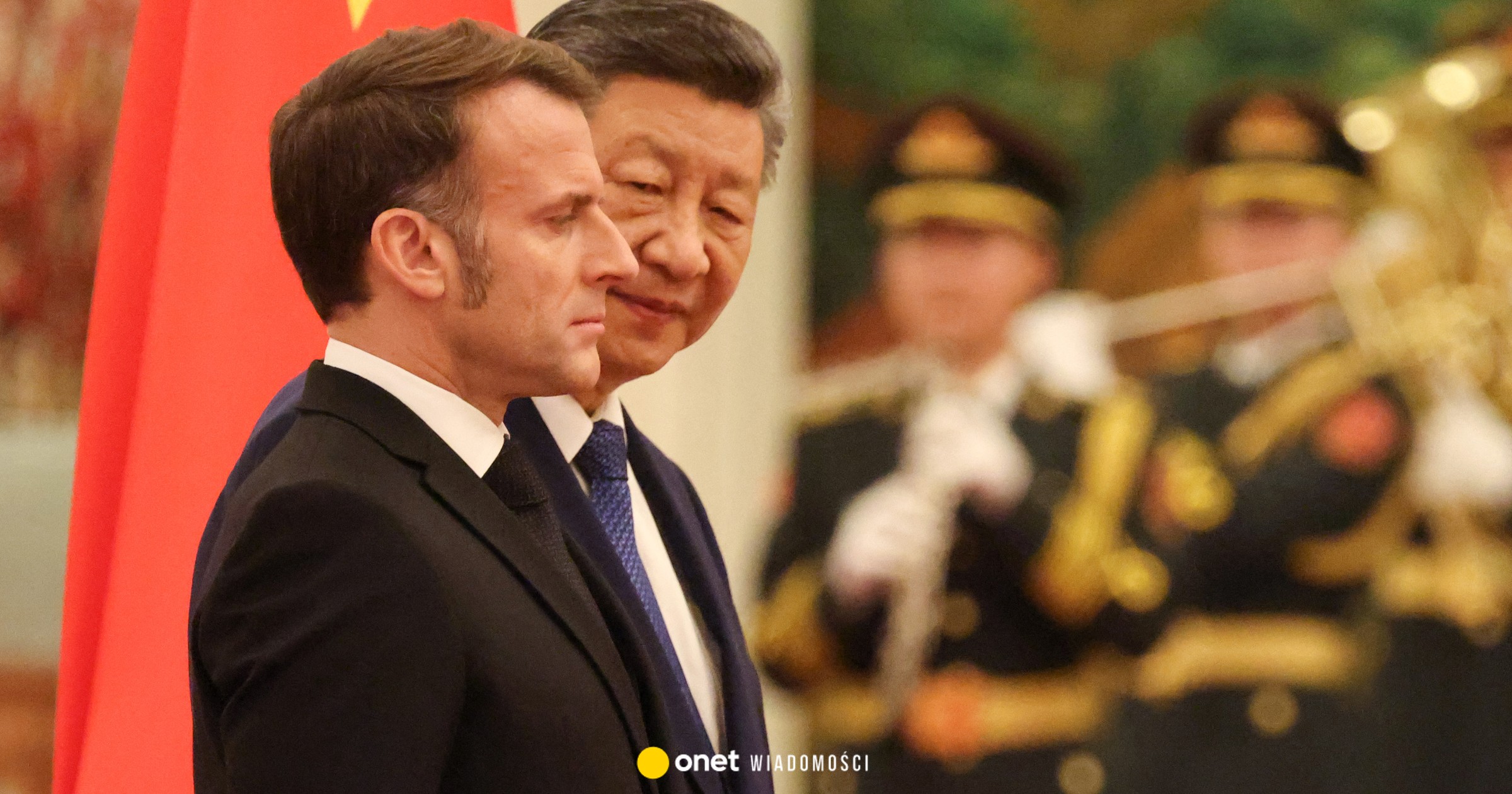
French President Emmanuel Macron wants an agreement reached during the G7 summit on the need to counteract the inflow of subsidized Chinese goods that are destabilizing world markets. However, even before the deliberations begin, it is known that it will be difficult to take specific actions in this matter.
The discussion on global imbalances scheduled for Monday – the first day of the meeting that Macron is organizing in Evian-les-Bains – is unlikely to bring a solution to the problem. Beijing is ostentatiously disregarding the G7 initiative, and Europeans and Americans disagree on how to limit China's trade surpluswhich reaches USD 1.2 trillion. (at the current exchange rate PLN 4.4 trillion).
On Thursday, Macron chaired an event called the “World Convergence for Growth Summit” [Światowy Szczyt Konwergencji na rzecz Wzrostu]where the issues of macroeconomic imbalance between representatives of the G7 countries and Beijing were discussed.
However, it was not a face-to-face meeting – it took place via videoconference, which was joined by only some of the G7 leaders, including: German Chancellor Friedrich Merz and Canadian Prime Minister Mark Carney. Vice Prime Minister Zhang Guoqing, who is not directly responsible for trade policy, spoke from Beijing. He presented the party's official position on the advantages of “true multilateralism.”
The winding road to agreement
The Élysée was quick to hail the video call with China as a success in itself, with one presidential official saying it was proof that “this G7 summit is already a success.”
According to Paris, participants agreed on the need to address global imbalances and continue talks at the G20 forum with the support of the International Monetary Fund.
If the main effect of these talks was an agreement that the problem exists and should be discussed elsewhere, the question arises why Macron decided to make it a a key topic of a forum to which China does not even belong.
“It seems like they had a hard time reaching an agreement on anything,” says economist Agathe Demarais, co-chair of the T7 expert group that advises the G7 presidency. She predicts that there will be no breakthrough in stopping China on Lake Geneva in Evian-les-Bains.
The article continues below the video
— It is obvious that China has no interest in engaging in talks with the G7 on this topic, emphasizes Demarais, a senior analyst at the European Council on Foreign Affairs think tank. He adds that Beijing “does not intend to completely change its economic model just to make the French G7 presidency happy.”
“Olive Branch”
According to a Chinese summary of the video conference, Zhang “called for prioritizing development, improving global governance and supporting the inclusive growth of the world economy.” He did not directly address the issue of macroeconomic imbalances, which, according to Western governments, are the reason for the decline in industrial production and employment.
One person from outside the government, familiar with the preparations for the G7 summit, describes the opening of the French presidency as an “olive branch” to Beijing. At the same time, the source admits that the G7 is not the best format to put pressure on China to change its trade policy.
By handing over the meeting to Zhang, Beijing gambled diplomatic protocol cardmaking it clear that he is not taking this conversation seriously.
Entrusting this to the deputy prime minister obviously reduces the importance of the problem
– says Elvire Fabry, a trade expert from the Parisian think tank Jacques Delors Institute.
Europe is toughening its stance
In her role as mediator as G7 president, France avoided publicly criticizing China. She presented the discussion under the neutral banner of global imbalances and emphasized that the United States also had a role to play here by reducing the budget deficit and the EU by increasing investment.
However, it is France that has traditionally been the loudest in calling for EU action in the face of the growing trade deficit with China, which reached EUR 360 billion (PLN 1.5 trillion) last year and has increased in the first quarter of 2026.
Paris led the initiative among the five EU countries that made the demand new trade defense measures against the dominance of Chinese exports. Macron recently publicly called for the EU to equip itself with stronger trade policy tools, modeled on the American ones, to confront China.
– This is not protectionism, this is fair protection – said the French president during a meeting with employees of a tire factory in his hometown of Amiens, calling for the introduction of tariffs and preferences for European products in response to competition from China.
Tensions on both sides of the Atlantic
Even German Chancellor Friedrich Merz, who had previously opposed confrontation with Beijing out of fear retaliation against the German export-oriented economynow seems more open to decisive action against China.
The European Commission has pledged to take action to resolve the “unsustainable trade deficit with China”, as EU Trade Commissioner Maros Sefcovic put it earlier this month. The topic will be on the agenda of the meeting of EU leaders in Brussels right after the G7 summit.
However, there are no signs that Europe and the United States are ready to coordinate their actions towards China, especially in the face of ongoing tensions in trade relations on both sides of the Atlantic.
“If they want to do what we've already done, they're free to do so,” US Trade Representative Jamieson Greer said late last month. — However, I do not intend to slow down and wait until we agree on a common position.
I’m Ashley Davis as an editor, I’m committed to upholding the highest standards of integrity and accuracy in every piece we publish. My work is driven by curiosity, a passion for truth, and a belief that journalism plays a crucial role in shaping public discourse. I strive to tell stories that not only inform but also inspire action and conversation.