The city sinks, Azteca resists! There are areas in Mexico City where the water level drops by almost half a meter every year

Article by Ionuţ Iordache, Sergiu Alexandru – Published Wednesday, June 10, 2026, 7:32 p.m. / Updated Wednesday, June 10, 2026, 7:32 p.m.
Mexico's capital city is sinking up to 50 cm a year due to massive groundwater extraction. How the soil crisis affects the infrastructure around the final tournament
Ciudad de México has a lot of problems: crime, overpopulation, lack of drinking water, severe flooding in the rainy season and high seismic risk.
In addition to all this, there is one more that few cities face.
Curse of the Conquistadors
The metropolis was built on the ruins of the ancient Aztec capital Tenochtitlan, a group of islands on a system of 5 interconnected lakes.
The Spanish conquistadors completely drained these lakes to expand the city, replacing the water with massive layers of spongy clay sediments.
Today, however, water is desperately extracted from the underground to ensure the needs of more than 22 million inhabitants. The result? The earth compacts massively and irreversibly.
For this reason, in some central areas, the ground sinks between 10 and 25 centimeters per year.
But the critical areas are in the east and south of the city, where the ground subsides by up to half a meter every year!
40% of the drinking water flowof the city is lost daily through the cracks in the pipes caused by the mechanical stresses generated by the uneven slope of the soil
The monument that “grows” towards the sky
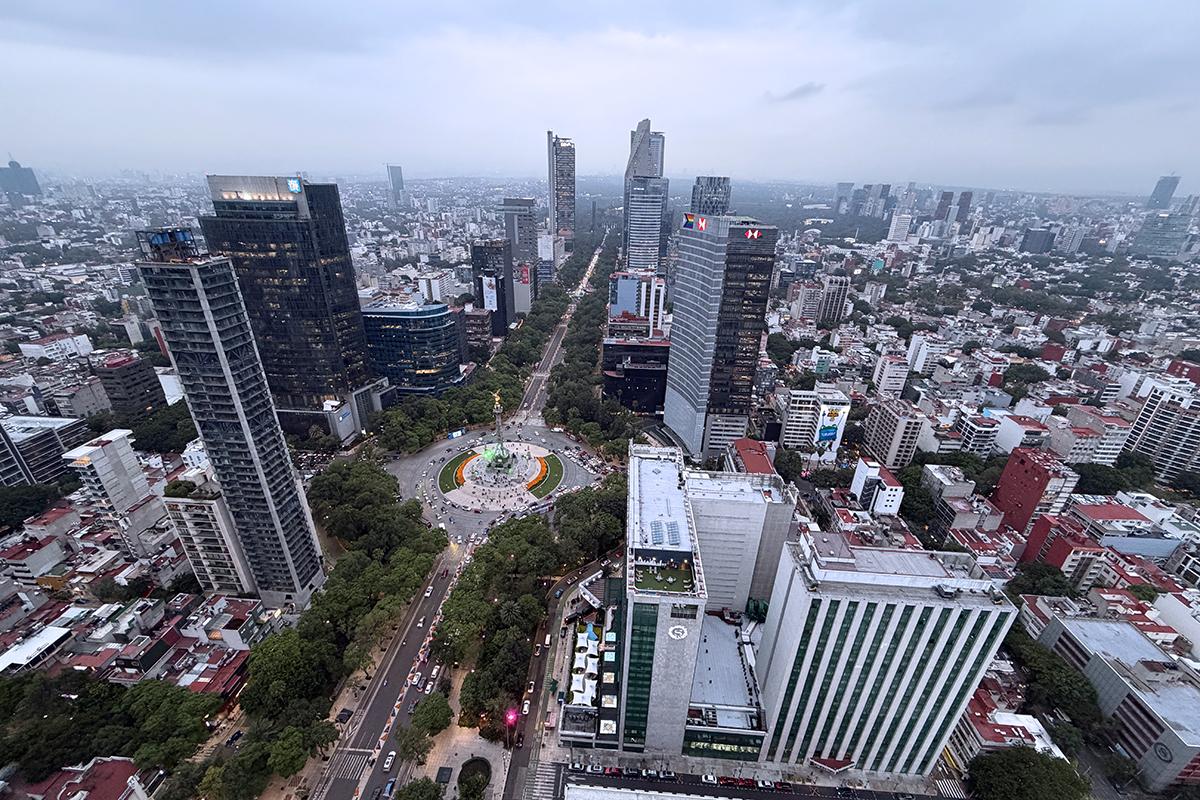
The phenomenon is best seen on the famous Paseo de la Reforma boulevard.
Here is El Ángel de la Independencia, the symbolic monument inaugurated in 1910.
El Ángel de la Independencia
Engineers a century ago knew about the soil's problems and drove hundreds of massive steel and concrete piles into the ground to a depth of over 30-40 meters, directly into the hard, stable volcanic rock at the bottom of the valley.
The “angel” remained fixed, anchored in the rock. But everything around him – the boulevard, the sidewalks, the restaurants – sank into the layers of clay.
The effect is truly incredible. At the inauguration in 1910, the base of the monument was exactly at street level, with only 9 steps. Today, to get to the plinth, you have to climb a huge circular structure with 24 steps!
The authorities were forced to keep adding steps down, essentially building a mini-pyramid beneath him as the earth ran away.
How does the mythical Estadio Azteca hold up?
The big question we asked ourselves when we got off at the metro station near the stadium was: what is going on with the colossus Estadio Azteca?
The answer is an optimistic one: the Santa Úrsula arena is standing thanks to geological luck.
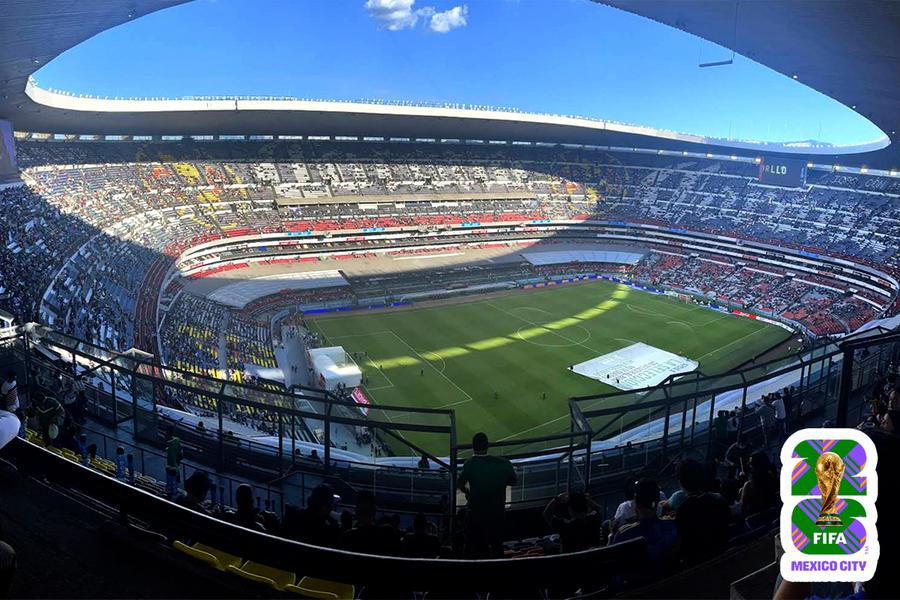
Estadio Azteca in Mexico City has 93,000 seats
Unlike the swampy east of the city, Azteca was built on partly rocky terrain, a former bed of lava consolidated by the eruption of the Xitle volcano.
For this reason, the famous stadium remains immune to the collapse that the rest of the metropolis is facing.
What will happen in the next 100 years
In the next 100 years, geological studies and predictive models show that Ciudad de México will not collapse suddenly like in a Hollywood movie, but will go through a “slow-motion catastrophe”.
According to models published in specialist journals, the clay layers under the city need about 150 more years to fully compact.
Certain areas in the east and south of the city will sink another 20 to 30 meters from the current level.
What solutions are there?
In order to avoid an apocalyptic scenario, urban planners are trying a radical transition towards the “sponge city” concept.
Massive rainwater catchment systems are being installed on roofs to stop pumping from underground at least during the rainy season, allowing the aquifer to breathe.
Also, modern buildings use special “box foundations”, which effectively float on the clay, balancing the weight of the excavated earth.