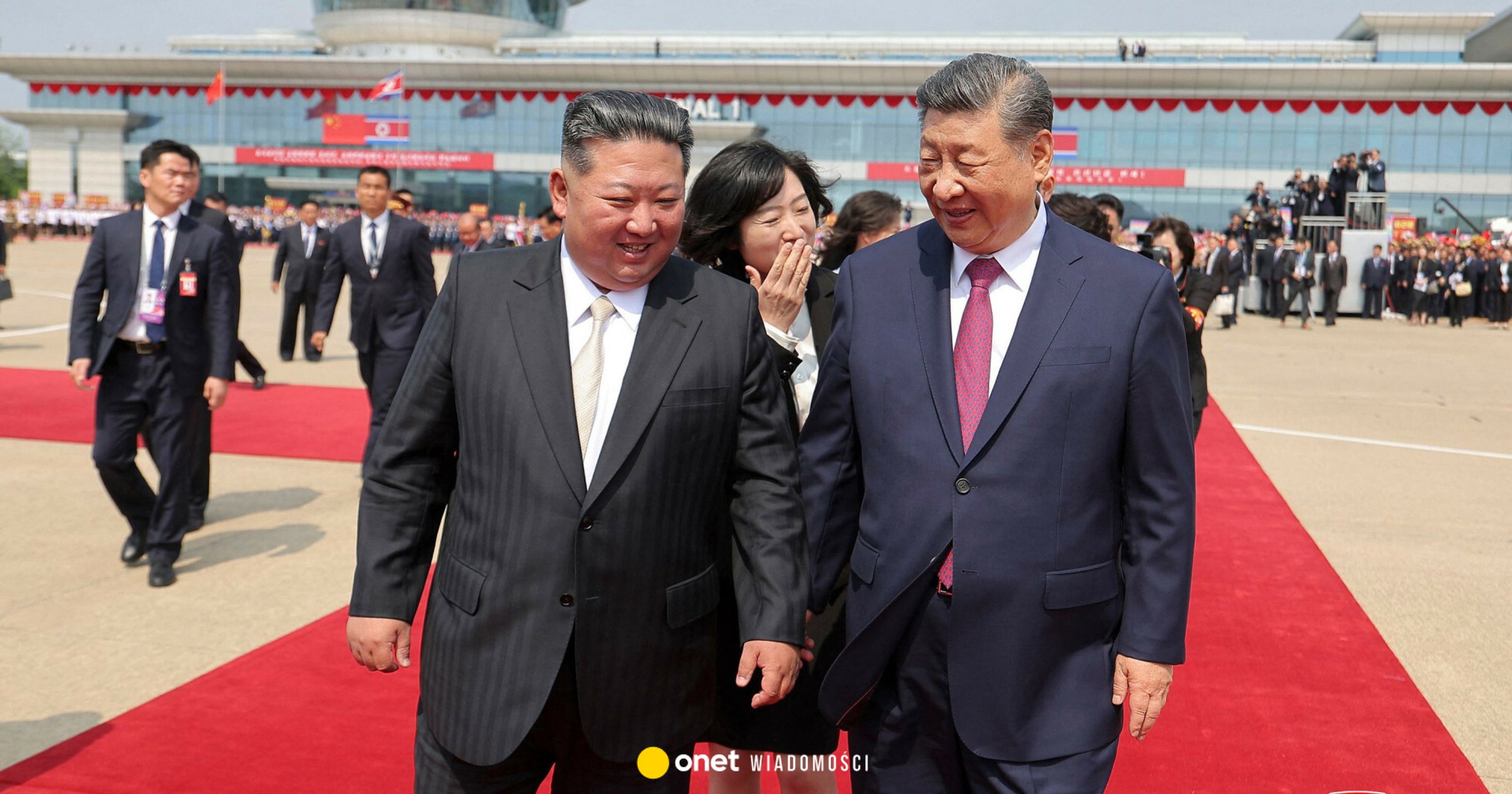
For decades, the only option North Korea had in relations with neighboring China was to act as a junior partner. Economically isolated, diplomatically restricted and heavily dependent on Chinese trade Pyongyang had no choice but to adapt to Beijing's interests and priorities. Today, however, this balance of power is beginning to change.
Xi Jinping's visit to North Korea this week underscores a remarkable shift in dynamics in the region. Xi did not come as the leader of an irreplaceable patron state seeking to influence a dependent neighbor. He met with a regime that has gained strategic value from its deepening partnership with Putin's Russia. North Korea has managed to obtain a new bargaining chip against China just at the moment when the fight for global domination of superpowers is transforming the world geopolitical system.
“For the first time in decades, Kim Jong Un has an alternative partner.”
Russia's full-scale invasion of Ukraine became a catalyst for this process. By signing a mutual defense pact in 2024, North Korea became a key military partner for Moscow, providing troops, ammunition and other support to Russia's war effort. In return, Russia provided economic and diplomatic support and enhanced military cooperationhelping to revitalize North Korea's flagging economy while reducing its dependence on China.
The article continues below the video
The consequences of this reach much further than just the battlefield in Ukraine. For the first time in decades, Kim Jong Un has an alternative partner who can offer economic support, political cover and strategic importance. This has weakened Beijing's historic ability to shape North Korea's foreign policy using economic tools.
Although China remains North Korea's largest trading partner – accounting for over 90 percent. annual turnover – revenues do not depend solely on the scale of trade exchange. The key is whether the state has viable alternatives. The ongoing exhaustion of Russia's economy by the ongoing war with Ukraine has forced it to look for new partners. Pyongyang filled this gap with enthusiasm. The relationship turned out of necessity into a strategic choice, allowing Kim to resist Chinese pressure with the most confidence he has had since taking power in 2011.
This shift in balance explains why Beijing's approach to North Korea has changed dramatically. In the past, China—along with Russia and the United States—supported international sanctions and publicly advocated the denuclearization of the Korean Peninsula, believing it had enough influence to steer Pyongyang's policy. Today, Chinese leaders seem resigned to the fact that such pressure is unlikely to be effective and may even backfire on them. Symbolically, a few days before Xi's official visit to Pyongyang, Kim Yo Jong, the North Korean dictator's sister, described the country's nuclear program as “irreversible.”
“North Korea is becoming an increasingly important player”
From Beijing's perspective, the problem is not only that North Korea continues to develop its extremely opaque nuclear weapons, of which it currently has approximately 60 nuclear warheads. The much greater risk is that excessive pressure could bring Pyongyang even closer to Moscow. Xi's visit may therefore be an attempt to stop the strategic drift and re-emphasize the importance of China in a relationship in which its influence is no longer obvious.
North Korea is becoming an increasingly important player in the emerging China-Russia-North Korea triangle precisely because it finds itself caught between two competing patrons.
EPA/ALEXANDER KAZAKOV / SPUTNIK / KREMLIN POOL / PAP
Vladimir Putin, Xi Jinping and Kim Jong Un. Beijing, September 3, 2025
Although Moscow and Beijing remain strategic partners, their interests on the Korean Peninsula are not always aligned. Russia seems less concerned about North Korea's growing military capabilities and nuclear program, looking at Pyongyang primarily through the prism of confrontation with the West and military support in the war with Ukraine.
Meanwhile, China is deeply concerned about regional instability, the potential for nuclear proliferation in Japan and South Korea as a result of Pyongyang's nuclear program, and the economic impact of a potential security crisis just across its border.
Kim has learned to exploit these differences. By strengthening relations with Moscow while maintaining relations with Beijing, increased North Korea's room for maneuver in the diplomatic arena. Instead of being the subject of great power competition, Pyongyang is increasingly becoming its beneficiary.
The new reality can be seen in China's gradual shift away from its previous emphasis on denuclearization. Chinese officials have become much less assertive about North Korea's nuclear program, and recent meetings between Xi and Kim have lacked references that had previously been made in official statements. Beijing has apparently concluded that North Korea's nuclear status is a fact that must be dealt with rather than sought to reverse it.
For Kim, this is a significant strategic victory. The nuclear arsenal, once a source of the country's international isolation, has become crucial to its geopolitical value. Combined with its growing importance for Russia this transformed North Korea from a dependent client to a more autonomous playerable to balance between larger powers.
Xi's visit therefore reflects more than just a routine show of socialist solidarity. It is an acknowledgment of changes in the regional orderin which North Korea has more independence than at any time in recent decades. What is most striking is that while China still has influence over North Korea, it now has to compete for that influence.
In the emerging triangle of relations between Beijing, Moscow and Pyongyang, North Korea is no longer just a junior partner. Taking advantage of the opportunities created by the Russian invasion of Ukraine and the intensifying confrontation between great powers, Kim Jong Un managed to turn strategic dependence into a strategic bargaining chip. The result is a Korean Peninsula where China's economic weight may still be enormous, but its political influence is no longer indisputable.
I’m Ashley Davis as an editor, I’m committed to upholding the highest standards of integrity and accuracy in every piece we publish. My work is driven by curiosity, a passion for truth, and a belief that journalism plays a crucial role in shaping public discourse. I strive to tell stories that not only inform but also inspire action and conversation.