Romanians' jokes after the GPS errors in Bucharest: “I was sitting on the couch and it told me that I was on the Băneasa runway. We were getting ready to take off”

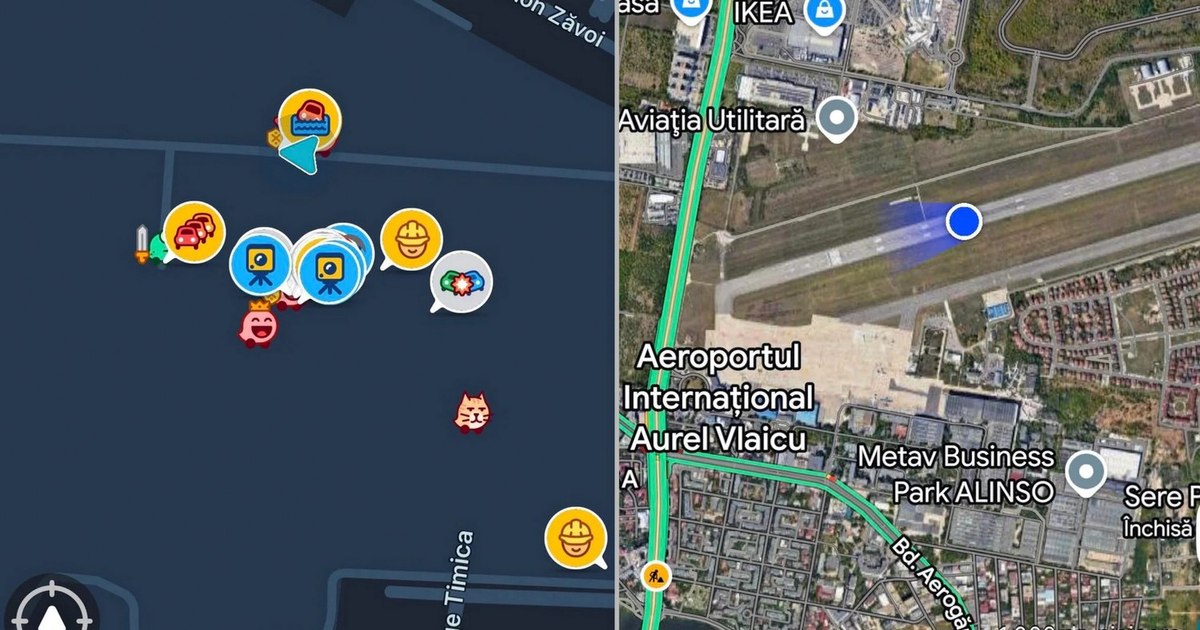
Many Romanians complained that they noticed unusual errors on their digital locator devices: their phones pointed them to areas other than where they were in reality, sometimes even on the runways of some airports. The accounts also sparked ironies on social media.
GPS errors reported by Romanians. Source: Reddit.com
The message of a Romanian who mocked the errors of navigation applications went viral on social networks. He said the apps were erroneously showing his position on an airport runway.
“I enter Google Maps. I was on the runway, I thought we were taking off. I enter Waze, I also see the other pilots next to me and calm down. But let's think about the Uber driver who got a dynamic rate in that area. Did you feel it?”, he asked on the Reddit platform.
He also pointed to a web page showing areas affected by GPS jamming: the intentional interference with satellite signals so that devices can no longer accurately locate or indicate an inaccurate position.
Map of “jams”: affected areas in Romania
The digital map created by John Wiseman in 2022 uses data provided by the ADS-B Exchange to indicate areas where GPS interference is likely to occur, based on aircraft reports of the accuracy of their navigation systems.
The GPSJam platform shows that among the most exposed areas are the southeast of Romania, especially Dobrogea and the Black Sea coast, but also the region near the cities of Galați and Brăila. Other affected areas also appear in the east of the country, towards the border with the Republic of Moldova, but also in Iasi and Maramureș. Western Romania appears mostly marked in green, which indicates a lower level of reported interference.
The jamming map shows the areas affected by interference in Romania. Photo: GPS Jam
Many Romanians responded to the message and reported that they had faced similar problems. Some noticed that the apps located them at airports even though they were in other areas or even in other towns. Others have argued that the errors could be caused by GPS jamming or the transmission of false coordinates.
“I confirm. At 22:50, Flightradar24 told me “Welcome to Aurel Vlaicu Airport”. I live in Popești”. wrote a netizen.
GPS app errors
Someone else claimed that multiple apps were affected by interference.
“I also confirm from a 15 Pro Max and a 13 Pro Max. My friends in Craiova were OK at that time, but in Bucharest — woe. It took about 20 minutes. Affected: Maps, Waze, Apple Maps. Plus all those near me with CarPlay and Android Auto”he specified.
“So that's why my friend asked me what I was looking for in Baneasa, as I was in Sector 3”another netizen joked, showing a photo of the wrong position on the GPS app.
An image with a localization error. Source: Reddit
Another user joked that the phone “teleported” him from his home to the airport runway.
“I was on the couch and it tells me that I left home. Where was I? On the Băneasa runway, I was getting ready to take off. I spent about 15 minutes there and I teleported back to the couch. When I said that I wanted my superpower to be teleportation, I didn't think it would happen.” the user wrote.
US wants Ukrainian drone technology. Washington demands access to AI systems and navigation without GPS, but Zelenski draws a 'red line'
A Romanian reported that the location error would have affected even the delivery man from whom he had ordered food.
“I also suffered after placing the order at Glovo. The delivery man arrived at Aurel Vlaicu. I thought it was a glitch from the application, but it seems to be due to jamming“, added another Romanian.
“I thought I was crazy when I woke up at the airport, even though I was on Camp Road,” someone else wrote.
Similar problems have been reported in other areas of the country.
“I confirm from Iasi, from a Garmin watch. Someone I know had a GPS jam at 20:00. His route was somewhere from the southwest of the city to the center, and in the Garmin application it showed him that he left the airport and that he passed through houses and blocks, with large deviations at the end of the route”, said a Romanian.
“I felt it in a commune in Brăila, around 16:00. I was trying to give the location to someone and it showed me that I was in the forest, about five kilometers away”another Romanian wrote.
A user from Constanța reported that he also noticed localization problems two weeks ago.
“My map position jumps or the blue dot moves even though I'm sitting still. I noticed this about two weeks ago.” he wrote.
Several users tried to explain the difference between GPS jamming and the phenomenon of “spoofing”, by which devices can receive false coordinates. The explanations have not been officially confirmed.
“Jamming is when you lose the signal, although it's more complicated from a signal processing standpoint. What you're seeing here is spoofing, not jamming. Spoofing is someone emulating satellites and sending GPS-like messages that your devices decode and calculate an erroneous position. The signal is very good, but the information is false.” someone else pointed out.
He also explained that “jamming” means complete loss of localization or degraded system operation with possible errors.
“In the case of spoofing, data is sent over the official, correct ones, and you can appear in completely different places than you are in reality”he added.
Interference that can affect the GPS signal
According to the information published by ROMPOS, the Romanian system for precise determination of position by satellite, GPS signals can be affected by several factors. Some problems may be caused by nearby RF sources.
Massive GPS jamming recorded in the Constanța port area in the last 24 hours. The Romanian coastline, among the most affected in Europe
“Examples of such sources include transformer stations or high voltage lines, airport radars, high power GSM/4G/5G antennas, radio/TV transmitters or even faulty electronic devices”shows ROMPOS.
Radio interference can prevent the receiver from maintaining contact with satellites or receiving data necessary for accurate positioning. The signal can also be affected by intentional jamming, which can come from devices sometimes misused to block vehicle tracking or occur in the context of military exercises.
An indication of interference is a sudden drop in the quality of all satellite signals at once or a complete loss of satellite tracking, ROMPOS says on its page.
Signal quality can also be affected by natural causes. According to ROMPOS, the atmosphere influences the propagation of signals from satellites. In particular, the ionosphere, an electrically charged layer of the atmosphere, can cause delays and variations in GPS signals, temporarily affecting location accuracy.
Another phenomenon is the falsification of the GPS signal, known as “spoofing”. In this case, the receiver does not necessarily lose the signal, but is misled and displays a different position than the real one.
“GPS Spoofing is the process of using an RF (radio frequency) transmitting device to intentionally cause a GPS receiver to calculate a false position. The transmitting devices used to do this are called 'spoofers' and are RF transmitters that are closer to the intended GPS receiver than the GPS satellites and are therefore able to overcome the weak signals from the satellites.” GPS spoofers recreate GPS signals of higher strength compared to real GPS signals and fool relatively simple GPS receivers that are pre-programmed to use the strongest possible signals to calculate time and position.” note the platform.
However, the information about “spoofing” does not confirm the exact cause of the incidents reported by Internet users.