What does the gag habit entail, different from simple stage dancing. In Craiova, the “Alaiulu Calușarilor”, anniversary edition, takes place

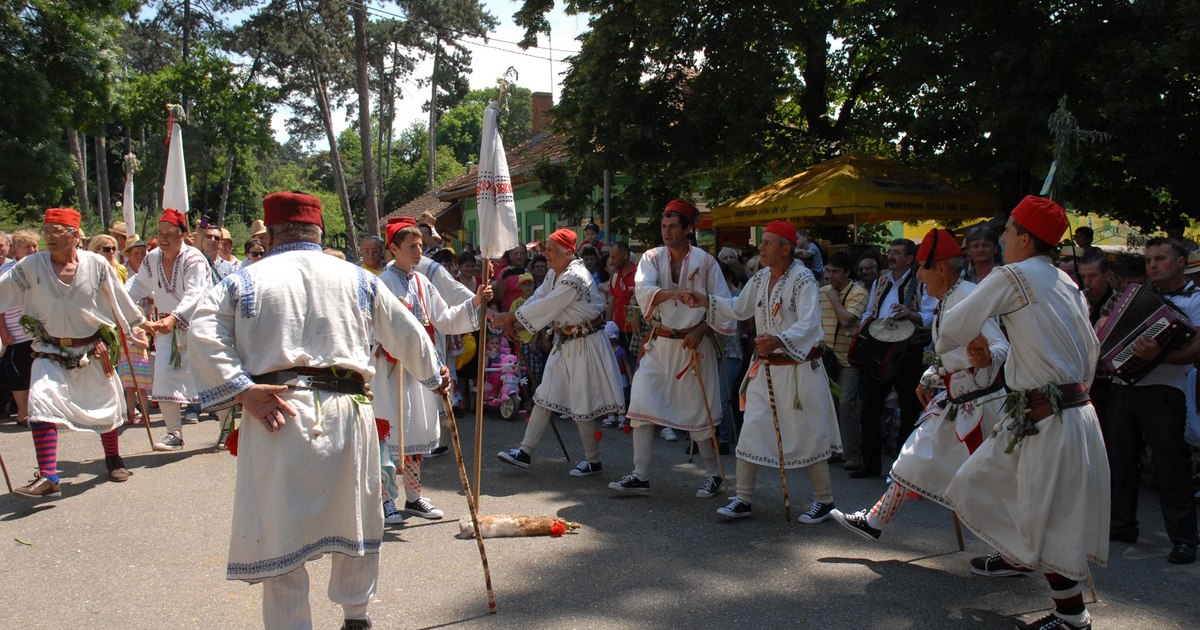
Pentecost is the time when the gaggles start their foray through the villages. It is a custom still preserved in the south of the country, with unwritten rules of gang members.
Vătaful George Ghiță, proud of the prizes won by his FOTo students. archive/A. Mitran
The days when the gaggles can be found in dozens of localities in southern Romania begin on Sunday, May 31, 2026, and end, in most places, on the following Sunday. Decades ago, the gag ritual required that it be played for nine days, says George Ghiță a lu' Porumbelu, a well-known vâtaf from Olt county. Calușarul revealed, for “Adevărul”, some of the secrets of the game that conquered the whole world.
The gag, today's increasingly spectacular dance on stage, has lost a large part of the ritual, but the “dirt gags” have a few mandatory elements.
I asked George Ghiță, who today teaches the gag to children and young people from the towns of Osica de Jos and Osica de Sus, in Olt county, what is still preserved from the old ritual.
“It plays for nine days. It starts on Sunday and gets buried on Tuesday”
“Starting with the taking of the oath, everything is respected. What I learned from the elders of the state I put into practice and all the generations that came after me, the children who went to play the gag on Pentecost, did not deviate in any way”said the witness. It should be noted that the ritual game is reserved for teenagers and young people, there is no place for children or girls in the formation.
The oath of the gang or band of swindlers is taken, in the Osica-Dobrun area, says George Ghiță, on Saturday evening, on the eve of Pentecost, before sunset. The Calușarii will begin their raid through the villages the next day, from Pentecost Sunday.
“Have you seen what a gag flag looks like? It's a stick and what else does it have? How many heads of garlic are there? Nine, right? It is the answer to the question. It is played for nine days. It starts on Sunday and is buried on Tuesday. That's why they put nine heads of garlic. And when they are buried, for example in my area, you have to go to Olteț, on a running water, there to cut a bit of the flag, and with the wormwood that is left, and with the garlic, because everyone flocks to them, but they are expensive, you don't have to give everything, we let them go on the water. The burying of the gag, in our area, does not mean that we bury it somewhere in the ground, we let it go on the water”revealed what the ritual entails that the boys who learned the dance and the custom from George Ghiță practice today.
The “Procession of the Gags” will reach its 25th edition in 2026 PHOTO: www.traditiidoljene.ro
Today, as much as they would like to, the band members cannot play for nine days. “They go on the day of Pentecost, on Sunday, they go on Monday and rarely on Tuesday. Wednesday, Thursday, Friday – they don't go anymore, because people go to work, gone are the days when they went with the plow, when it was the big girl. You look at them when they finish the 8th grade and they already take each other to cover the houses with tin. I don't come to rehearsals anymore. Things have changed a lot,” add the wataf. The bogeyman is played again the weekend after Pentecost, and the ritual ends with “the buried gag”, after nine days.
From generation to generation, boys become harder to control, says the watchman. The former competition, on the other hand, is missing, today it has become difficult to keep them, let alone fight with each other to maintain or win their place in the formation, reveals the veteran.
The people who still enjoy watching the spectacular dance no longer believe in the magical powers of the gags, so the custom is slowly changing. It is also a natural evolution, and in this sense the vataful relates a situation that could have ended very badly.
Years ago, after an event at an important event organized in Bucharest, he was with the band of gags he was coordinating in a public place in the Capital, when he was approached by a policewoman who informed him that he would have to give a statement, because one of the members of the band, most likely the mute of the gag, would have made obscene gestures towards the public. It was at this point, he says, that he gave up using the phallus in the show, otherwise an important element in traditional ritual – related to fertility, regeneration, vitality and magical protection and not in any way obscene.
In fact, many of the elements of the gag are today much toned down, being adapted for the stage and the urban audience and removed from the official festivals.
What gaggers care about is the “brand” of each zone, though that too has become difficult to achieve, as the spectacular figures of one gag formation are often taken over by others, even if that means bringing in elements from outside the zone you represent. This is not the case with George Ghiță's young apprentices, says the witness, instead there are many other gaggles who have taken over from their elements.
Oltenia under the magic of the Calusaris. The divine stud that danced in the dust VIDEO
What happens in the host's yard
If today whoever gets the gag does it especially to see the “air dancers” perform, in the past people believed in the unsuspected powers of the gags.
A whole ritual took place, partly preserved. The host welcomed the gaggles in the middle of the yard, where he placed on a table or directly on the ground a reed or a carpet on which he placed the mandatory elements – a straw with salt, wheat, garlic, wormwood, water. All these elements were “played” alongside the flag, thus considered to have been “sanctified” to bring abundance and health.
The spectacular dance, performed at the signal of the wataf, had the role not to impress, but to drive away the Ieles and evil spirits from the yard.
The mute, the character that in recent years has been recovered, he was absent for a while from the gag procession due to various controversies, in turn makes his own show. He is primarily the one who does not allow anyone to enter the circle drawn around the gang of gaggers, this space thus marked being the area where the dancers evolve.
In fact, experienced dancers explain, the humorous evolution of the mute was also the way to give the dancers a chance to catch their breath after the grueling performance.
In the past, people believed so much in the powers of gags that mothers would bring their crying babies to be “played” and thus cured. The villagers did the same with the sick, considered to be “taken from the gag” and brought for healing.
In the healing ritual, the Galuşians used wormwood and garlic, at the end the one brought for healing was touched with a stick or suddenly lifted from the bottom, in a gesture that symbolized the removal of disease from the body.
The lucky ones, among those who took part in the ritual, were chosen with wormwood and garlic which they could later use in healing practices. It should be noted that the effort of the gaggers was rewarded in measure, in the past there were few who could afford to welcome the gaggers into the yard.
“Alaiul calășului Oltenesc”, anniversary edition in Craiova
And if in Olt county there will be almost a whole month reserved for the gag, the performances starting with incursions of the little gags in the county and culminating with the Children's Dance Festival “Romanian Gag” from Slatina, in the neighboring county, in Dolj, where the custom is also preserved in several localities, you can join the chorus with the gags even on Pentecost Sunday.
Who won the trophy of the biggest children's festival in the country, organized in the “Land of clobbers” VIDEO
The Dolj County Center for Culture and Art – the Department for the Conservation and Promotion of Traditional Culture announced that it is organizing the “Oltenesc Calușului Procession” – the 25th edition. The event is one of reference in Dolj county, and in 2026 the people of Craiova and their guests will enjoy the meeting with the gangs from the localities: Dăbuleni, Giurgita, Sopot (Petroaia village), Șimnicu de Sus (Leșile village).
The show begins on Sunday, May 31, 2026, at 9:00 a.m., in William Shakespeare Square – the esplanade of the “Marin Sorescu” National Theater, and the spectators will be able to join the chorus with the gags, as happens every year and how the evolution of the gags that were welcomed in people's yards ended in the past.
From 10:00 am the marchers will start the parade towards “Nicolae Romanescu” Park, on the route “Marin Sorescu” National Theater – Buzești Brothers Square – Lipscani Street – Unirii Street – “Nicolae Romanescu” Park (Debarcader area). Gangs of gaggles will play and share wormwood and good cheer, “but also the hope that evil will avoid us in everything”, the organizers emphasize.
“CThe ghosts must be welcomed in all houses because it is believed that the Dînsele and Ielele flee from them, who harm the householders, repent and steal the children. After the games are over, they smash their objects or insignia (the rabbit, the sticks and the whip), bury them and run away without looking back, so that they don't regret Pentecost.”stated Tudor Pamfile in the volume “Romanian Holidays”.
It should be noted that the fascinating game brought Dolj County two honorary titles of Tezaur Uman Viu, the first in 2010, awarded to the head of the Ceta de Calușari from Giurgița – Dolj commune, Nicolae Veleanu, and the second, in 2024, received by the head of the Ceta de Calușari from Dăbuleni, Dumitru Șotorog.
Caluș was declared a Cultural Masterpiece of Humanity in 2005 and since 2008 it has been included in UNESCO's Representative List of Intangible Cultural Heritage of Humanity.