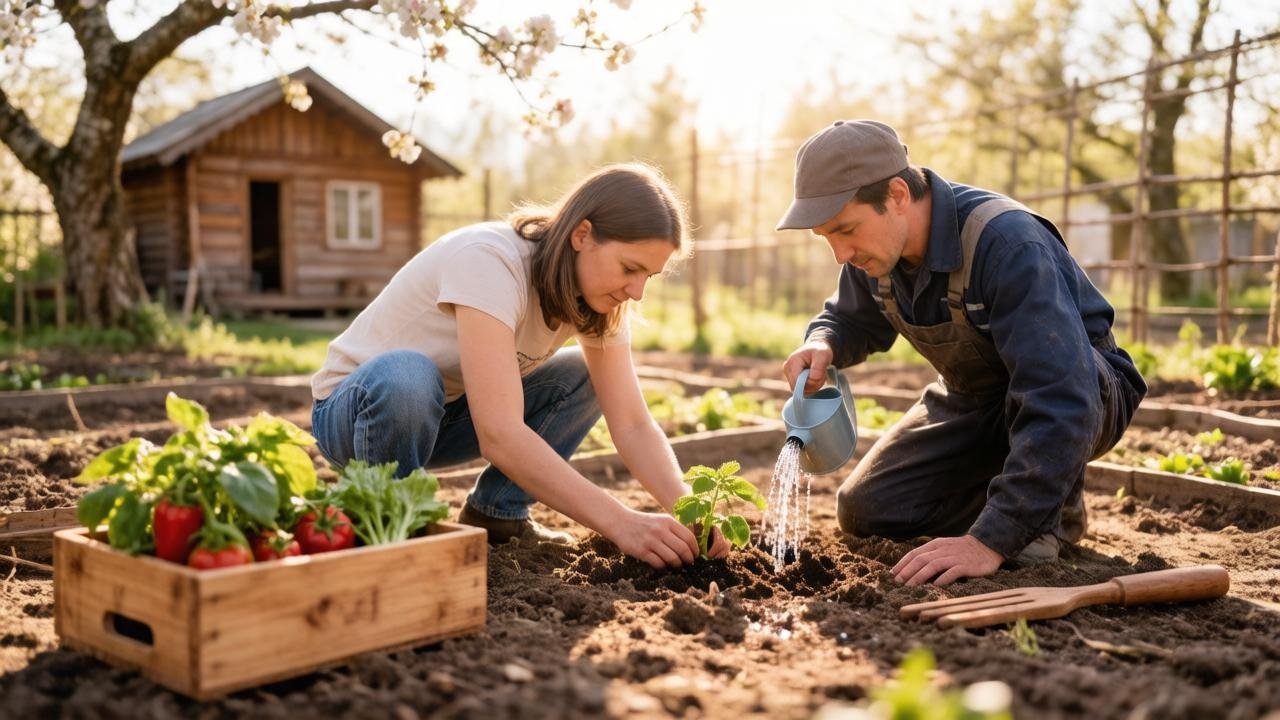
Immediately after transplanting, the tomato roots are under stress. The small roots that absorb food are damaged and the plant cannot eat normally. If at this moment concentrated mineral water or fresh organic matter is lying next to the roots, a chemical burn occurs. The bush does not just slow down – it spends all its energy on restoration, and not on growth.
Fertilizers from the bag begin to work only after the plant has taken root and started growing. Until this moment, the roots do not need abundant nutrition, but soft, non-acidic soil with a minimum set of available elements.
Wood ash
Place two good handfuls under each bush – approximately 100-150 grams. The ash is mixed with a small amount of soil directly in the hole and the roots are lowered into this mixture. There should be no pure ash in direct contact with the root – only through the soil.
“I saw the difference for the first time when I planted two identical bushes next to each other: one with ash, one without. After five days, the bush with ash had already begun to grow a little, the second stood for another four days. Then I repeated this experiment several times on different varieties. The picture did not change,” the author of the Zen channel “Garden Cribs” (12+) shares his observations.
Humus
Improves the soil structure in the hole, retains moisture and gives the plant soft, gradual nutrition. Place half a bucket on the hole and mix it with garden soil. If there is a lot of humus, that’s good, it won’t do any harm. If there is none at all, you can replace it with mature compost. But fresh compost, where decomposition processes are still ongoing, is not suitable for the same reason as manure.
Onion peel
The husk contains phytoncides and flavonoids. They work as a natural defense against soil fungi and small insects in the soil. This is not a treatment or a spray. Just an environment in which the roots are more comfortable.
Place a handful of dry husks at the bottom of the hole, under the humus. Nothing is steamed or soaked – just put in dry. Over time, it rots and becomes part of the soil.
How to put everything together when planting
The husks are poured into the bottom of the hole. A mixture of humus and garden soil is placed on top, and ash is added there. The roots are lowered into this pillow, straightened out, sprinkled with earth and gently compacted with your hands. On the day of planting, water only with clean warm water – about a liter per bush. If the ground is cold, the water is heated to 30–35 degrees.
Previously, we reported on three popular ways to get rid of dandelions on your property.