in Beijing, the breakthrough was visible to the naked eye

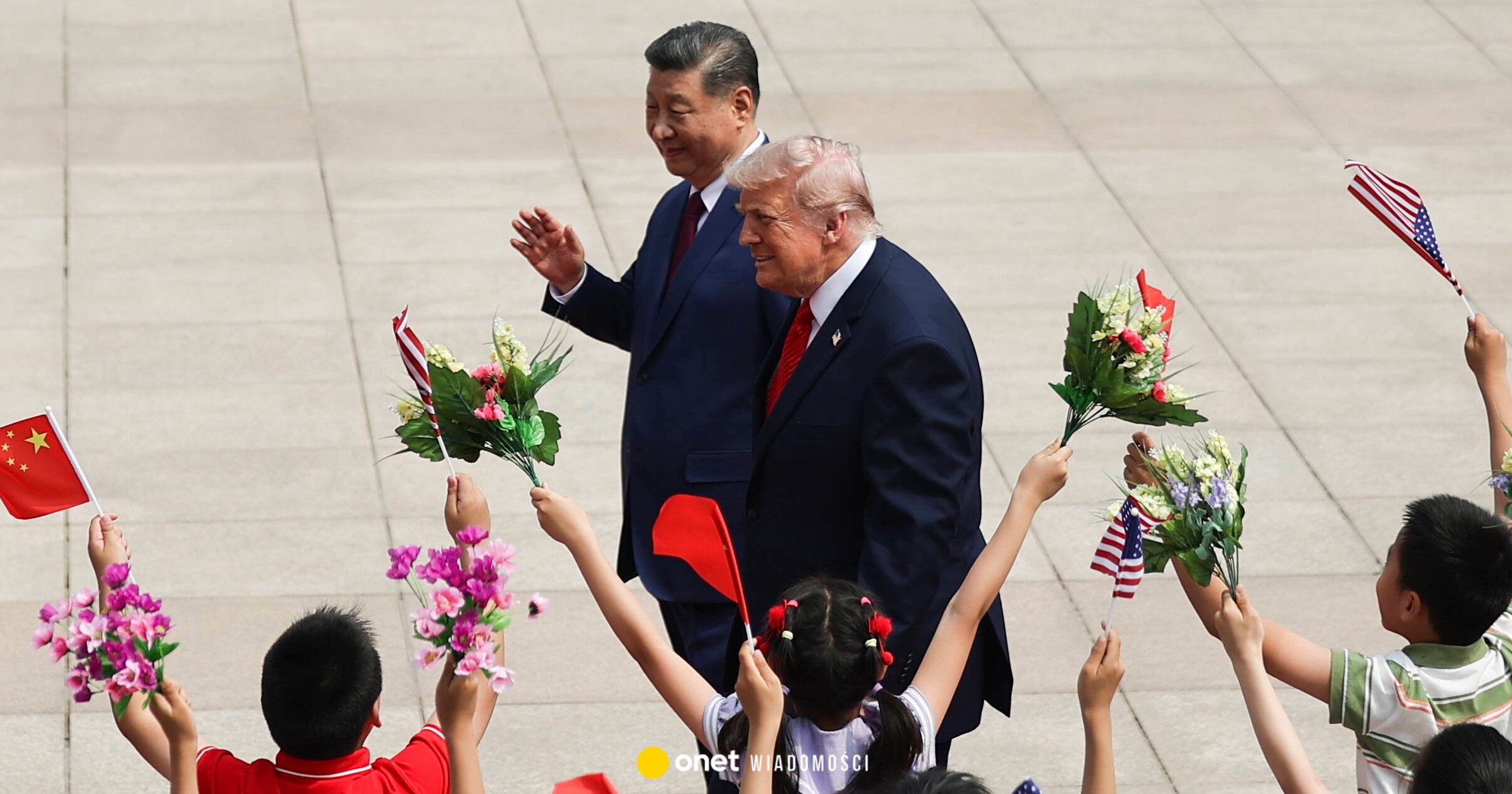
On May 13-15, US President Donald Trump stayed with the so-called state visit to the People's Republic of China. The very fact that the visit had the highest – state, and not official or even working – importance and was accompanied by the most extensive ceremonial meant that observers, including the author of this text, expected groundbreaking decisions and far-reaching arrangements. Meanwhile, nothing of the sort happened.
As a result, I am presenting this text to you only today, because having learned very little, I expected further leaks. In fact, the breakthrough was visible to the naked eye. But there is a problem with it.
The problem is that the breakthrough involved neither Taiwan, nor Iran, nor Russia, nor Ukraine.
During the summit, the far-reaching assertiveness of the President of China and General Secretary of the Communist Party of China, Xi Jinping, was evident. Already while greeting Donald Trump, the Chinese leader spoke about the Taiwan issue in a very decisive manner, containing an almost directly expressed threat.
It was also clearly visible that although the Chinese side formally declared that it was against Iran acquiring nuclear weapons, it did not support the United States in the Iran case in any way, even the slightest. There was no breakthrough in trade relations, and the crisis in relations was not resolved but rather postponed as a result of the visit.
It was characteristic that even when a tangible agreement was reached regarding the purchase by Chinese airlines of a total of 200 Boeing passenger planes, the shares of the American manufacturer fell, not increased. Everyone expected an order not for 200, but for 500 aircraft.
The expectation that a Sino-US summit meeting will result in some significant agreement is probably a derivative of the historical Soviet-US summits that culminated in the signing of fundamentally important nuclear arms limitation agreements – as was the case with the meetings between Richard Nixon and Leonid Brezhnev, Gerald Ford and Brezhnev, and Jimmy Carter and Brezhnev.
Earlier meetings between Presidents Dwight Eisenhower, John Kennedy and Nikita Khrushchev did not end with the signing of similar agreements, but resulted in some minimal calming of relations between the two countries. Later summits between Mikhail Gorbachev and Ronald Reagan, and then his successor George Bush, led first to détente and then to the signing of disarmament agreements ending the Cold War.
Trump-Xi summit: Russian propagandist explains what's going on
Nothing like this happened in the case of the Trump-Xi summit. A hypothesis put forward by Fyodor Lukyanov seems to be a credible explanation for this state of affairs. Although he is a Russian propagandist, he also publishes very important analyzes as the editor-in-chief of the Russian foreign policy magazine “Russia in Global Affairs”.
In one of his latest texts, Lukyanov, although not directly referring to the China-US summit, claims that agreements with Trump cannot be groundbreaking by nature. The President of the United States has a very unsophisticated way of understanding international politics, the essence of which is the word “deal” he loves. The problem is that Trump understands a “deal” more as a short-term, not necessarily long-term transaction, rather than an agreement in the traditional sense of global diplomacy. If this is in fact the case (and everything indicates that it is), then it becomes natural that a self-respecting partner – and such is China in its relations with the United States under Trump – simply could not conclude any fundamental agreements.
There is one more reason why, expecting significant results from the summit but not seeing them, I made a mistake by refraining from publishing the text. I assumed that if the leaders of the two largest powers meet, then, apart from the question of Trump's character, an agreement must by nature be reached. This has always been the case for over 60 years when the two most important people in the world met.
The point is that the Soviet-American summits took place in the reality of a bipolar world. At that time, not only the two most powerful people met, but also two politicians who not only had no equals, but who headed military-political blocs. But the world is no longer bipolar, but multipolar. Smaller countries such as Germany, Great Britain, France, Japan, South Korea, Russia, India or Brazil or blocs of countries such as the EU are closer or further from the main poles, but they are also independent players. As a result, agreements between the two most important powers are inherently less important.
So, just as Trump's power is a shadow of the power of his Cold War and post-Cold War predecessors, Xi actually weighs less in world politics than the General Secretaries, but not the CCP, but the CPSU. For this reason alone, the significance of the Sino-American summit must simply be less important than the Soviet-American summits whose echoes experts have been looking for.
Perhaps the only similarity to the Soviet-American summits is that, just like during the “late” Brezhnev, they were also attended by one old man whose intellectual condition can be seriously questioned. The difference is that this time the old man was the President of the United States.
What's after the summit? Five conclusions
Although the Sino-American summit did not bring any ground-breaking decisions, several important conclusions can be drawn.
The first and most basic is that for probably the first time in the history of summit meetings between Beijing and Washington, equal partners met. A measure of China's strength was the almost complete disregard by the Chinese media of Donald Trump's compliments towards both Xi personally and China as a whole. The summit in Beijing completed what had been obvious for some time, but which had not yet found a symbolic act heralding a new era. Well, there are two superpowers in the world today and they are the United States and China.
Secondly, it is very clear that Russia, apart from its nuclear potential, the value of which is greatly overestimated, today has a status closer to a minor power than to the two major powers. A measure of this, paradoxically, was Moscow's announcement of Vladimir Putin's visit to Beijing, which happened exactly on the day Trump's visit to China began. Moscow, certainly despite its intentions, has shown the world that it really wants to emphasize how much it matters. The point is that the one who has to emphasize such a thing always means less than he wants to mean.
Third, it is evident that the United States is much weaker today than it was not only during Trump's first term, but even just two years ago, during Joe Biden's presidency. Under Biden, the US was strengthened by the strength of its alliances, now dramatically weakened by Trump. They have also not been bogged down in the war with Iran, which is much less bloody for them than the Afghan one, but actually weakens them much more. The powers are bleeding not the victims of their wars, but their political costs.
Fourthly, it is very clear that Beijing has completely abandoned the method of politics recommended by the legendary Chinese leader Deng Xiaoping. He taught that the Middle Kingdom should be patient and build its power in silence. The Chinese have already felt the power very clearly.
However, the most important conclusion from Donald Trump's visit to China was presented by the already quoted Fyodor Lukyanov. This conclusion is important for us because it tells us, on the one hand, not to trust Washington, but, on the other hand, not to panic when Americans communicate, for example, with Russia. In the world of the current tenant of the White House, not only alliances are unstable, but also betrayals.