
The municipality's general plan is one of the most important reforms affecting the real estate market in Poland in recent years. The new regulations are intended to bring order to the spatial chaos and increase the predictability of investments, but in the short term they may cause serious tensions. This year will be crucial – and whether local governments will manage to adopt documents that will determine the future of many investments.
Read also: Apartments for rent in Poland. KZN is developing Social Rental Agencies
General plan of the commune – key changes for the real estate market
The general plan of the commune is a mandatory act of local law that replaces the study of conditions and directions of spatial development. It covers the entire territory of the commune and constitutes the basis for local plans and decisions on development conditions.
In practice, this means just that this document will decide where development will be possible and where investments will be limited.
— The obligation to adopt general plans comes into force one of the most important and systemic changes for the real estate market in recent years – says Tomasz Czubak, member of the management board and investment director of Pekabex Development. — Its importance goes beyond planning issues and may determine the pace of construction of new apartments, the stability of the land market and investment security – he adds.
The key change is that after 2026, decisions on development conditions will only be able to be issued in areas indicated in the general plan.
The south of the country is clearly ahead when it comes to adopting general plans
See also: Access to land and mortgage registers in mObywatel. What will change for users?
Master plan deadlines – time pressure and risk of delays
In accordance with the regulations municipalities have until June 30, 2026 to adopt general plans, although in practice it is increasingly suggested that this deadline be extended until the end of August.
The scale of the challenge is enormous. At the beginning of 2026, general plans were adopted by only a few dozen municipalities across Poland (as of the end of January: 21 units)which shows how much work still needs to be done for local governments.
— Many communes will not be able to adopt the general plan by the end of the first half of the year – says Grzegorz Kubalski, deputy director of the Office of the Association of Polish Counties. – This is not a surprise, because it was already pointed out at the stage of work on the regulations that the time assumptions were unrealistic – he adds.
At the same time, the expert emphasizes that the lack of general plans does not mean a complete stop to investment.
— This will be some difficulty, but not paralysis. Local development plans and previously issued decisions on development conditions are still in force, he notes.
Real estate market – risk of limited housing supply
From the developers' perspective, they are crucial consequences after the statutory deadline.
— After 2026, decisions on development conditions will only be able to be issued in areas indicated in the general plan – says Tomasz Czubak. – This means that the municipalities that will not make it will realistically will block the possibility of launching new housing investments – he emphasizes.
The expert also points to risk of the so-called “planning traffic jam”.
– If the pace of work does not accelerate, we may see a period in which investments will be suspended not for market reasons, but for formal reasons – he says.
The consequences may be felt for the entire market: limited land supply, extension of investment processes and pressure on housing prices.
— The real estate market works well in advance. If there is a slowdown in project launches in 2026, its effects will be felt in 2027-2029 – adds Czubak.
Local governments and developers – different perspectives of the same reform
Local governments emphasize that preparing general plans is a complicated and time-consuming process, requiring extensive analyzes and consultations.
— Work in Ożarów Mazowiecki is ongoing and I am convinced that we will meet the deadline, says Paweł Kanclerz, mayor of Ożarów Mazowiecki. – Although I think so this type of solutions do not help local governments like ours – he adds.
At the same time, he indicates that the situation of his commune is stable.
— We are not at risk of investment paralysisbecause we have local plans in force on the basis of which investors can act – he emphasizes.
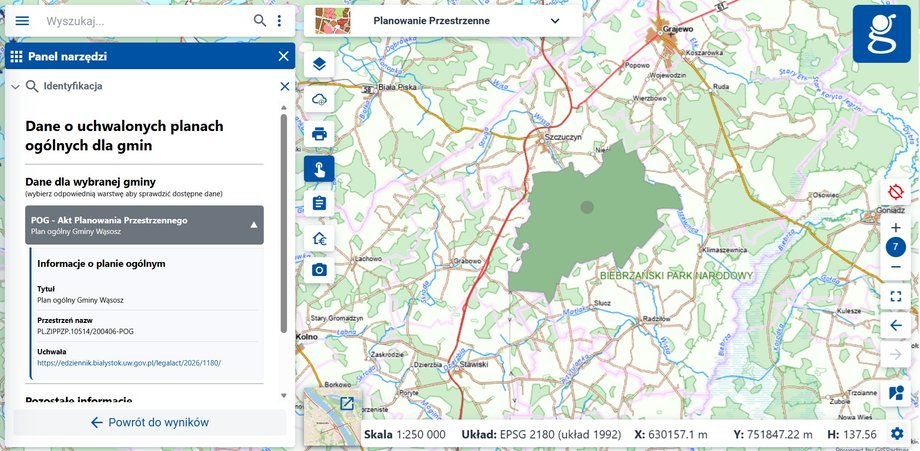
Wąsosz is the only commune in the province. Podlaskie, which has already approved the general plans
Read: Sale of an apartment under the microscope of the tax office. New rules and more control
Developers look at the situation more broadly.
— The key challenge is not the change in regulations themselves, but the pace of their implementation, says Jakub Sobczyński, managing director of the Megapolis Group. — If general plans are not adopted on time, this may mean periodic decision-making uncertainty and difficulties in preparing new investments – he adds.
At the same time, it reassures us that we should not assume the worst-case scenario.
— I wouldn't expect complete market paralysis, especially in large cities where developers have secured land portfolios, he notes.
The master plan and the future of investment – between governance and the risk of blockage
In the long run, the reform may bring positive effects: greater predictability, better infrastructure planning and reduced spatial chaos.
However, in the short term the pace of work in municipalities will be crucial.
— Much depends on how local governments use the new tools, says Jakub Sobczyński. — If general plans allow for the development of a residential function, they may increase the availability of land. Otherwise limited supply may lead to further pressure on prices – he adds.
In turn, Grzegorz Kubalski draws attention to the most sensitive areas of the market.
— Problems will arise where development was based mainly on decisions about development conditions – says. – In such places it may turn out that a specific investment cannot be implemented – he sums up.
The coming months will be crucial for the entire real estate market. If municipalities speed up their work, the reform may become a development impulse. If not, 2026 may bring a period of temporary blocking of investments, the effects of which will be felt by both developers and apartment buyers.