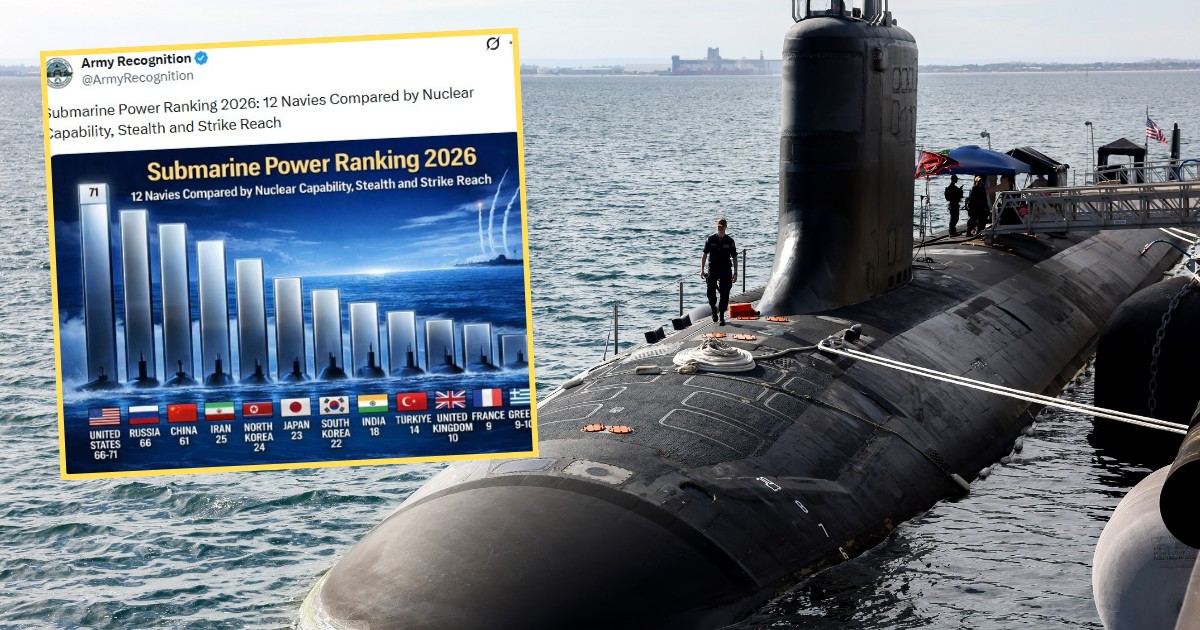
Experts from the website armyrecognition.com, specializing in defense, have prepared a ranking of the world's largest powers in terms of the size and quality of their submarine fleet. However, they point out that in such summaries it is not only numbers that count. What is surprising in the ranking is, for example, Iran's high, fourth position, which – as it turns out – does not necessarily mean much power. In addition – as the authors of the ranking note – Tehran's fleet has recently been severely damaged as a result of the armed conflict with the USA and Israel. “Iran is the clearest example of why fleet size alone can be misleading,” it concluded.
See also: Polish killer whales in the Baltic Sea. New submarines may change the balance of power in the region
Which countries are at the top of the ranking and what are the differences in their fleet capabilities? The podium is not surprising – the United States is the leader with about 70 submarines, but it is not the number itself that makes it difficult to compete with them.
Submarines. China “dynamic”, North Korea “strategically dangerous”
The main advantage of the US submarine fleet is its almost complete nuclear nature. According to the authors of the list, “the combination of amphibious submarines, guided missile submarines and ballistic missile submarines gives Washington a full spectrum of capabilities, from covert ISR warfare and anti-submarine warfare to land attacks and strategic deterrence.”
Right behind the USA is Russia with 66 fleet units. According to the authors, its doctrine is based on survival and escalation control, and the main goal is to “defend bastions”. Russian submarines are designed not so much for global expansion, but for “strategic retreat” or “theater disruption”.
China, with 61 submarines and ranking third in the ranking, is considered the most dynamic in this field. Their fleet is growing rapidly, and the Chinese are increasingly focusing on the production of nuclear-powered ships. While still focused on protecting coastal waters, their fleet is evolving to operate in distant seas and escort carrier groups.
See also: The great race for aircraft carriers. Russia is left behind
Iran came surprisingly high, in fourth place, but its navy strength is smaller than the number of ships would suggest (25 – more than half as many as China). Moreover, Iran's fleet has recently been severely damaged as a result of the conflict with the US and Israel.
Just below Iran we have North Korea, which the authors consider “strategically dangerous”, although its fleet is based on outdated vessels. However, submarines serve as a tool for asymmetric warfare, pressure on neighboring countries and the creation of a nuclear component of the navy. According to armyrecognition.com, in the case of North Korea, “unpredictability is part of the weapons system.”
The next positions in the ranking were: Japan (23 ships), South Korea (22 ships), India (18 ships), Turkey (14 ships), Great Britain, France and Greece. The last three countries have between 9 and 10 submarines.