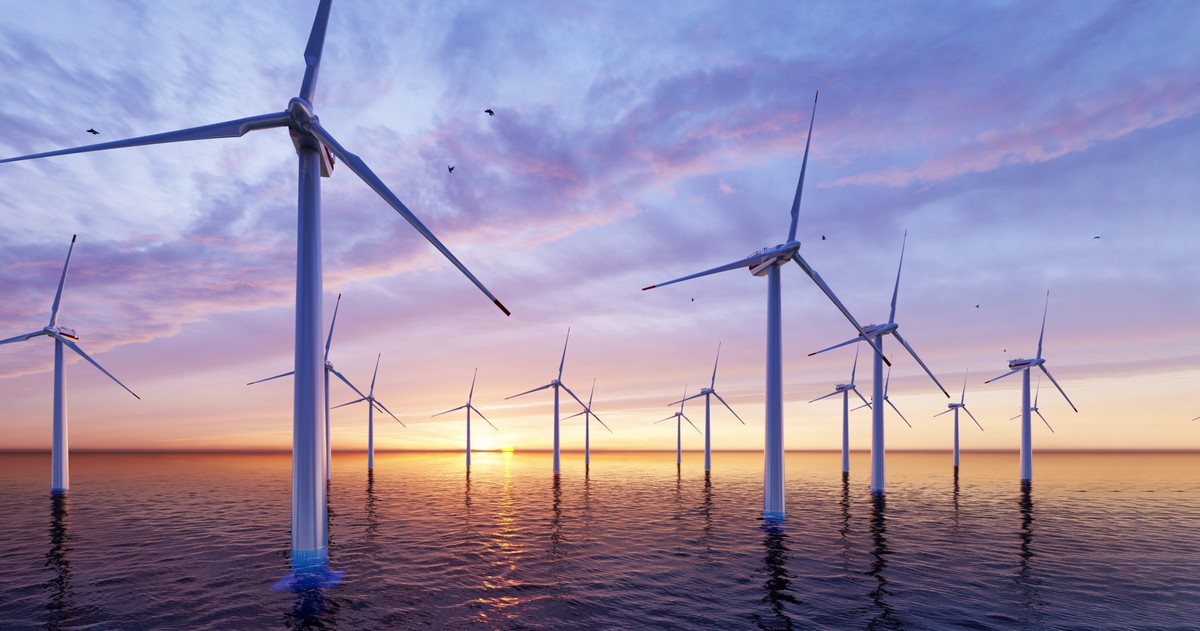
Already next year, the first current from wind farms at sea is to appear in the national power system. To Baltic Power, the joint investment of the Orlen Group and Northland Power, in the following years more projects will join, implemented by PGE and Ørsted, Polenergia and Equinor, Ocean Winds and RWE, and to ensure in 2030 5.9 GW of installed power.
By 2040, this number is to increase to 18 GW, and the overall potential for maritime wind energy in our country is estimated at 33 GW, which could translate into covering up to 57 percent. Electricity demand.
A lot has been said about the energetic strength that lies in sea windmills, but what about their meaning for production companies and component suppliers? In the era postulated at the highest level of economic patriotism, the industry can provide a developmental impulse and market for Polish entrepreneurs; As the creators of the proposed industrial strategy argue, not only can, but should also.
Read also: “We reach a milestone”. A breakthrough contract of the Polish shipyard [WYWIAD]
We can afford more?
The document entitled “Polish Strategy for the Development of the Polish Wind Farms” was prepared by the Polish Wind Energy Association and the Wind Industry Hub Foundation in cooperation with CEE Energy Group. The full version of the version has up to 400 pages and, starting from the diagnosis of the maritime role of wind energy in the energy transformation of Poland and Europe, goes to the assessment of current policies, summaries of previous experiences and finally appropriate recommendations.
By 2050, investments in the offshore industry in Poland can reach up to PLN 400 billion. Analysis of Bank Gospodarstwa Krajowego from 2023 showed that over 200 domestic companies can engage in the implementation of projects; Still, the so -called The first phase, the effects of which we will see at the end of the decade, turned out to be an unused opportunity.
The participation of Polish entities did not exceed several percent in it, and the survey showed that according to 63.5 percent. Asked stakeholders “could have been better”. Among the threats to the development of the national supply chain, factors such as employee deficit (56 percent of indications), lack of access to financing (29.3 percent), but also no specific strategy (42.7 percent) were indicated.
73.3 percent were in favor of urgent development of the document. examined. Experts want him to gain a state rankalso implementing the provisions of EU law, including last year's regulation on neutral emission (Net Zero Industry Act), which says, among others on shortening the issuing of permits and accelerating investment processes. “Poland should be ready to indicate its proposal as part of an industrial strategy in European termsdetermining what products and services will achieve the status of European champions, which of them should mainly use regional supply chains, and which components can be imported without significant risk from outside the EU, while maintaining a specific level of production capacity in Europe ” – we read.
Foundations and transformer stations
What elements of wind turbines placed in the Baltic Sea can provide Polish companies? Among the components with the high potential of domestic production, the strategy mentions both the towers themselves (constituting up to 20 % of investment costs) and shovels (similar in size), generators, bearings, cooling systems and hydraulic systems or security measures.
As part of the so -called priority implementation programs the authors of the document assumed that from 50 to 75 percent components It can come from Poland for turbines emerging in Europe. They also assumed that pOnad 50 percent implementation and design works For farms.
The next areas in which we can prove ourselves are the assembly of foundations by Polish shipyards and ports, but also Designing transformer stations. As we read, every such facility for Polish farms should be built on the spot, which will also allow further development of competence. Development opportunities are also created by cable production, installation services and operation of operating farms (including using artificial intelligence).
After school – to study with offshore
Where to look for financing for national projects? The solution may be, among others Programs of the National Fund for Environmental Protection and Water Management; According to the authors of the strategy, they should have the annual budgets of the order until 2035 PLN 500 million. Investments in production capacity can also be allocated to emission allowance, and possibilities are also facing the initiatives of public-private partnerships, e.g. with the participation of Bank Gospodarstwa Krajowego or the Polish Development Fund.
Further suggested instruments in the field of public aid permissible by the EU are a separate investment fund or the program of the development of port infrastructure. The state may also call Guarantee Fund For companies producing components, and securing demand for delivery and services is enforceable thanks to long -term contracts.
The strategy also raises the problem of insufficient number of qualified employees and competence gapwhich they can overcome the appropriate one training programs – Including people looking for opportunities to change.
Expert proposals already include the level of primary schools in which students could gain basic knowledge about renewable energy; Special fields of study would also arise in the design of turbines or in other areas necessary for the industry. Its constant development would be supported by innovations financed from deliberate funds, which should also apply to the issue Farm safety – both physical at sea and digital.
504 percent increase in turbine imports
In the authors' conviction of the proposed strategy, strengthening national supply chains in the offshore industry should be used by the entire complex, institutional ecosystem, which would include such public units as the National Center for Research and Development, the Polish Agency for Enterprise Development or the Industrial Development Agency, and which would also be in contact with the European Commission.
As for the latter, strengthening Local Content – the involvement of local entities – is also needed at EU level. Although local suppliers are still dominating in European offshore markets, their competitiveness is planned today.
The value of wind turbines to the EU in 2012-2022 increased by 504 percent, and China dominates among the directions from which we import technologies. The trends that the authors of the strategy discuss are disturbing; In a few years, all key elements of supply chains for marine wind farms, from installation vessels, through steel, towers, blades and gondolas can become narrow throats for investments.
Meanwhile, the plans are very ambitious. According to the Wind Europe report published at the end of March, the EU is to have 48 GW of power installed in sea windmills by 2030; 10 years later it will be 150 GW. Meanwhile, in 2024, in the entire community, the power of sea wind farms was 21 GW.
Time pressure
How to achieve high goals? In addition to the standard strengthening of European production potential, including acceleration of permits and ensuring a stable regulatory environment, Wind Europe calls for the development of the network (which, of course, not only applies to windmills at sea, but also those on land).
Read also: New recipes for windmills. The power is to double until 2030.
A strategy that, apart from the lever for domestic companies, would also play a role Polish pebble to the European gardenAccording to its authors, it should be accepted by the government until June 30. The end of the year is, in turn, the recommended date for accepting a detailed implementation document.
“Time pressure results from the schedules of contracting components and services For projects from the so -called The second phase of offshore, as well as open negotiating processes in the field of international partnerships in the implementation of projects for which in 2022 the Minister of Infrastructure issued positive decisions in decisive proceedings, “explain the creators of the document. Caused by the Prime Minister the spirit of repolonization should favor this.