“We're coming back.” The Artemis II mission is heading back to Earth. What the astronauts saw when they circled the moon and when they will get home

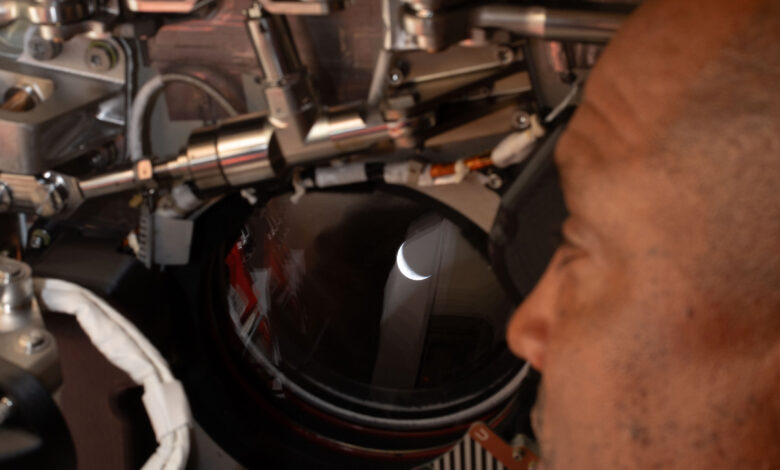
Unknown lunar craters, a sunset and a sunrise of the Earth and a solar eclipse: after a flight above the Moon full of memorable moments, the four astronauts of the Artemis mission resumed their way to Earth, reports AFP.
“We're coming back,” said Christina Koch, a seasoned explorer who is making history as the first woman to fly above the moon.
US President Donald Trump called them to congratulate them warmly.
“Today you've made history and you've made all of America really proud, incredibly proud,” he told Americans Reid Wiseman, Victor Glover and Christina Koch, as well as Canadian Jeremy Hansen, who had not only just completed the first flight around the moon since 1972, but had gone further into space than any human before them, more than 406,000 km from Earth.
Glued to the portholes for almost seven hours, they benefited from an unprecedented perspective to observe the Moon, from a higher altitude (6,500 km) than the view of their predecessors in the Apollo mission, from a hundred km.
Discovering in awe the lunar landscapes, they provided countless descriptions of the relief or the brown and greenish shadows of the lunar craters and soil.
“You can see a very beautiful double crater. It looks like a snowman. It's really hard to describe. It's incredible,” said pilot Victor Glover, who became the first black astronaut to take part in a lunar mission.
The astronauts noticed regions of the hidden face that “were never illuminated during the Apollo missions,” Jenni Gibbons, the Canadian astronaut who handled all communications with the crew from NASA's control room in Houston, told AFP at the end of this historic day.
“Some of the features that Artemis II observed and described today have never been seen by the human eye. This is the first time that the most sensitive cameras in the world, namely the human eye, have been able to observe them,” she explained.
They saw a sunrise of Earth
Their return will take place Friday off the coast of California, where the Orion capsule will land, slowed by parachutes.
NASA emphasizes the scientific importance of the mission. The flight was broadcast live and in very high definition on several platforms, such as Netflix and YouTube, thanks to GoPro cameras installed on the outside of the ship.
During the flight, the astronauts passed behind the Moon for 40 minutes, which interrupted communications, just as during the Apollo missions.
They witnessed this spectacle seen by only a few people in history: a sunset and a sunrise of the Earth. As well as an eclipse where the Moon blocked the Sun, worthy of “science fiction”, exclaimed Victor Glover.
They specifically intended to capture the sunrise of the Earth, just as in 1968 their predecessors on Apollo 8, the first to orbit the Moon, in a photograph that radically changed our view of the world.
Astronauts on the Moon in 2028
The distance record from Earth was only 6,000 km longer than that of the Apollo 13 crew in 1970, but it was celebrated by NASA and President Trump as evidence of the revival of the US manned space program – with Trump even promising a mission to Mars one day.
“We are choosing this moment to issue a challenge to our generation and the next to make sure this record is short-lived,” Jeremy Hansen said shortly after the record was set.
The crew took the opportunity to make a special request: to name two lunar craters, one in honor of their ship, christened “Integrity” (“Integrity”), and the other in honor of Carroll Taylor Wiseman, the commander's deceased wife, which brought the crew to tears.
The day began with another emotional moment, with a message from Jim Lovell, pioneer of the Apollo 8 and 13 missions, recorded a few months before his death in 2025.
“I know you'll be very busy, but don't forget to enjoy the view,” the astronaut urged them. That's what happened.
If this mission and the next one next year go smoothly, the US space agency plans to send astronauts to the moon in 2028.