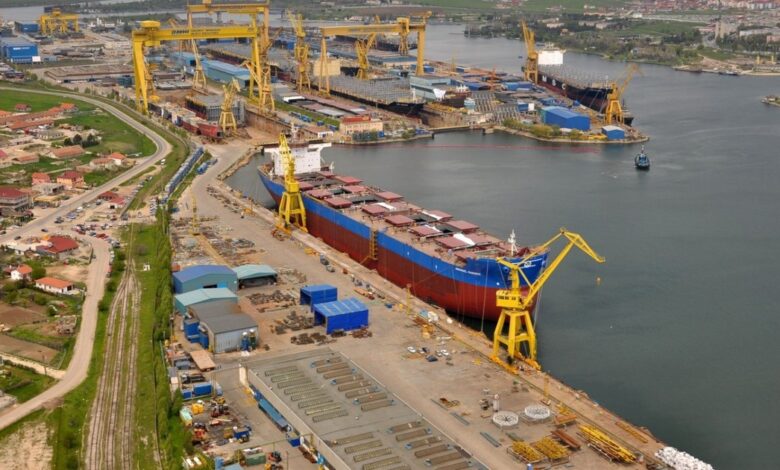
What began in 1956 as a vital repair center for the war fleet has today become a textbook case of administrative failure. The Mangalia Shipyard sees its future blocked by bankruptcy, amid legal and financial disputes between Romania and the Damen group.
The Mangalia Naval Shipyard was established in 1956 and formalized as a military unit in 1960
“On April 1, 1960, Mangalia Military Port No. 12 was established also comprising the Naval Shipyard, Detachment 301 Munitions, Detachment 310 Port Maintenance, Technical Barracks and Detachment 147 Auxiliary Ships“, as the Romanian Naval Forces explain in the history of the “Pontica” Naval Logistics Base.
Many years later, in 1976, the shipyard devoted to the construction of large tonnage ships was established, a structure that would become one of the largest in the region. During these years, the facilities in Mangalia have produced numerous commercial and offshore vessels, but have gone through multiple stages of transformation and adaptation to the global economy.
In 1997, the entity called Daewoo-Mangalia Heavy Industries (DMHI) was formed, as a joint venture between the Romanian shipyard and Daewoo Shipbuilding & Marine Engineering from South Korea, which represented the first major stage of integration into an international naval production chain. This partnership allowed access to technology and important contracts, and the company built over 100 new vessels and repaired hundreds more during its time under this management.
Later, in 2017, the Dutch group Damen Shipyards Group acquired the stake of the Korean partners, and in 2018 effectively took over the operational control of the yard, which was renamed Damen Shipyards Mangalia SA.
According to the associative structure, the Romanian state, through the state company Șantierul Naval 2 Mai SA, kept 51% of the shares, and Damen Holding BV held 49%, but the association agreement granted the Dutch group managerial control over the current activity.
Although the beginning associated with Damen was seen as an opportunity for industrial revitalization, in practice things have evolved into serious financial difficulties during the last few years. Against the backdrop of low demand in the European shipbuilding industry, international competition and internal organizational problems, the yard's economic performance has progressively deteriorated.
The financial problems started as early as 2022
In December 2022, representatives of the Free Navalist Union and the Federation of Free Trade Unions in Romania (FSLR) started large-scale protests at the headquarters of the Ministry of Economy due to the restructuring in Mangalia. The organizers of the protests said then that the representatives of Damen Shipyards Mangalia assumed, both through the association contract and publicly, that the number of employees would increase to 3,000, but at the moment the company has only 1,500 employees, fewer employees than there were when the Dutch company took over the share package.
Also at that time, the trade unionists complained that in the 4 years since the takeover of the construction site, this company has major financial losses every year and it is expected that it will continue to register annual losses and that, only from 2027, it will make a profit, although at the time of the takeover the foreign shareholder (Damen) assumed that “will exercise managerial and operational control in such a way as to cause the company to achieve operational profit in the shortest possible time, but not later than the end of the financial year 2024“.
In August 2023, the minority shareholder of the Mangalia Shipyard, Damen Holding BV, announced the cancellation of the legal operating framework of the association with the Romanian state regarding the Mangalia Shipyard. The Minister of Economy at the time, Ştefan-Radu Oprea, stated that he did not understand Damen Holding BV's decision to cancel the association with the Romanian state regarding the Mangalia Shipyard, as Damen is not in a position where any of its rights would be affected.
In March 2024, Damen sued Romania at an international arbitration court, demanding the termination of the association agreement concluded in 2018, through which the Romanian state became the majority shareholder (51%) of Damen Shipyards Mangalia SA, and in May 2024, Damen Holland requested the shipyard's bankruptcy.
The crisis at the Mangalia Naval Shipyard: in whose yard did the “dead cat” end up
Insolvency and layoffs
On June 19, 2024, the Constanța Court officially opened insolvency proceedings for Damen Shipyards Mangalia SA, at the request of the company itself, recognizing its inability to manage its debts and bring in enough new business to stay afloat.
The difficult situation was not resolved with the opening of insolvency. In 2025 and the beginning of 2026, the actual activity was severely reduced, and a large part of the employees was unemployed. For example, in February 2025 more than 200 employees were laid off, and about 1,000 remained technically unemployed, according to local unions, at a time when the shipyard was trying to find directions for a comeback or strategic investors.
In the autumn and winter of 2025, rescue plans were proposed by the receivers, including strategies to capitalize on the assets and to identify potential investors interested in resuming production, and at that time there were reported to be around 1,060 employees still working on the platform for contracted repair work.
However, disagreements between shareholders continued to hinder a real recovery. In March 2026, the reorganization plan proposed by the insolvency administrators was rejected by creditors, including the Dutch side, which condemned the construction site to the opening of bankruptcy proceedings and the dissolution of individual employment contracts.
In addition to the financial challenges, the situation has also become a social one, with employees who have not received their salaries for over three months and have organized protests to draw the attention of the authorities to the deep crisis in which the site is.
Official bankruptcy at Mangalia Naval Shipyard
Damen Mangalia Shipyard will enter bankruptcy and liquidation. The employment contracts of the employees will be terminated, the CITR judicial administrator informed, stating that the meeting of creditors rejected the company's reorganization plan. The reaction of the Ministry of Economy was not long in coming.
Damen Mangalia filed for bankruptcy by the Dutch parent company. Employees, sent into technical unemployment
Following the announcement of the judicial administrator of the Mangalia Naval Shipyard – CITR – the Minister of Economy, Irineu Darău, wanted to specify that the institution did everything possible not to end up here, the salaries being paid, but also that the bankruptcy means the end “the current form of organization, the entry of the construction site into conservation and the dismissal of employees, but it also creates the framework in which new solutions can be found and built”.
“The immediate priority is the people. The payment of outstanding salaries is ongoing. We have taken steps to accelerate this process, and the amounts related to the months of December 2025, January and February 2026 are in the payment procedure and will reach the employees in the next period. The Ministry of Labor is managing this process as a priority.
In parallel, we are working on the next stage. Bankruptcy means the closure of the current form of organization, the entry of the site into conservation and the dismissal of employees, but it also creates the framework in which new solutions can be found and built. The objective is to intelligently capitalize on existing assets and create the conditions for the resumption of activity, either by attracting investors, or by other viable formulas”, said the Minister of Economy, Irineu Darău, on Monday.