Article by Tudor Belivacă – Published on Thursday, 02 April 2026, 21:20 / Updated on Thursday, 02 April 2026 21:20
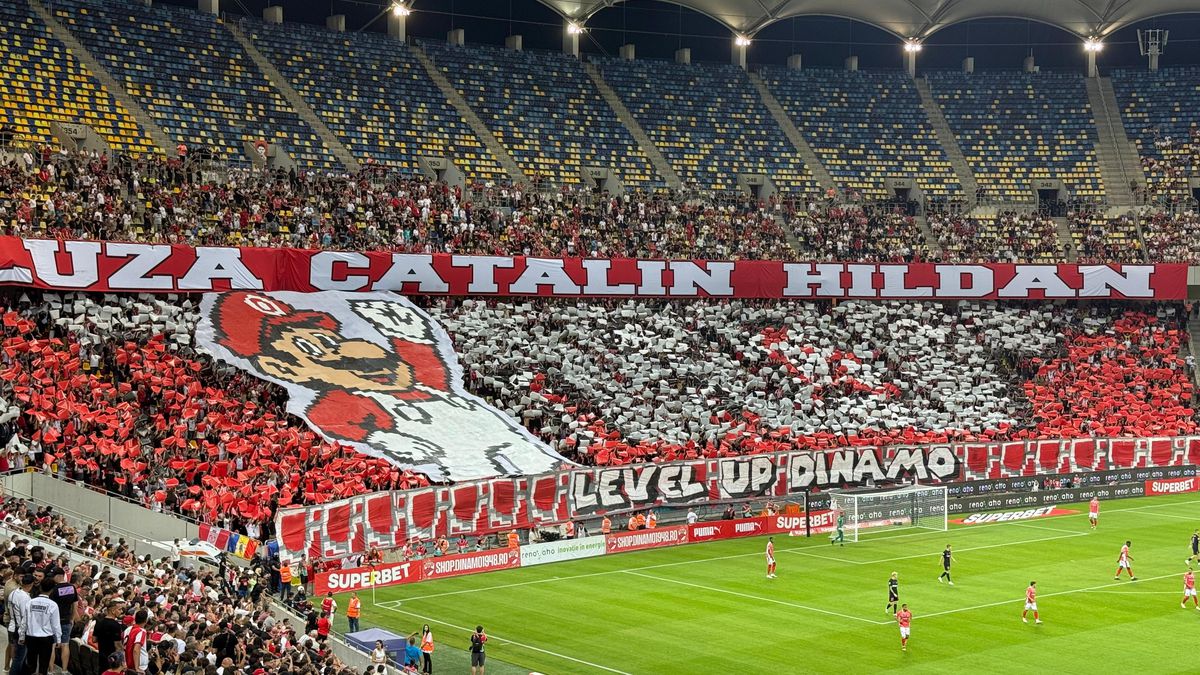
Dinamo issued an official statement on the club's website condemning the new amendments to Law 4, which regulates the behavior of spectators at sporting events.
After several supporters' groups protested on social media, clubs also began to take a stand. The first club was Craiova University, through the voice of the general director Ovidiu Costeșin, and then Farul Constanța also issued a statement.
Those from Dinamo are unhappy with the new changes because they “raise serious issues of clarity, proportionality and practical applicability”. In the press release issued by Dinamo, they analyze 5 different passages in which there are “several provisions susceptible to excessive or disunity interpretations.” In this context, the people from Dinamo had 4 requirements for the authorities, all related to the clarification of the laws so that they are no longer interpretable.
Ultras and clubs are unhappy because the new law imposes several conditions on them:
-
Ultras are no longer allowed to use pyrotechnics during the game, only before or after the final whistle. Pyrotechnic shows can only be organized by authorized companies and with the approval of the police, in specially established areas
-
Only authorized persons may enter the areas where pyrotechnic materials will be used
-
It forces organizers to continuously video monitor all spectators, including at access, in the stands and in consumer areas, and the footage can be used as evidence by authorities.
-
Even if beer can be sold until the final whistle of the games, access to low-alcohol drinks (maximum 5.5%) in the stands is strictly prohibited. “The consumption of alcoholic beverages is prohibited in any space in the sports arena that offers a direct view of the playing field, during the sports event, including access to the stands with purchased alcoholic beverages”
-
The clubs are obliged to provide the data of those who buy alcohol, at the request of the gendarmerie
-
Violators can be banned from the stadium for 1 year, with repeat offenses leading to bans of up to 2 years. If a banned supporter enters the stadium, the act becomes an offense and can be punished with up to 2 years in prison.
The press release from Dinamo: “Sport means performance and fair play, but also supporters.”
“Dinamo Bucharest unequivocally reaffirms that it strongly supports safety at the stadium, the protection of spectators, the prevention of violence and the rigorous application of the law in sports competitions.
At the same time, we consider that the new legislative amendments adopted to Law no. 4/2008 raises a number of serious issues of clarity, proportionality and practical applicability that cannot be ignored by any responsible club.
Dinamo appreciates the legitimate objective of the authorities to strengthen order and safety at sports competitions. However, any legal regime that restricts the exercise of certain rights, expands control mechanisms or establishes new obligations and sanctions for organizers must be clearly formulated, predictable and unambiguous.
Sport means performance and fair play, but also supporters. They play an essential role in the life of a club. Therefore, any legislative change should encourage their presence in the stadiums, not keep them away from the sports spectacle.
Supporters have an extremely important role in the life of a team: they support the team in achieving results and can make a decisive contribution to the existence of a club, as we at Dinamo know very well. That is why the stadium must be an attraction for fans and a safe, accessible and friendly space.
Or, from the analysis of the adopted text, it follows that there are several provisions susceptible to excessive or non-unitary interpretations.
-
First of allthe law introduces general and insufficiently defined formulas, such as “when the situation requires it”, “based on data and information of operative interest”, “in the event of the identification of some clues” or the possibility that the degree of risk of a competition can be challenged and changed “at the request motivated in fact and in law by any legal subject”. In the absence of clear, objective and verifiable criteria, such formulations create a real risk of discretionary, uneven and difficult to anticipate application by clubs, organizers and supporters.
-
Secondlythe new mechanism for approving and revising the action plan transfers important additional obligations to the organizer, including the remedy of some “irregularities” whose seriousness can lead to contraventional liability. Although the law stipulates that these irregularities must be motivated in fact and in law, the text does not provide a sufficiently precise framework for their delimitation, nor clear criteria regarding the threshold of gravity that attracts the sanction. In practice, this can lead to operational bottlenecks, delays, uncertainty in the organization of matches and disproportionate legal pressure on clubs.
-
thirdly, the law significantly expands the obligations of supervision and monitoring, including through video systems and through electronic monitoring systems in certain areas of the arena, and in the matter of the sale of alcoholic beverages conditions the operation of this regime on the use of personal data collected when selling tickets. From the club's perspective, any such mechanism must be backed up by explicit legal guarantees regarding the determined purpose of processing, data access limits, storage duration, information security and liability for possible abuses. In the adopted form, the law establishes obligations and possibilities of data access, but does not provide the same level of clarity with the necessary guarantees to avoid excesses or ambiguities of application.
-
Fourthlywe consider that the provisions concerning the prohibition of displaying in the arena elements with “political” content, placed in the same text as prohibitions on obscenity, xenophobia, hatred or violence, raise serious problems of interpretation. Combating incitement to hatred, discrimination or violence is necessary and legitimate. Instead, the generic notion of “political content”not clearly defined, may lead to the disproportionate restriction of freedom of expression and arbitrary applications, depending on the interpretation of the authority or the organizer. A norm that produces punitive consequences must be precise and predictable, not susceptible to variable readings from one case to another.
-
Fifthly, the sanctioning regime introduced or aggravated by the law is of considerable severity. For the organizers, the fines can reach up to 250,000 lei, and their application can include the suspension of the right to organize sports games with spectators or the restriction of access to certain sectors of the stand for significant periods. In the absence of clear rules and sufficiently well-defined individualization criteria, such a sanctioning regime risks becoming, in practice, not only a disciplinary tool, but also one of institutional and financial imbalance for the clubs that organize competitions”, the Dynamo players said in the statement.
Requests addressed by the dynamists: “Urgent clarification”
-
the urgent clarification of the criteria for applying the provisions on control, the reclassification of the degree of risk and the detection of irregularities in the action plans;
-
establishing explicit and transparent rules regarding the processing, access and protection of personal data used in connection with access and services in the sports arena;
-
the precise definition of the limits of interpretation of notions susceptible to abuse, especially where the law uses general terms or not sufficiently correlated with clear legal standards;
-
the strictly proportional application of sanctions, so that safety does not become a pretext for arbitrariness, excessive pressure on organizers or the unjustified restriction of spectators' rights.