publication
2026-03-09 20:00
The People's Bank of China bought another batch of gold in February, extending the series of purchases to 16 months. At the current rate, the “official” gold reserves of the Chinese central bank will soon be larger than those held by its Russian counterpart, which has also recently sold some of its reserves.
Official the gold reserves of the People's Bank of China increased by 30,000 in February 2026. troy ounces and amounted to 74.22 million ounces at the end of the month. Royal metal resources in reserve assets increased by approximately 933 kg to nearly 2,308.4 tons. This was the 16th consecutive month that China's central bank's gold reserves increased.
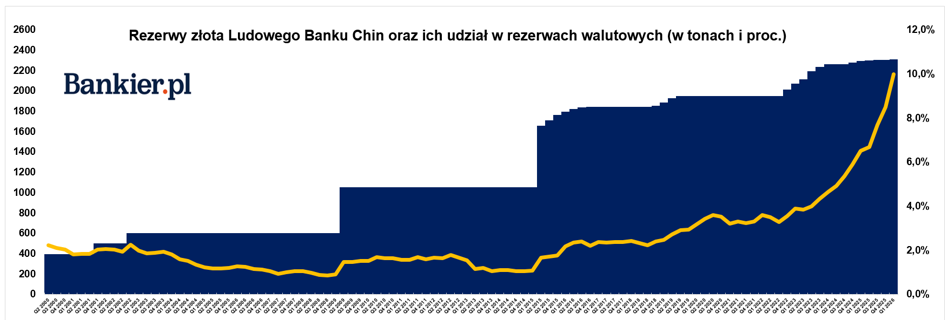
The previous period when the People's Bank of China continuously purchased gold lasted 18 consecutive months and ended in May 2024. Since November 2024, when the current round of purchases began, China's official gold reserves have increased by 1.42 million troy ouncesor approximately 44.16 tons.
In 2025 alone, China purchased 27 tons and was one of the largest buyers of central bank gold in the world. The leader in this field was the National Bank of Poland, which in 2025 purchased 102 tons of the “barbaric relic”. This year, China has bought about 70,000 so far. ounces, or 2.8 tonsbut the Polish NBP could add about 20 tons to its reserves at that time, according to Bankier.pl calculations.
Gold already constitutes 10 percent. Chinese reserves
The value of Chinese gold at the end of February 2026 was nearly USD 387.59 billion and accounted for almost 10%. total state reserve assets, valued at over $3.882 trillion. – according to information provided by the State Administration of Monetary Affairs (SAFE).
From the perspective of optimizing reserve structures, gold in China's assets accounted for one tenth of foreign exchange reserves for the first time. In mid-2024, it was less than 5%. The increase in share is primarily the result of increasingly higher gold prices on global markets and gradually increasing reserves by the People's Bank of China.
Russia in the crosshairs of the People's Bank of China
Official gold reserves of the Middle Kingdom, are the sixth largest in the world (excluding International Monetary Institute reserves). At the current purchase rate of approximately 30-40 thousand. ounces per month, the People's Bank of China by the end of the year will overtake the Central Bank of Russia, which, according to official data, had 74.5 million ounces (2,317.2 t) at the end of January. This could happen faster if Russia continues to liquidate its Central Bank's reserves, as it did in January by selling 300,000 ounces (9.33 t). Of course, we are talking about the official reserves of central banks, excluding national funds and institutions that also hold gold.
| The largest gold reserves and their share in foreign exchange reserves | |||
|---|---|---|---|
| No. | Country | Tons of gold | Share in reserves (%) |
| 1 | USA | 8133.5 | 78.50% |
| 2 | Germany | 3350.3 | 77.60% |
| 3 | Italy | 2451.8 | 74.40% |
| 4 | France | 2437 | 75.10% |
| 5 | Russia | 2317.2 | 48.31% |
| 6 | China | 2308.4 | 10.00% |
| 7 | Switzerland | 1039.9 | 11.20% |
| 8 | India | 880.2 | 13.20% |
| 9 | Japan | 846 | 6.90% |
| 10 | Türkiye | 644.3 | 48.80% |
| 11 | Netherlands | 612.5 | 72.70% |
| 12 | Poland | 550 | 28.20% |
| 13 | ECB | 506.5 | 12.30% |
| Data from WGC, NBP, CBR and PBOC | |||
Central banks have no shortage of reasons to stockpile gold these days. Rising geopolitical tensions will only deepen fiscal concerns in major economies and accelerate de-dollarization, which will help keep gold stable even as prices fluctuate. Despite some slowdown in central bank purchases in 2025, analysts suggest that the “oil shock” and geopolitical instability will sustain accumulation throughout 2026. “Geopolitical risks show no signs of abating, which is likely to keep institutional interest levels high,” said Marissa Salim, an analyst at the World Gold Council.