The terrible weapons with which Iran terrorizes the world. Intelligence general: “It would be something terrible, no one has done it so openly before”

The conflict between the US and Iran risks degenerating, and the Iranians could use “dirty bombs”. An intelligence general explains, for “Adevărul”, under what conditions this risk would exist.
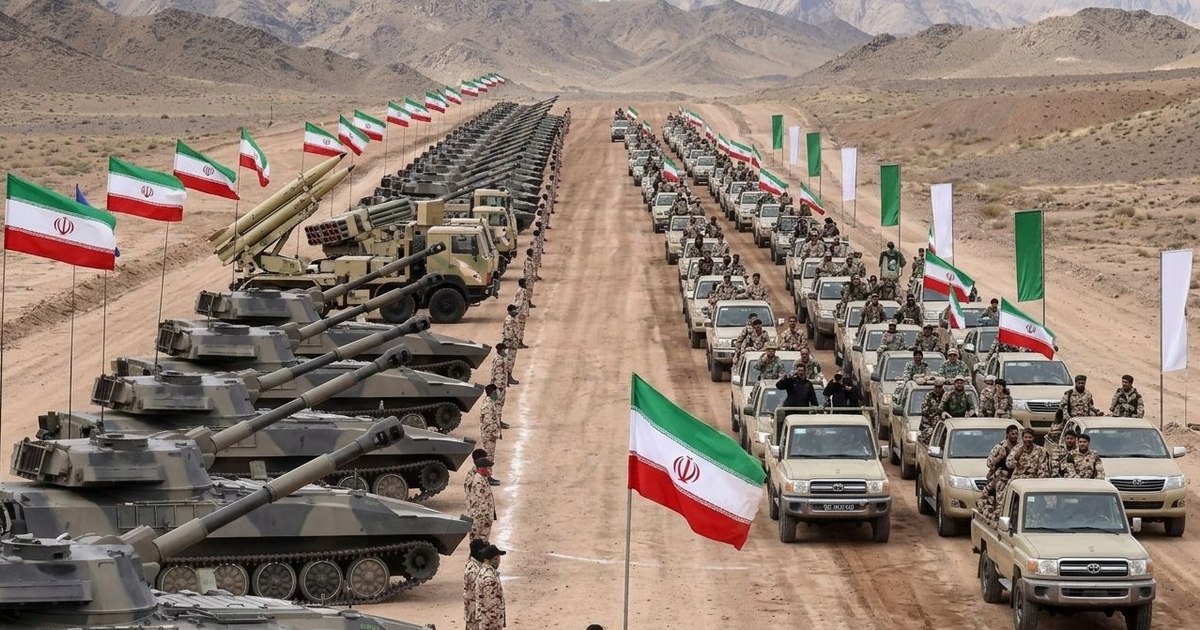
The Iranian army is well organized and can cause big problems. PHOTO: AI
The conflict in Iran has escalated and is starting to turn into a regional one, since Tehran hit American military bases on the territory of neighboring states (Bahrain, Kuwait, the United Arab Emirates, Saudi Arabia, Israel, etc.). In addition, once the Iranians also hit Cyprus, the conflict has given signals that it risks even going beyond the regional sphere, prompting some of the experts to even talk about the risk of a new global war.
The terrible weapons with which the Iranian leaders threaten
If, however, regarding the risks of a new global conflict the opinions of experts are rather divided, there are fears shared by more and more analysts. Thus, there is talk of an even greater risk of Iran using so-called “dirty bombs” or chemical weapons or biological weapons. “Dirty bombs” are generally referred to as radiological dispersal weapons of mass destruction. They combine radioactive material with conventional explosives for the purpose of radioactive contamination.
At the same time, there is also the fear that Iran has and could be tempted to use EMP bombs. It is an electromagnetic pulse weapon designed to emit a short, intense burst of electromagnetic energy capable of permanently destroying or disrupting electronic equipment, power grids, and communications systems over a wide area. These weapons are considered a major threat and can devastate the infrastructure of an entire country. And some of the news coming out of the area is indeed worrying.
General (r) Adriean Pârlog was in top positions at the level of the Romanian military intelligence services. Pârlog was deputy of the Directorate of Military Intelligence in Romania. In an analysis for “Truth”, the general spoke openly about the risk of Iran using unconventional weapons.
How can the situation degenerate
“Unfortunately, it is very possible that this war will degenerate from certain perspectives. But for now I note that China and Russia are not intervening, and that is a good thing. The two could have exploited this. So I have the feeling rather that the three big capitals, Washington, Beijing and Moscow are taking into account what has been achieved so far between them from a constructive perspective. From a constructive perspective, from the US, to China, it seems to me that the most important step taken is the one regarding Washington taking a softer line on the trade tariffs they initially wanted to impose on China.Then, the Americans returned to feeling a little better about the Chinese, especially during Donald Trump's presence in South Korea.“, says the general.
China, although one of Iran's allies, has not directly intervened. General Adriean Pârlog says this sends the message that neither Beijing nor Moscow are ready to escalate and do not want a conflict with the US or a global war.
“On the other hand, China, in relation to what is happening now in Iran, has a line rather directed towards urging the parties to find a solution acceptable to everyone. In contrast, the Russian Federation is the big surprise in terms of how it sees the conflict between Iran on the one hand, the US and Israel on the other. In the sense that, at least officially, it has not adopted an aggressive official rhetoric, even though it has criticized the attack on Iran. Of course, we see that there are critical points of view coming from some such as Dughin. These are more percussive points of view, but which have not been taken up at the official level, and I say that the important thing is that at the official level they do not have an aggressive position“, says the general.
Why there are serious fears
This does not mean that the risk of escalation does not exist or that we can look calmly at the events in the Middle East.
“There is a risk of the conflict degenerating into an even wider one, a more intense one, obviously yes. There is this risk, but on the other hand there are also prospects for finding an amicable solution to diminish, to de-escalate the current situation. There are prospects in both directions“, says the general.
The big fear is that Iran might decide to use so-called “dirty bombs”. And the fear that Tehran, which is in a delicate situation, will use chemical or biological weapons is not at all negligible.
“It is obvious that Iran is in an extremely delicate situation, especially after the extensive beheading of the political leadership apparatus, first of all, the military. The most delicate element, in my opinion, however, is related to the large area that Iran has hit, almost a surprise. Iran, I think, wanted to demonstrate its potential to oppose in a consistent manner the attacks of Israel and the United States. It is a surprise to me that they hit the main urban centers of the Middle East, cities with a positive global image connotation, centers of tourist attraction, areas where projects from the world of current technology are underway, and I am thinking of server farms, of energy projects. It remains to be seen how the hydrocarbons file, the energy file, will evolve.”adds General Pârlog.
Iran's “dirty” bombs
After the aggressive action against Turkey, other question marks appeared. Turkey may retaliate, but so far it has sent balanced messages.
“A second extremely dangerous element for my perception is related to the real line of conduct that Ankara will adopt in the future. Turkey, obviously, reacted; it was not an attack on the scale of those in Dubai and other cities, real urban agglomerations in the Emirates area, in the Saudi Arabian area, in the central Middle East area, but Turkey has registered the lack of security, the potential registered at the Incirlik base, as well as an event that calls into question its potential to I think that Ankara has adopted a rather restrained line of conduct, comparable to Riyadh“, he says.
General Adriean Pârlog is of the opinion that Iran could, in desperation, resort to “dirty bombs”. But there is still hope, he says, that Tehran will not cross this red line and that it will continue to fight with conventional means.
“I'm not saying it's completely out of the question. They are in a difficult situation and they could decide to use such weapons. But I hope they will come to their senses, that they will not use these weapons. So far, they have not done that. If this thing had been an option for Iran, I think they would have had the opportunity to do it. In fact, Iran has referred to weapons that they still have in their stockpile and are not using them for strategic reasons. I do not think and I hope that Iran will not suicide-specific behavioral psychology, and they won't want to be the first to use a weapon with such an image impact, but less so as a military-strategic force. Using a bomb that no one has used in such an overt and obvious manner would be terrible. Basically, if they did that, I think that would make them a pariah state actor for the whole world. I think that's one of the reasons why they didn't do it. On the other hand, it can't be completely ruled out, I think“, claims the general.
General Adriean Pârlog hopes that a cease-fire agreement will still be reached and that diplomacy will prevail, at the 13th hour.
“I honestly tell you, from tonight until now I am a little more confident about the prospect of reaching a compromise situation on both sides. It is still possible that a realistic proposal will emerge from somewhere and end this war that brings so much harm to the region and beyond as soon as possible.”concludes General Adriean Pârlog.
Who is General Adriean Pârlog
General (r) Adriean Pârlog was in top positions at the level of the Romanian military intelligence services, being deputy of the Directorate of Military Intelligence in Romania and Defense, Military, Air and Naval Attaché in the Kingdom of Norway. It currently offers training courses in the fields of business intelligence and corporate security.
He is the author of more than 10 scientific communications published in volumes of national scientific events; 49 articles published in specialized journals; 12 research and development projects; 24 sets of specialized lessons; 6 books; 25 applications or complex specialized exercises. Attended NATO courses, Naval Postgraduate School, Monterey, California; Center for Defense Studies and King's College London, Great Britain; Harvard University/John F. Kennedy School of Government, Boston