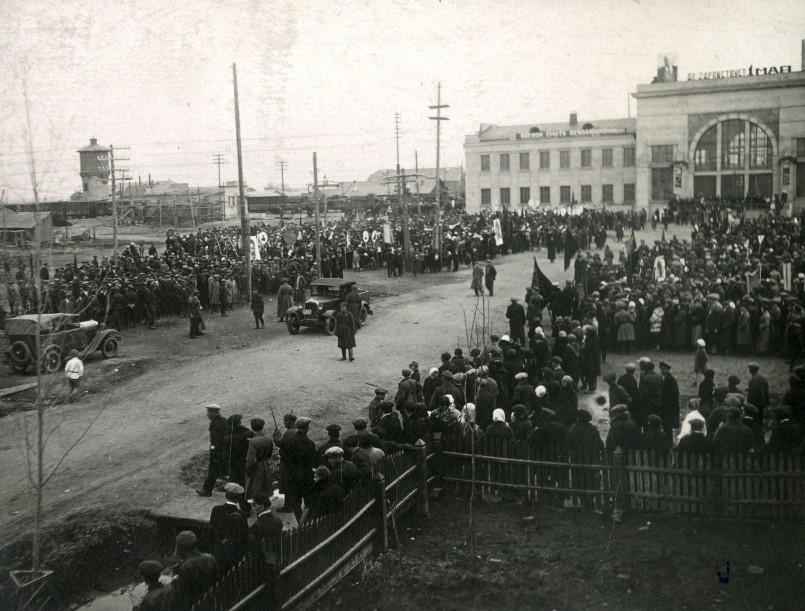
May Day demonstration on the square near the new station. Birobidzhan, 1936.
Photo: Heritage JAO
March 2, 1937
By decree of the Presidium of the Supreme Soviet of the RSFSR, the working village of Birobidzhan was transformed into the city of Birobidzhan.

A village was founded on the banks of the Bira in 1912; by 1915, the station village received the same name as the station, which was called Tikhonka Sopka for more than two years. The village became part of the Uldurinsky volost of the Zavitinsky district of the Amur region under a new name. After the Civil War and the expulsion of the interventionists in 1922, a truly quiet, calm, measured life, typical of station villages in the Far East, took place in Tikhonkaya.
In 1923 there were 127 farms and 604 people. The main city-forming element was the railway; the other part of the inhabitants was engaged in logging, mining and panning of gold-bearing sand, and hunting.
The rapid growth of the settlement dates back to 1928, when the first batch of Jewish settlers arrived. In 1931, the village of Tikhonkaya was renamed the working village of Birobidzhan. In 1934, with the formation of the Jewish Autonomous Region, Birobidzhan became its administrative center.
In the reference and information publication “Administrative-territorial structure of the Jewish Autonomous Region 1858-2003.” (0+) published “Extract from Minutes No. 69 of the meeting of the Presidium of the All-Russian Central Executive Committee on the transformation of the workers' village of Birobidzhan into a city dated March 2, 1937:
LISTENED: About the transformation of the workers' village of Birobidzhan into a city.
DECIDED: To satisfy the petition of the Far Eastern Regional Executive Committee and the Regional Executive Committee of the Jewish Autonomous Region to transform the workers' village of Birobidzhan into a city, retaining its former name.”
In 1972, Birobidzhan was awarded the Order of Friendship of Peoples, in 1984 the city was awarded the Badge of Honor, and in 2007 Birobidzhan was awarded the Order of Peter the Great.
March 2, 1974
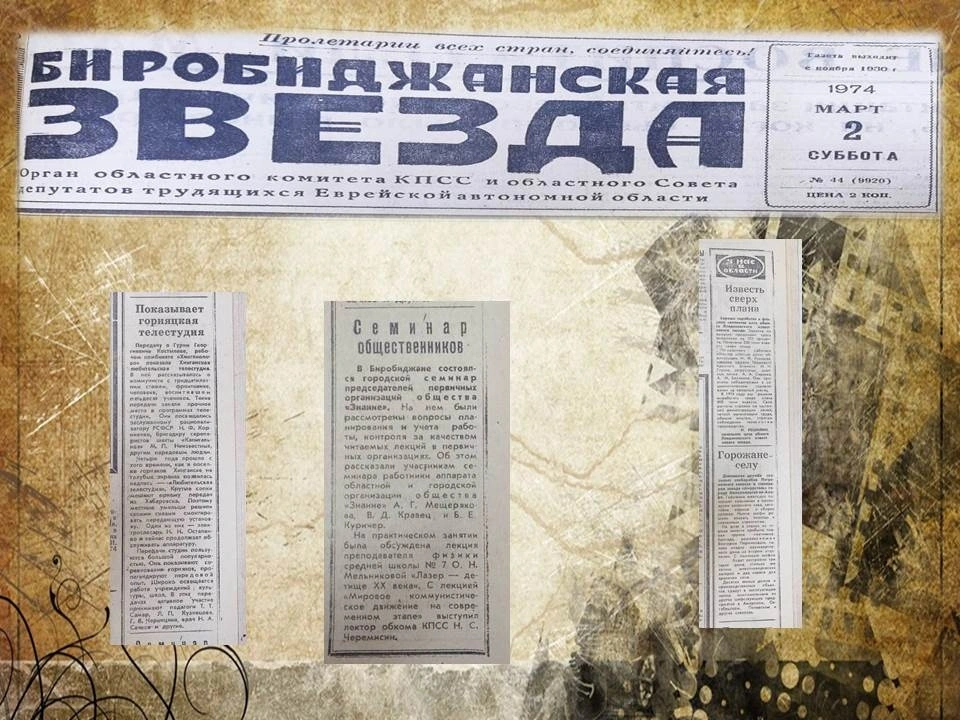
Newspaper clippings. Photo: Photo: Regional Library
The newspaper “Birobidzhanskaya Zvezda” (12+) on March 2, 1974, in the regular column “In our region” wrote that the team of the roasting shop of the Londokovsky lime plant produced products 103% above the plan.


The same section talks about programs from the Khingan Television Studio.
“Four years have passed since the inscription “Amateur Film Studio” appeared on the blue screens in the mining village of Khingansk. Steep hills interfere with the reception of broadcasts from Khabarovsk. Therefore, local craftsmen decided to install a transmission installation on their own. One of them, electrician N.N. Ostapenko, continues to service the equipment now. The studio’s broadcasts are very popular. They show miners’ competitions and promote advanced experience. The work of cultural institutions and schools is widely covered. Teachers T.T. Samar, L.P. Chernitsina, doctor N.A.
March 2, 1909
Far Eastern writer, poet, who visited Birobidzhan in 1933, Bytovoy Semyon Mikhailovich was born on March 2, 1909 in the town of Zhlobin, Rogachev district, Mogilev province.
In 1933, he first came to the editorial office of the newspaper “Birobidzhaner Stern” (12+). Semyon Mikhailovich’s communication with Genakh Kazakevich made a great impression on him. From the memoirs of S. Bytovoy:
“We arrived at Tikhonkaya station on May 14. We immediately went to the editorial office of Stern, which we didn’t have to look for long – the city was just in its infancy and consisted of a dozen wooden houses. The second meeting with the editor of Birobidzhaner Stern took place a year later, when I had already settled firmly in Khabarovsk and worked in the newspaper Tikhovensky Komsomolets (12+). I did not receive a special assignment from the editorial office to visit Birobidzhan. It’s just that I wanted to go – I boarded the first train and, despite the night, went to Birobidzhan… We came home to Kazakevich at about three in the morning and had tea for another hour and a half. During the conversation, I learned that Genakh Lvovich’s son, Emmanuel, was in Valdheim, working there to organize the people who had just arrived.
The writer Semyon Bytovoy spoke warmly about his friendship with father and son Kazakevich, with whom, by the way, they were also connected by creative collaboration – in 1933, a poem by Emmanuel Kazakevich in the Russian translation of Semyon Bytovoy was published in the newspaper “Pacific Komsomolets” (12+).
In 1972, his story “From Snow to Snow” (12+) was published. Memories of A. Fadeev, E. Kazakevich, P. Komarov occupy a prominent place in it. The continuation of these memories was the story “Return Addresses” (1976) (12+). The last book by Semyon Bytovoy, published after his death in 1986 in Leningrad, is the story “Long Thunderstorms” (12+). This work, written in the genre of travelogues, was the completion of a trilogy begun by the books “From Snow to Snow” and “Return Addresses.”
CM. Bytovoy was awarded the Order of the Red Star and the Red Banner of Labor. Died February 1985