Military “Lego” on a gigantic scale: The great navies of the world propose a new ship model, an idea that also passes through the Galati shipyard

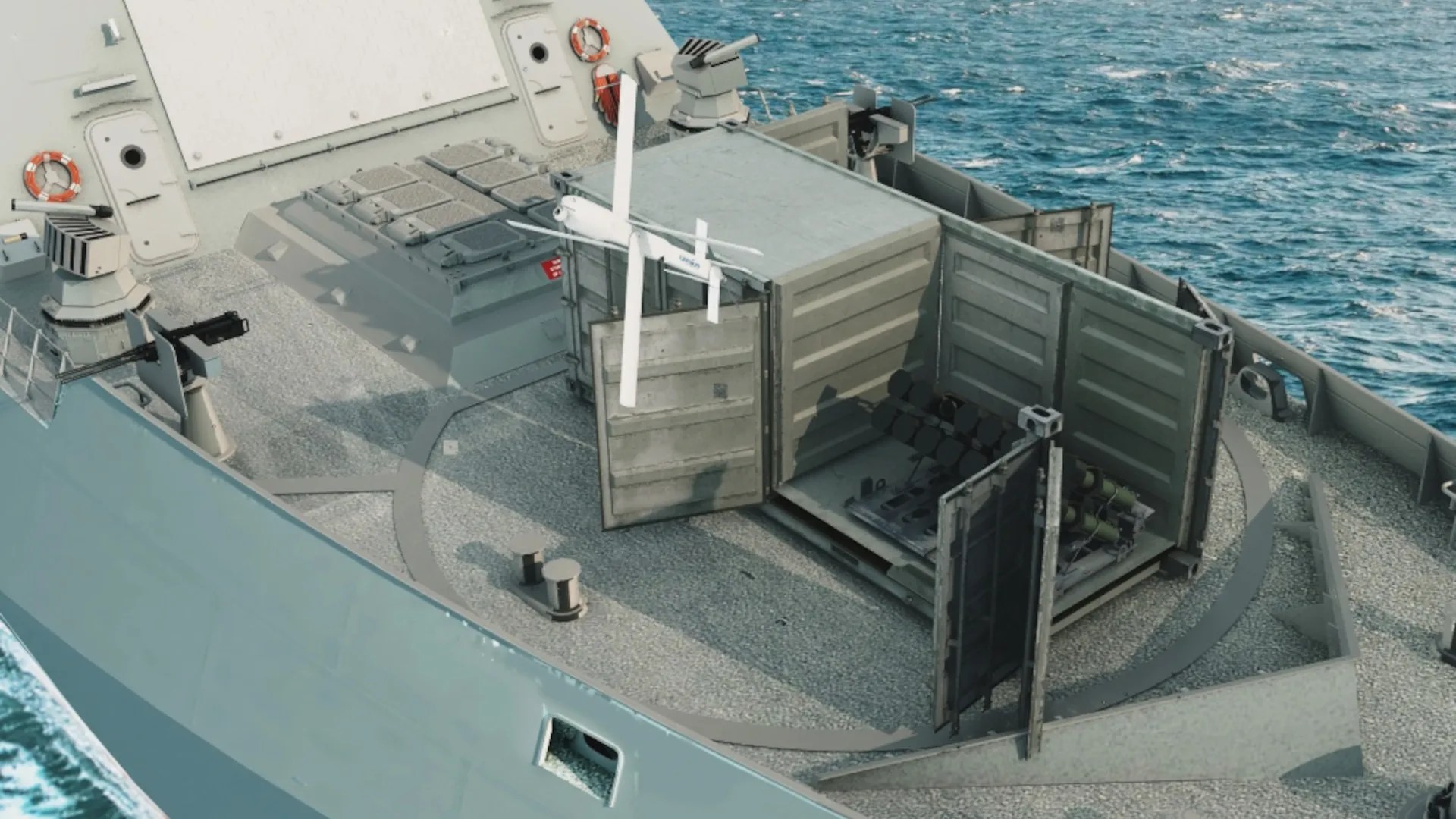
The “armies of the waters” of the United States and Europe are taking decisive steps towards a radical change in the construction of warships: plug-and-play modularity, a concept often compared to Lego pieces. What does this mean?
Modularity sounds pretentious and is not easily achieved. But it starts from a simple idea: it allows missiles, sensors or drone systems to be quickly installed on the decks of existing ships, without the need for years spent in shipyards for expensive upgrades or for the construction of specialized ships.
Holland and the container ships from Galati
New strategy, shaped in various forms in the bosom of the great Western navies, comes in response to the accelerated pace of technological innovation. In addition, it responds to the need to quickly supplement “firepower” (combat punch) in the face of adversaries such as China or Russia, Defensenews writes.
The new Italian Thaon di Revel-class patrol frigates have been designed to carry containerized mission modules. And the Netherlands has announced a class of multi-functional support ships that will be built in Romania, in Galati. They will carry containers loaded with everything from air defense missiles to electronic warfare equipment or assault drones.
A ship that moves quickly from one mission to another
During this time, the United States Navy announced that its new type of frigate will be equipped with containerized mission packages. In parallel, US forces are looking to develop autonomous containerized systems to store drones for the long term. They will be dormant, launch, recover and prepare for new missions almost automatically or with minimal human intervention.
“All our future ships will be designed specifically for this type of capability,” Admiral Giuseppe Berutti Bergotto, the Italian Navy's chief of staff, told the Naval Conference in Paris, quoted by Defensenews. “The main role of the ship will remain the same, but the ship must have this capability to be ready to perform different missions.”
He said the Italian navy has also experimented with mounting different containers with different payloads on the deck of a merchant ship.
A transport ship can become an offensive platform overnight
At the heart of this shift in naval approach are companies such as Denmark's SH Defense, which developed “The Cube” system.
It uses standardized containers that can house everything from vertical missile launch systems (VLS), to underwater drone command centers or mobile hospitals.
The advantage is huge, the company says: a transport ship can become an offensive platform overnight.
“Our concept allows a Navy to change a ship's mission profile in less than four hours, not months,” said a senior industry representative at the recent Naval Security Conference.
Such an approach reduces reliance on the total number of dedicated combat ships, virtually allowing the auxiliary fleet to be used in combat roles when the situation calls for it.
The concept of arsenal ships
Among the strongest proponents of this new architecture is the Royal Netherlands Navy, which recently announced concrete plans for a new class of multi-role support vessels.
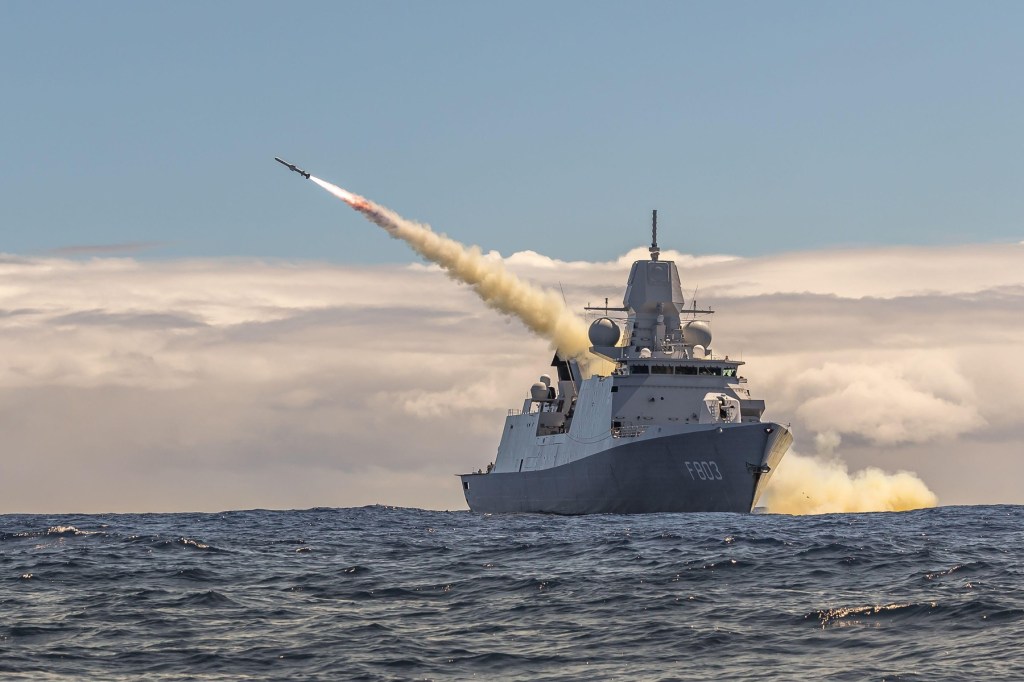
In the context where “drone warfare” can unbalance forces composed of complex and expensive ships, the Netherlands has announced that it needs a new type of vessel to work together with its modern and powerful De Zeven Provinciën-class frigates. For Romania, the announcement was an important one because the new ships will be built at the Damen shipyard in Galati.
 Romania will build the special military ships with which the Netherlands is rethinking its defense strategy at sea. How many people are working on our site and when will construction begin
“Weapons Stores”
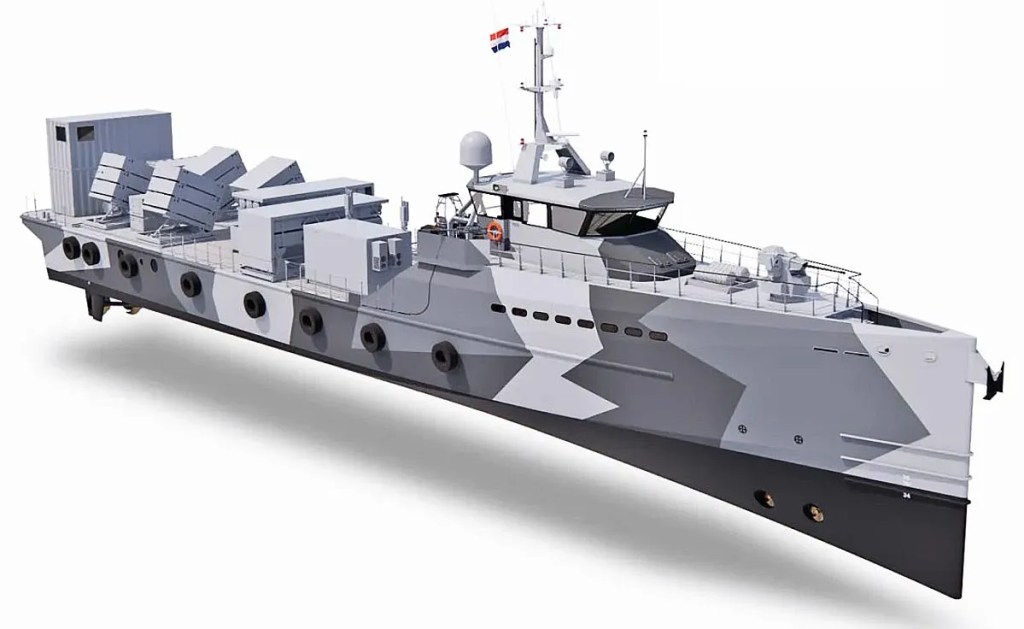
The ships, 55 meters long and with a displacement of 550 tons (a frigate has a displacement of 5-7,000 tons) are designed to function as external “weapons stores” for air defense frigates, being able to carry containers equipped with Barak ER interceptor missiles and Harop “loitering” (kamikaze drone) munitions.
Vice Admiral Harold Liebregs, commander of the Royal Netherlands Navy, explained the simplicity of this system in a statement on the sidelines of the Paris conference: “If you look at modularity, it's like Lego: the building blocks are already there, you just have to assemble them. But we have to keep it simple. We don't have to over-integrate.”
6-8 sailors on a ship?
This approach allows for a drastic reduction in costs and required personnel. The new Dutch ships will operate with extremely small crews of just six to eight sailors, performing missions that would normally drain the resources of an expensive frigate.
“It's an affordable way to increase our fleet,” Liebregs pointed out, adding that these ships can also be used to escort Russian ships in the North Sea, “thus saving a lot of very expensive warships.”
CADDS: The 'box' that stores, launches and recovers thousands of drones autonomously
In parallel with European efforts, the United States is accelerating the program CADDS (Containerized Autonomous Drone Delivery System).
The program aims to transform standard shipping containers into ultra-complex robotic systems capable of not only launching massive swarms of drones, but also automatically recovering and reloading them for a new mission with minimal human intervention.
The technical requirements were published by the Defense Innovation Unit (DIU) and cited Interesting Engineering: A system that can keep drones in a “dormant state” for long periods, then activate and launch them in minutes.
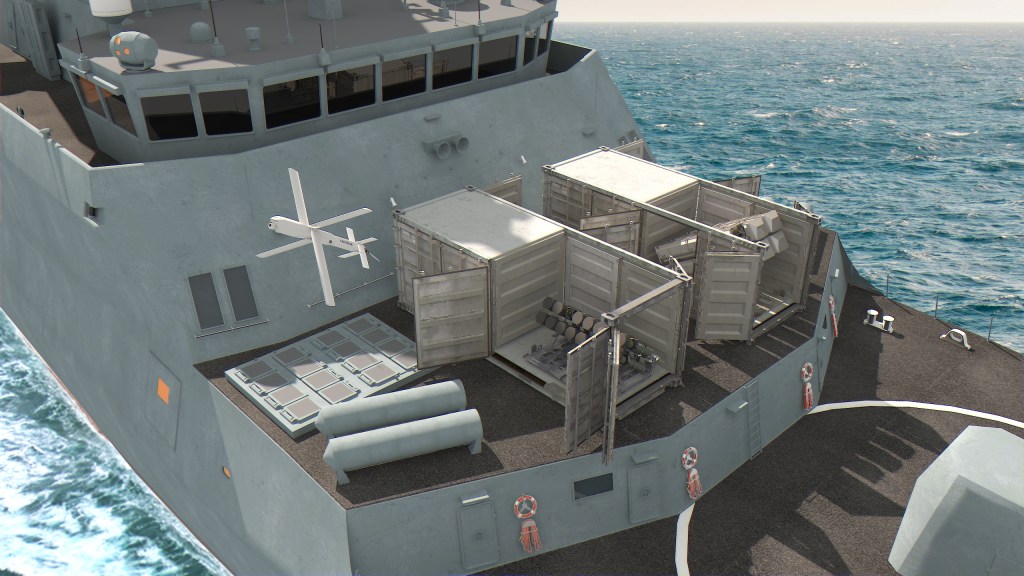
“We need containerized systems that can store, rapidly launch, recover and reuse multiple drones, operating from both land and sea platforms,” say officials running the program.
This recovery capability transforms the drone from a “disposable munition” into a reusable asset and means a drastic reduction in pressure on supply chains.
The US strategy, backed by new directives from the top of the Defense Department, calls for the purchase of hundreds of thousands to millions of small, inexpensive drones in the coming years.
The CADDS program is the centerpiece of this deployment infrastructure, eliminating the classic “one operator per aircraft” model.
“Reusable and reconfigurable drones will free up manned aircraft and ships for critical missions, multiplying combat power,” explained a US Navy program manager.
“The challenge is data integration”
Although the idea of ”putting missile containers on any ship” sounds ideal, experts warn that the integration of digital systems remains the main obstacle.
It is not enough for a module to physically fit on the deck, it must communicate instantly with the ship's radar and battle management systems.
“The physical part is simple. The challenge is data integration. If you put a missile launcher on a supply ship, how does that launcher know where the target is if the ship doesn't have high-performance sensors?” said a former ship commander, quoted by the publication.
For this reason, new European ship designs, such as the EPC (European Patrol Corvette), are being designed from the ground up with open architectures to enable this type of digital integration.
However, most experts agree that amid tensions in the Red Sea and lessons learned from the conflict in Ukraine, where cheap drones have crippled expensive ships, modularity is no longer just an economic option, but a tactical necessity.
The ability to rapidly adapt anti-drone defense systems to any available platform could decide the outcome of a future large-scale maritime conflict.