- Two Japanese soldiers became famous in their country from day to day, when the news arrived there that they competed for which one would first cut his head to the Chinese. These “competitions in killing hundreds of people” stretched until March 1938 and ultimately their winner was cut by 374 people
- The Japanese moved customs from four years of fighting the Chinese to war with colonial powers. Their reputation of barbarians was ahead of them, but the collision with them was a shock to the soldiers of the Western Army
- American soldiers widely felt disgust and contempt for Japanese, which were fueled by propaganda showing them as inhuman animals, the products of exotic and unfathomable culture
- More important information can be found on the Onet's main page
Below we present a fragment of the book with the consent of the publishing house:
The Japanese war in China was conducted from the very beginning with a small respect for conventions regulating the principles of modern armed conflicts. Chinese soldiers who gave up, They were routinely shot or cut on the spot by the advancing Japanese. The wounded were killed with bayonets or samurai swords, which the Japanese infantry used with a clear pleasure.
Although leaflets were dropped from the aircraft, in which the Chinese were encouraged to give up, promising that the Japanese army “would not hurt the prisoners”,,, Registration in Japanese soldiers' diaries clearly show that this promise was only a trick.
One Japanese participating in the attack on the province of Hebei described the pleasure that he caused him to beat the wounded Chinese with a stone and cut the prisoner with a sword. In turn, when his unit raced the retreating Chinese troops deep into the province of Shanxi, he noted that killing escaping soldiers was fun for him:
Such dailies also reveal a deep sense of lack of security and fear harassing Japanese soldiers who regularly fell into the ambush of Chinese soldiers, when those, after escaping from the battlefield, began the partisan fight. Following forward, the Japanese army suffered great losses, and its soldiers retalmed the enemy with calculated sadism.
The apogee of these atrocities occurred during the storm of the capital of Chinese nationalists in Nankin and after it was obtained, when According to estimates, about 20,000 Chinese soldiers and thousands of civilians were murdered. Although the above rank of Japanese commanders in China wanted their soldiers to show moderation, many months of difficult fights in endless spaces stimulated the emergency of revenge.
Two Japanese soldiers became famous in their country from day to day, when the news arrived there that they competed for which one would first cut his head to the Chinese. These “competitions in killing hundreds of people” stretched until March 1938 and ultimately their winner was cut by 374 people. In Japan, this “patriotic killing hundreds of people” was celebrated in poems, songs and even children's books.
Everywhere, hunting for Chinese soldiers, who were murdered using a whole range of brutal methods – they were hung by the language, buried or burned alive, used to exercise with a bayonet, thrown naked into the icing to the icing so that they “go to fish”. A Japanese soldier passed by about 2,000 dead and mutilated Chinese, who gave up, hanging the white flag. As he noted, they were “killed in various ways” and left to rot on the road.
This like an unrestrained wave of violence was the aftermath of Japanese military decisions to consider Chinese soldiers as a bandit, which removed all legal barriers preventing them from murdering them right after capture. The Geneva Convention on the treatment of prisoners of war was not ratified by Japan, but even if it happened, the restrictions imposed by international law in Geneva agreements were not communicated even by an older degree of Japanese commanders.
When the Japanese have already got used to the brutal fight, the custom of killing wounded and captured opponents became a kind of lifestyle for them. “I walked on the corpses of Chinese soldiers without worrying about it,” wrote one of the witnesses of the Nanny massacre in Dziennik, “because my heart became wild and restless.”
When in December 1941 Japan attacked American, British and Dutch estates in Southeast Asia and in the southern Pacific, most of the soldiers participating in these operations had already served in China behind them, unlike the Allied troops stationed in that region, which had little or no combat experience.
Meanwhile, the Japanese moved customs from four years of fighting the Chinese to war with colonial powers. They were ahead of the barbarians' reputation, but still a collision with them It was a shock to the soldiers of the Western Army, who not only underestimated the opponent's tactical abilities, but also assumed that in the fight against white, the Japanese would follow the conventions limiting violence.
When the British Governor Hong Kong surrendered the city on Christmas day in 1941, the invaders began to sow havoc in the entire international district, killing prisoners, piercing with bayonets of wounded in hospitals, raping and murdering nurses (although only a few days earlier British soldiers and police officers opened fire from machine guns to Chinese sabers, and In one case they set up in a row of alleged subversives, put on their heads and shot them one by one).
During the invasion of Malay, the Japanese, who was south south, killed prisoners and massacred the wounded, and this pattern of their behavior was to be repeated in the whole war in the Pacific. During the fighting in Nowa Guinea, where Japanese troops were often close to hunger death and poorly stocked with ammunition, captured by Australian soldiers were later found naked naked to trees, Because they were practiced with bayonet pushes or chopped swords, and in many cases slaughtered to provide hungry Japanese human meat.
American soldiers found the bodies of their mutilated and tortured companions or trophies taken from Americans in the pockets of fallen Japanese. The Japanese Navy sinking ships without any warning and left survivors in the water or even shot them from machine guns. During the invasion of Dutch Eastern India (current Indonesia) Japanese sailors also committed land on land, massacred hundreds of captured Australian and Dutch soldiers on the Amboin islandwith each of the perpetrators could choose whether to cut their heads to the victim or stab it with a bayonet.
The US Navy also waged an unlimited submarine from the very beginning. In 1945, however, there was little to flood and American submarines began to attack fishing boats and coastal samples, thus breaking the rules of the use of weapons in force during the war. In such situations, it is rather the conscience of individual commanders, and not the provisions of international law decided whether the Japanese trying to stay on the water or get to the lifeboat was left to the fate of fate or killed.
The cruel behavior of Japanese invaders in relation to Allied soldiers, however, brought the opposite effects to the expected. Because the Japanese did not try to follow the convention of war law, their opponents responded the same. Not every Allied soldier and not every Japanese soldier committed acts contrary to international law, but in the war in the Pacific such violations were common, and soldiers of the American infantry and land forces knew that they were not punishable by any punishment.
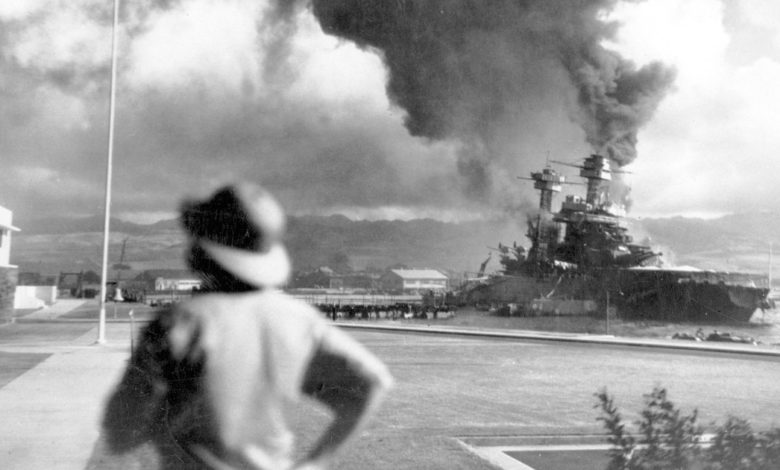
The American military approach was shaped by a wave of spontaneous anger caused by the attack on Pearl Harbor. Already a few hours after him, the head of US Navy Admiral Harold Stark announced the start of the “unlimited air and underwater war against Japan”, thus canceling the international obligations of the United States before the fight really began.
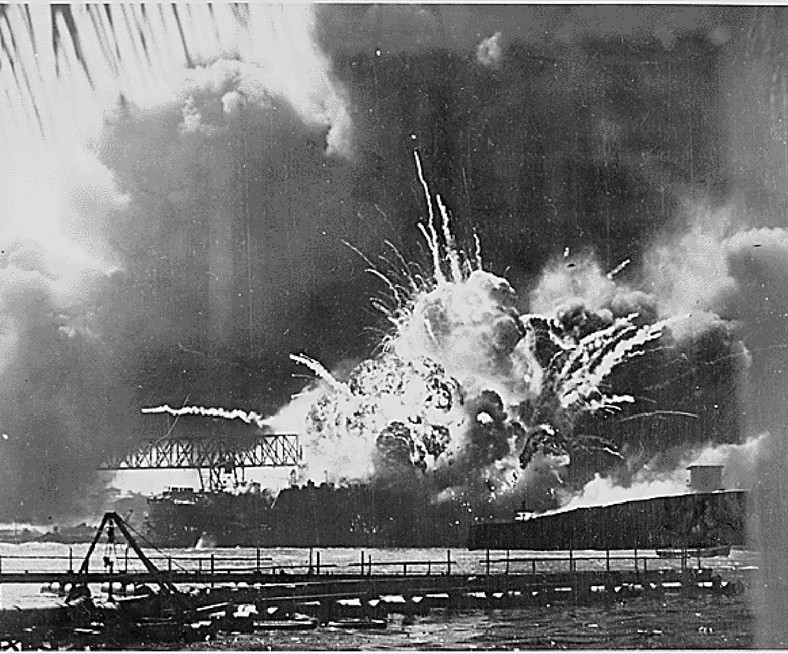
Japanese attack on Pearl Harbor
Roosevelt's personal adviser Admiral William Leaha also made the matter clearly, saying that in the fight against “Japanese savages” the adopted rules of war “must be abandoned.” In turn, Vice Admiral William Halsey sent the crews of his aircraft fleet signal:
In these circumstances, there was no chance that some legal restrictions would stop American military, all the more after they saw examples of Japanese atrocities with their own eyes. The slogan “kill these bitches” was repeated constantly in the literature read by American soldiers.
The defending Japanese did not follow any rules, even if it was contrary to common sense: they waved white flags to pull the opponent into ambush; They lay on the battlefield, pretending to be the dead; They gave up, holding a grenade without a pin to die with those who captured them; In rare cases, they moved with samurai swords to a massive attack on the positions of enemy machine guns.
American soldiers commonly felt disgust and contempt for Japanese, which were fueled by propaganda showing them as inhuman animals, products of exotic and unfathomable culture. It was believed that in the “Good Japanese” field is a “dead Japanese”, which is why few prisoners were taken. The wounded were sometimes killed, cutting their throats. Trophies were collected in the form of part of the bodies of enemies, which were pulled up the scalp or golden teeth were pulled out to wear them in small bags.
Malming the corpse was so common that in September 1942 the Department of War ordered all commanders to prohibit the collection of such macabre souvenirs, but without much effect. When the skeleton of Japanese soldiers from the Marian Islands was exhumed and transported to their homeland, it turned out that 60 percent of them did not have skulls.
A paper knife made of Japanese bones was even given to Roosevelt, but the president insisted on sending him to Japan. Some Japanese, unable to accept the fact that they did not die in battle, fought until the opponent deprived them of their lives.
During the Battle of Guadalcanal on the Salomon Islands, it was so difficult to take Japanese alive to interrogate him that the soldiers of the American 23rd Infantry Division “Americal” promised whiskey and additional beer for bringing a prisoner. In October 1944, after almost three years of war in the Pacific, There were only 604 Japanese prisoners in the hands of the Allies. Only 41,000 Japanese soldiers and sailors were taken prisoner throughout that theater of war, of which almost all at the end of the war.

Fragments come from the book “Blood and ruins. The Great War of the Emplory 1931-1945. Volume 2”, which was published by Rebis Publishing House. The author is Richard Overy.