Romania, full of potholes after snow and frost. What solutions has a Nordic state found to limit winter damage


Snow and frost accelerated the deterioration of many roads in Romania. The phenomenon is natural, but it can be managed more effectively. Some states have found seemingly simple solutions to limit the occurrence of potholes and reduce long-term repair costs.
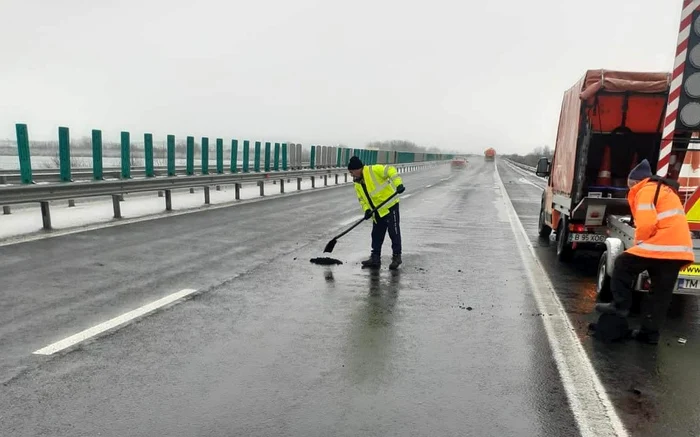
Repairs on the A1 Motorway. Photo: DRDP Timisoara
The heavy snowfalls since the beginning of 2026 and the freezing period have caused numerous problems in cities, but also countless complaints from Romanians.
Locals complained about the way the authorities intervened to remove snow from the roads, traffic jams, bus and train delays, sidewalks and streets not cleaned several days after the snowfall stopped, trojans stored chaotically or left to impede traffic, as well as areas with poles and ice.
There were also reports of roofs becoming dangerous due to icicles and heavy snow. Numerous localities were left in the dark or isolated, some for several days, due to damage to the power grid or fallen trees.
City halls, county councils and snow removal companies were most often targeted by complaints, even in situations where the authorities' representatives coordinated the mobilization for snow removal. Some blamed the problems on the unexpectedly heavy snowfall, pointing out that the cities had not experienced such winters in many years.
Others complained that they needed more support from the citizens, at least in cleaning the sidewalks in front of the blocks and the access ways to shops, homes and institutions. The problems did not end with the passing of the first snow wave of 2026.
The first pothole repairs, carried out on highways
Snow and frost left deep tracks on highways, national roads and town streets. On some highways, employees of the Maintenance and Coordination Centers (CIC) intervened since the first days of 2026 for the temporary repair of the roadway. The Western Highway (Deva – Lugoj – Nădlac) was littered with potholes.
“The phenomenon is specific to the cold season, when freeze-thaw cycles accelerate asphalt wear. Repairs are temporary, using storable mixture, the only technical solution possible in the cold season to maintain traffic safety and limit the extent of degradation. The definitive works will be carried out when the weather conditions allow the resumption of hot asphalt work”informed the Timișoara Regional Directorate of Roads and Bridges.
The appearance of potholes on the streets of Cluj-Napoca was intensely commented by internet users.
“It's full of potholes all over the city after the cold weather. I don't know how it is that in other countries, with a much colder climate, the asphalt lasts for decades, and here, at the first serious cold, it cracks everywhere”advertises a Cluj resident on the Reddit platform.
Numerous town halls are preparing to allocate additional funds for repairs, while local residents' complaints about the appearance of potholes point to them among those responsible.
The deep traces of winter
Specialists from Finland, a country with a much harsher climate than Romania's, but often given as an example for managing infrastructure problems, explain why the cold season causes damage to road infrastructure. Freeze–thaw cycles, water action, and traffic are the main sources of roadway degradation in regions with seasonal frost.
Ruts, i.e. the grooves and deformations formed in the asphalt on the tracks of the wheels, appear especially on heavily traveled surfaces during the winter, at low temperatures.
“Especially severe winter conditions accelerate the wear of studded tires by up to about 30 percent. Skids occur when the structure and ground beneath the roadway cannot support the load, or when a heated layer is compressed under the weight of the vehicles.”notes the Road Infrastructure Agency of Finland.
Potholes form in the roadway as a result of the combined effect of freeze-thaw cycles and the stresses produced by water and traffic. Once a pit begins to form, the affected area can expand rapidly.
“On wet surfaces, tires push water into the already damaged or aged asphalt. When the temperature drops, the water in the asphalt freezes, expands and detaches stones or whole pieces of brittle asphalt. Potholes develop easily when there is puddled water and networks of cracks in the surface. The worst situation occurs in winter, when the temperature hovers around zero degrees”the Finnish specialists note.
Why asphalt cracks and deforms
Winter also favors the appearance of longitudinal cracks in the roadway. They develop when asphalt layers built over soil subject to repeated freezing and thawing are too thin.
“In general, the deeper the frost penetrates the soil, the wider the cracks that form. This phenomenon is common on bike paths and old dirt roads that were not properly consolidated before paving.” show the specialists.
Cracks can appear transversely, longitudinally or obliquely on different areas of the roadway. When frost raises the center of the road more than the edges, a longitudinal crack forms along its axis. Transverse cracks are mainly caused by the contraction of the road surface or structure at sub-zero temperatures. Longitudinal and diagonal cracks are usually caused by uneven settlement or different freezing of the soil or too steep side slopes of the road.
Block cracks are usually caused by the reduced bearing capacity of the road or other similar deficiencies. Although they do not directly impede traffic, they quickly worsen and lead to the disintegration of the surface, with the detachment of whole pieces of asphalt.
Uneven freezing and thawing of the roadway can also cause bumps or subsidence. Some occur in areas where the ground beneath the road changes from dirt to rock.
“Sometimes such dislocations can even occur in rock when water is trapped in a cavity and expands through freezing,” show the specialists.
Frost is also responsible for subsidence on roads built on soft ground or weakly reinforced embankments. Both concrete and asphalt roads are affected by heavy rainfall and cold winter temperatures.
Authorities in Finland are encouraging people to come forward
Finland is one of the countries that have implemented rapid intervention measures regarding potholes. The Finnish Transport Infrastructure Agency reports that winter road maintenance methods are completely different from 60 years ago.
New technologies, the use of data, autonomous machines, weather forecasts assisted by artificial intelligence, quality control with the help of artificial vision and new measurement methods allow a much more precise picture of the situation and an exact control of interventions. Some of these possibilities are already in use, others are still in the future.
Proactive maintenance was one of the factors that contributed to the improvement of the infrastructure. Local residents have apps and reporting services available and are encouraged to report potholes to regional authorities so that they can be repaired regardless of the season.
In winter, the pits are covered with bituminous sand, and as soon as the weather permits, the final repairs take place. And minor damages are taken into account, even if they are not repaired immediately.
“If, following reporting, it becomes clear that the pothole is large, we will intervene quickly. It is a good idea to report small potholes as well, as they will also be monitored.” stated Henri Aaltonen, representative of a regional transport and infrastructure center.
Every year in Finland, the Finnish Transport Infrastructure Agency receives approximately 120,000 complaints and feedback from road users, which are used to improve the quality of the transport network.